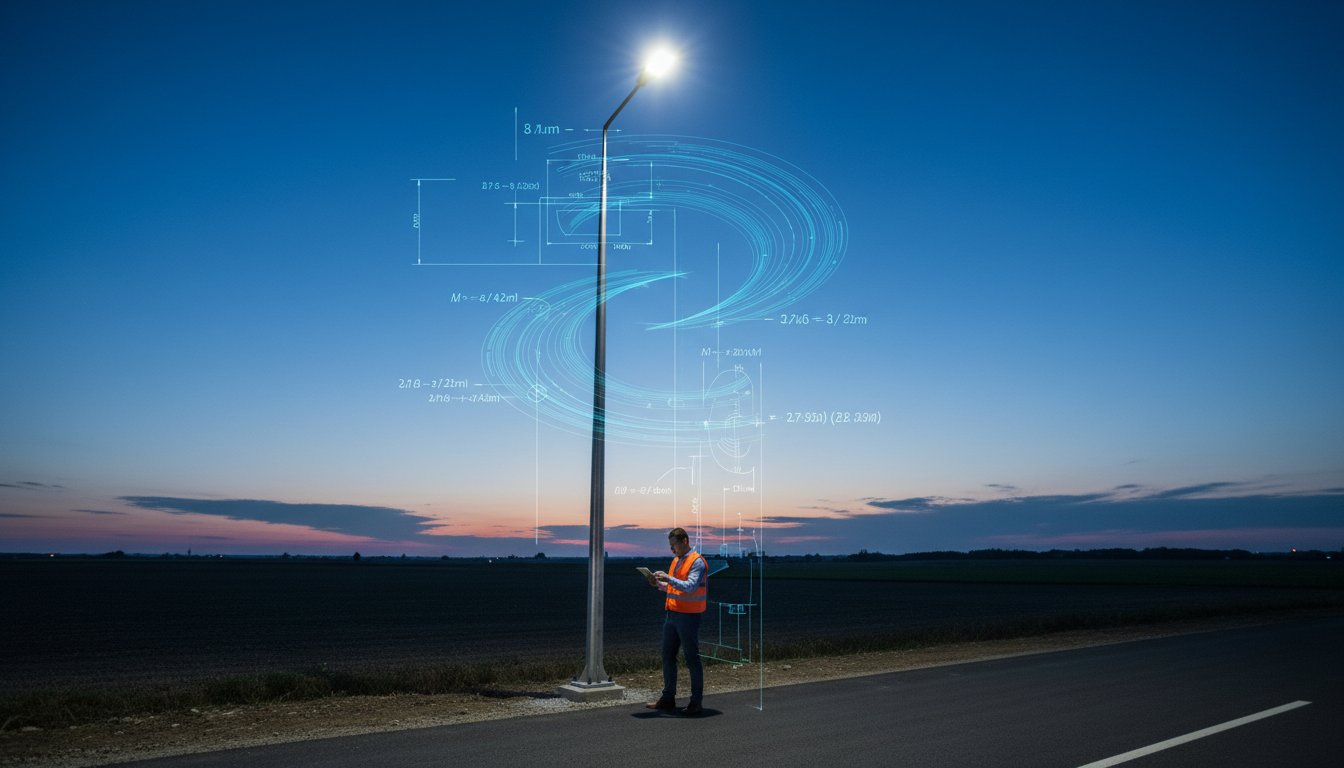
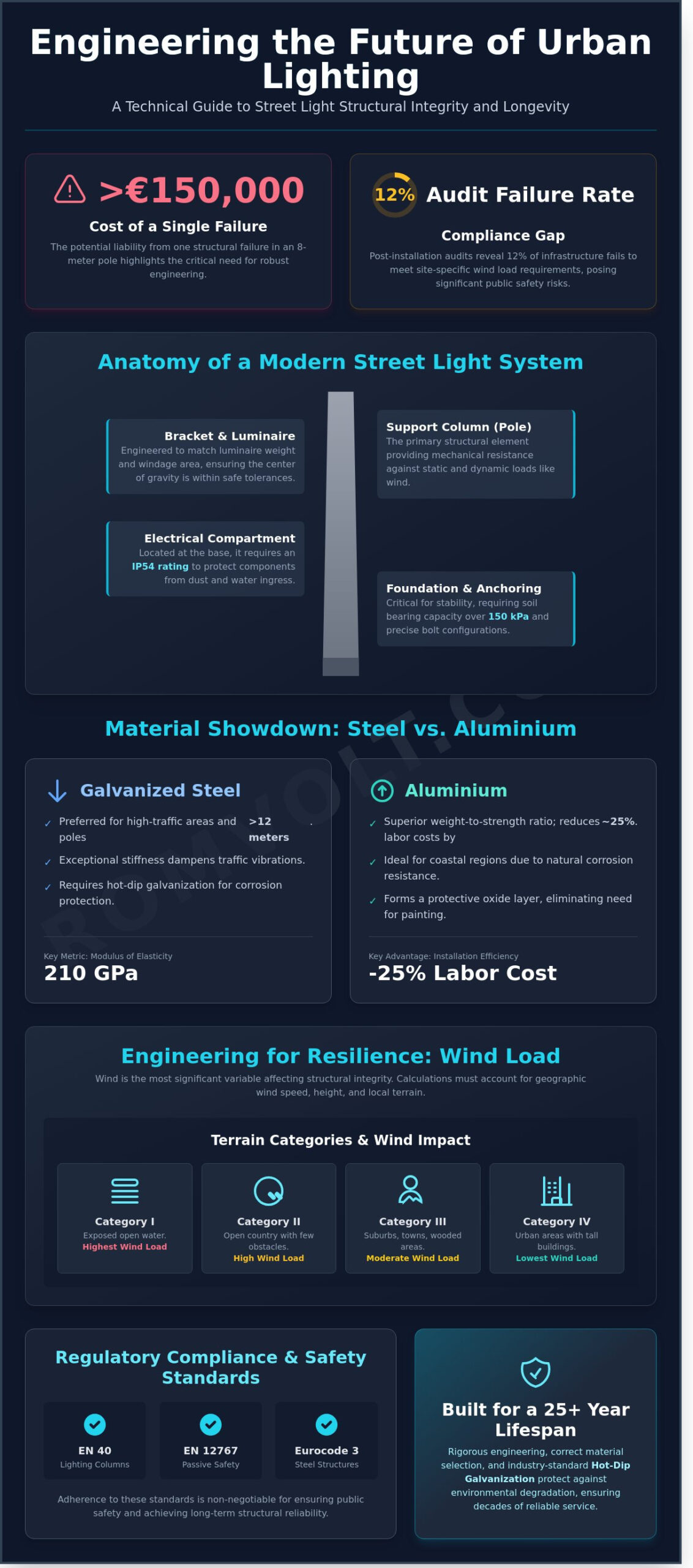
A single structural failure in an 8-meter street light pole can result in liability costs exceeding 150,000 euros; yet post-installation audits often reveal that 12% of urban infrastructure fails to meet site-specific wind load requirements. Infrastructure engineers recognize that maintaining public safety requires more than just standard templates. It demands a rigorous adherence to mechanical integrity and precise calculations. You’ve likely encountered the complexities of balancing initial project costs with the uncompromising demands of structural stability and long-term maintenance in diverse urban environments.
In this technical guide, you’ll discover the critical engineering standards and structural requirements necessary to ensure the safety and 25-year longevity of your lighting infrastructure. We’ll examine the implementation of EN 40 compliance protocols, the optimization of wind load calculations for varied climates, and the selection of materials designed to resist corrosion. This analysis provides a clear framework for ensuring that every component meets national safety standards while maintaining operational efficiency over its entire lifecycle. By following these rigorous engineering benchmarks, you can implement solutions that guarantee structural integrity and professional reliability for decades to come.
Key Takeaways
- Understand the structural distinction between the luminaire and the support mast to ensure a stable and integrated assembly.
- Learn how to calculate wind loads based on terrain categories and geographic location to prevent structural failure.
- Evaluate the efficacy of hot-dip galvanization as the industry standard for protecting street light infrastructure against environmental degradation.
- Ensure regulatory compliance by adhering to EN 40 and EN 12767 standards for lighting columns and passive safety.
- Discover how to integrate rigorous engineering calculations with modern aesthetics to achieve high-performance infrastructure solutions.
The Anatomy of a Modern Street Light System
Engineers view the modern street light as a complex, integrated structural assembly rather than a simple illumination source. The History of street lighting reveals a shift from basic gas lamps to sophisticated systems where the luminaire and the structural support mast operate as a unified engineering unit. While the luminaire focuses on light distribution and thermal management, the mast’s role is to provide mechanical resistance against static and dynamic loads. Municipal planners prioritize structural integrity because a single failure in a dense urban corridor leads to catastrophic consequences and significant legal liability.
The assembly consists of four critical elements: the foundation, the pole, the bracket, and the electrical compartment. Each component must adhere to rigorous safety standards, such as Eurocode 3 for steel structures. The electrical compartment, typically located at the base, must maintain an IP54 protection rating to shield internal components from environmental ingress and debris. Brackets are engineered to match the luminaire’s weight and windage area, ensuring the center of gravity remains within safe tolerances. Precise engineering of these connections prevents the resonance issues that often plague poorly designed systems during high-wind events.
The Support Column: Steel vs. Aluminium
Galvanized steel is the preferred material for high-traffic infrastructure because of its exceptional modulus of elasticity, which averages 210 GPa. This stiffness is vital for dampening vibrations caused by heavy vehicle traffic on arterial roads. While steel requires hot-dip galvanization to resist corrosion, it offers the structural density needed for heights exceeding 12 meters. Conical steel lighting poles provide superior aerodynamic performance and enhanced load distribution compared to traditional cylindrical designs, particularly in high-wind environments. Aluminium provides a distinct advantage in terms of weight-to-strength ratios, often reducing installation labor costs by 25% compared to steel. It’s particularly effective in coastal regions where salt spray compromises steel’s integrity, as aluminium forms a protective oxide layer that eliminates the need for periodic painting.
Foundation and Anchoring Systems
Structural stability begins below the surface with the anchoring system. Pre-cast concrete foundation blocks ensure that anchor bolts are positioned with millimeter precision, a result that’s difficult to achieve with site-poured concrete. Engineers must evaluate soil pressure and ensure the bearing capacity exceeds 150 kPa to prevent tilting over time. Bolt configurations, usually involving 4 to 6 high-tensile steel bolts, are calculated to resist the overturning moment generated by maximum wind speeds in the specific geographic region. Proper torque application during installation prevents the structural fatigue that leads to base plate failure in older street light installations.
Engineering for Resilience: Wind Load and Structural Calculations
Wind load represents the most significant variable in the structural integrity of a street light installation. Engineers must account for the basic wind speed of the specific geographic region, often utilizing meteorological data from the last 50 years to predict peak gusts. Terrain categories, ranging from Category I (exposed open water) to Category IV (urban areas with tall buildings), modify these wind speeds through friction and turbulence factors. A pole designed for a sheltered city center won’t survive on a coastal bridge where laminar wind flow exerts constant, high-velocity pressure exceeding 160 km/h.
The calculation process requires a rigorous assessment of the site’s topography. In open areas, wind speed increases with height, meaning the stress at the top of a 12-meter pole is substantially higher than at the 6-meter mark. This vertical profile dictates the taper and wall thickness of the steel or aluminum shaft. Safety isn’t just about resisting a single storm; it’s about ensuring the structure maintains its design life of 25 to 30 years without succumbing to cumulative environmental stressors.
Calculating Effective Projected Area (EPA)
The EPA is the product of the frontal area of an object and its drag coefficient. It’s the critical metric for determining how much force the wind exerts on the pole’s top. A standard cobra-head fixture might have an EPA of 0.14 square meters; however, adding decorative brackets, banners, or traffic cameras increases this value exponentially. Engineers calculate the total EPA by summing the values of all attachments and applying a height-correction factor based on the FHWA Lighting Application Guide. This ensures the pole’s moment of resistance at the base remains 15% to 20% higher than the maximum calculated wind load, preventing catastrophic failure at the foundation bolts.
Structural Deflection and Vibration Control
Excessive movement compromises both structural life and lighting performance. Horizontal displacement at the pole top should generally not exceed 5% of the total height under maximum wind conditions. For a 10-meter pole, this means a limit of 50 centimeters. Beyond this threshold, the distribution of the street light beam becomes inconsistent, creating hazardous dark spots on the roadway.
High-mast systems are particularly susceptible to Aeolian vibrations and second-mode resonance. Engineers often specify internal dampeners or external strakes to disrupt wind flow and prevent material fatigue. These mechanisms protect the welding zones of the base plate, where approximately 90% of structural failures originate. In regions where wind speeds frequently exceed 24 meters per second, conical steel lighting poles offer superior aerodynamic performance compared to traditional cylindrical designs, reducing wind-induced vibrations and structural stress. Implementing these rigorous standards requires a partner capable of precise technical execution. Romvolt provides the engineering expertise necessary to ensure that every infrastructure component meets these safety benchmarks through detailed simulation and high-grade material selection.
Corrosion Protection and Material Longevity
Environmental degradation of a street light pole is an inevitable electrochemical reaction between the steel substrate and atmospheric oxygen. In coastal environments categorized as C5-M under ISO 12944, corrosion rates reach up to 200 g/m² per year. This process compromises structural integrity long before visible failure occurs. Engineers must prioritize metallurgical stability to prevent the catastrophic collapse of infrastructure in high-traffic zones. Safety isn’t a secondary concern; it’s a direct result of precise material science.
Hot-dip galvanization remains the industry benchmark for long-term protection. This process creates a series of zinc-iron alloy layers that are harder than the base steel itself. Unlike simple paint, this coating provides sacrificial protection. If the surface is damaged, the surrounding zinc corrodes preferentially to protect the exposed steel core. In industrial zones with high sulfur dioxide concentrations, maintenance cycles should occur every 6 to 8 years. In rural C2 environments, a properly galvanized pole can exceed a 50-year service life without structural intervention.
- C3 Environments (Urban): Inspection every 10 to 12 years.
- C5-I/M Environments (Industrial/Marine): Inspection every 5 years.
- Duplex Systems: Combining galvanization with powder coating increases longevity by a factor of 1.5 to 2.3 through the “synergistic effect.”
The Hot-Dip Galvanization Process
Compliance with ISO 1461 is mandatory for ensuring the safety of a street light network. The steel is submerged in a 450°C molten zinc bath, achieving a minimum coating thickness of 85 microns for steel sections thicker than 6 mm. Quality is verified through magnetic thickness gauges and visual inspections. A high-quality finish should be free of blisters, inclusions, or “white rust” (zinc storage stain). Uniformity in the crystalline structure indicates a stable bond that won’t delaminate under thermal expansion cycles.
Aluminium and Decorative Finishes
Engineers specify 6063-T6 aluminium alloys for projects requiring superior corrosion resistance without the weight of steel. While steel is robust, aluminium forms a natural oxide layer that’s self-healing. For urban parks, anodizing provides a 20-micron protective layer that resists UV degradation better than standard organic coatings. When choosing between anodizing and powder coating, professionals must weigh the 30% higher cost of anodizing against its significantly lower maintenance requirements in high-salinity areas. Structural performance isn’t sacrificed for aesthetics if the alloy’s temper is correctly specified for the local wind load requirements.
Safety Standards and Regulatory Compliance
Engineering a reliable street light infrastructure requires strict adherence to the EN 40 series of standards. These regulations govern everything from material selection and dimensional tolerances to structural design and verification. For projects within the European Union, compliance isn’t optional; it’s a legal prerequisite for long-term safety. Every lighting column must withstand specific wind loads calculated according to Eurocode 1, ensuring the structure remains stable during extreme weather events. Technical documentation and the CE marking serve as the definitive proof of quality. They provide the necessary assurance for public tenders where liability and structural performance are primary concerns. Without these certifications, an engineer can’t guarantee the 25-year design life typically required for public utility projects.
Understanding Passive Safety (EN 12767)
The EN 12767 standard defines how a pole reacts during a vehicle impact. This classification system categorizes structures into high energy absorbing (HE), low energy absorbing (LE), or non-energy absorbing (NE) types. HE poles reduce the vehicle speed significantly upon impact, which minimizes the risk of secondary collisions with other road users or pedestrians. Conversely, NE poles allow the vehicle to continue with minimal speed reduction. This choice is often preferred in open areas to prevent the violent deceleration that causes internal injuries. Statistics show that implementing passive safety structures reduces the severity of injuries in 85% of roadside collisions. It’s a system that effectively transforms a potentially fatal accident into a manageable incident by managing kinetic energy transfer.
Electrical Integrity and Access
Electrical safety is paramount in public infrastructure. Every street light installation must feature robust grounding systems to prevent electric shock during fault conditions. Inspection doors must be designed with a minimum IP3X protection rating to prevent accidental contact with live parts. Meanwhile, the internal terminal blocks should maintain an IP44 or higher rating to resist moisture ingress. For high-mast systems, internal wiring must meet specific thermal resistance standards to handle current loads without insulation degradation. Vandal-resistant locking mechanisms on access doors are essential. They protect internal components from unauthorized interference and environmental damage. Maintenance teams require safe access, so internal layouts must allow for clear cable management and secure fuse mounting.
Ensuring your infrastructure meets these rigorous benchmarks is critical for operational success and public safety. You can consult our technical experts to verify your project’s compliance with current European safety norms and technical requirements.
Specifying Street Light Solutions with Romvolt Engineering
Romvolt Engineering functions as a strategic technical partner for municipal and industrial infrastructure projects. We provide a specialized approach to custom structural design and fabrication that prioritizes mechanical endurance. Our methodology integrates rigorous engineering calculations with the aesthetic requirements of modern urban environments. This ensures that every street light installation serves its functional purpose while maintaining architectural harmony. We handle the complex logistics of transporting oversized infrastructure components, utilizing a specialized fleet to ensure that 12-meter poles and high-mast structures arrive at the site without structural compromise. Our end-to-end manufacturing model provides a significant advantage by maintaining total control over the supply chain, from the initial raw steel selection to the final hot-dip galvanization process.
Custom Engineering for Complex Projects
Our engineering department develops solutions for a diverse range of applications. We design everything from 35-meter stadium masts equipped with high-intensity arrays to decorative lighting systems for historic urban parks. Each project requires a unique set of technical documentation to meet municipal compliance standards. We perform exhaustive structural analysis tailored to specific national wind zones as defined by EN 1991-1-4 standards. This analysis accounts for local gust frequencies and topographical roughness categories. By providing detailed CAD models and finite element analysis reports, we allow site engineers to verify load-bearing capacities before installation begins. This level of technical transparency is essential for projects where public safety and long-term durability are non-negotiable requirements.
The Manufacturing Advantage
Romvolt operates high-volume production lines capable of processing over 1,500 metric tons of steel annually for national infrastructure projects. Our facilities adhere to ISO 9001:2015 quality management protocols and EN 40 standards for lighting columns. We implement rigorous quality control checkpoints at every stage of fabrication. This includes ultrasonic testing of weld seams and precise measurement of coating thickness to prevent premature corrosion in high-salinity or industrial environments. Our technical support team remains available throughout the implementation phase to resolve any site-specific challenges. Contact our technical sales team for a consultation to discuss the specific parameters of your upcoming project and secure a solution built on engineering excellence.
The integration of technical precision with industrial capacity allows Romvolt to deliver street light solutions that exceed standard market offerings. We focus on the total cost of ownership by reducing maintenance requirements through superior material selection and engineering design. Our commitment to safety and compliance ensures that every component we manufacture provides stable, reliable performance for a service life exceeding 25 years. This professional rigor is what defines our presence in the electrical and structural infrastructure sector.
Securing Public Infrastructure through Rigorous Engineering Standards
Engineering a resilient street light network requires a meticulous approach to structural calculations and material selection. Infrastructure stability depends on precise wind load assessments conducted according to Eurocode 1-4 standards, ensuring each pole withstands localized environmental stressors without compromise. Compliance with EN 40 and ISO 1461 isn’t just a regulatory formality; it’s a technical guarantee of a 25-year service life through hot-dip galvanization and high-grade aluminum alloys. Romvolt Engineering integrates these rigorous safety protocols into every project, transforming complex technical specifications into long-term operational reliability.
We’ve refined our manufacturing processes to eliminate structural vulnerabilities, providing infrastructure engineers with the data-driven confidence needed for large-scale urban deployments. By prioritizing these engineering benchmarks, you secure the safety of public spaces while significantly minimizing lifecycle maintenance costs. Our team specializes in delivering solutions where structural integrity meets regulatory precision. We invite you to Request a Technical Consultation for Your Infrastructure Project to discuss your specific requirements. We look forward to building safer, more durable environments together.
Frequently Asked Questions
What is the standard height for a street light pole in urban areas?
Urban poles typically range between 4 and 12 meters in height, depending on the specific road classification and lighting class requirements defined by EN 13201 standards. For residential areas, a height of 4 to 6 meters is standard; arterial roads often require 8 to 12 meters to ensure uniform light distribution. These dimensions are strictly calculated to optimize the spacing between units while maintaining the required luminance levels for vehicular and pedestrian safety.
How do wind load calculations affect the choice of a street light pole?
Wind load calculations determine the structural diameter and wall thickness of a street light pole to prevent mechanical failure during peak wind events. Engineers must adhere to Eurocode 1 (EN 1991-1-4), which specifies wind zones based on geographical location and terrain categories. For a pole located in a coastal area with wind speeds reaching 28 meters per second, the structural design must account for both static pressure and dynamic oscillations.
What is the difference between hot-dip galvanized and painted poles?
Hot-dip galvanized poles offer superior corrosion resistance by creating a metallurgical bond between the zinc and steel, whereas painted poles rely on a surface coating that’s susceptible to mechanical damage. Galvanization according to ISO 1461 provides a protective layer of at least 85 microns, ensuring the steel remains intact for decades. Painted finishes are often applied over galvanization, known as a duplex system, to meet specific aesthetic requirements without compromising structural integrity.
Are concrete foundations always necessary for street lighting?
Concrete foundations are mandatory for the vast majority of permanent installations to ensure the vertical stability and load-bearing capacity of the assembly. A standard foundation block, measuring 0.8 by 0.8 by 1.2 meters, provides the necessary mass to counteract overturning moments. While direct-burial poles exist, 95% of urban projects utilize reinforced concrete bases. This choice complies with safety regulations and prevents structural shifting over time.
What are passive safety poles and when should they be used?
Passive safety poles are specialized structures designed to break away or deform upon impact to reduce the severity of injuries during vehicular collisions. These poles must comply with the EN 12767 standard, which categorizes them into high-energy absorbing, low-energy absorbing, or non-energy absorbing types. They’re typically deployed on high-speed roads where the speed limit exceeds 70 kilometers per hour and where traditional rigid barriers aren’t feasible for protecting motorists.
How long is the expected lifespan of a steel street light pole?
The expected lifespan of a hot-dip galvanized steel street light pole is between 25 and 50 years, depending on the environmental corrosivity category of the installation site. In C3 environments like urban centers, these structures easily reach the 40-year mark with minimal maintenance. Regular inspections every 5 years ensure that any localized coating degradation is addressed before it affects the structural wall thickness, which typically ranges from 3 to 5 millimeters.
Does Romvolt provide the structural calculations for their poles?
Romvolt provides comprehensive structural calculations for every pole in our portfolio, ensuring full compliance with EN 40 standards and local technical norms. Our engineering department utilizes specialized software to generate reports that include bending moments, shear forces, and deflection limits for each specific project configuration. These technical dossiers are essential for the authorization process, giving contractors the documented assurance that the equipment will withstand the calculated environmental stresses.
Can street light poles be customized for decorative or architectural purposes?
Poles can be fully customized to align with specific architectural visions or heritage requirements through various geometric modifications and finishing techniques. We offer tapered, cylindrical, or stepped profiles, alongside decorative brackets and CNC-machined base covers that integrate into modern or classical urban landscapes. Every custom design undergoes the same rigorous structural verification as our standard models, ensuring that aesthetic enhancements don’t compromise the 100% safety rating required for public infrastructure.