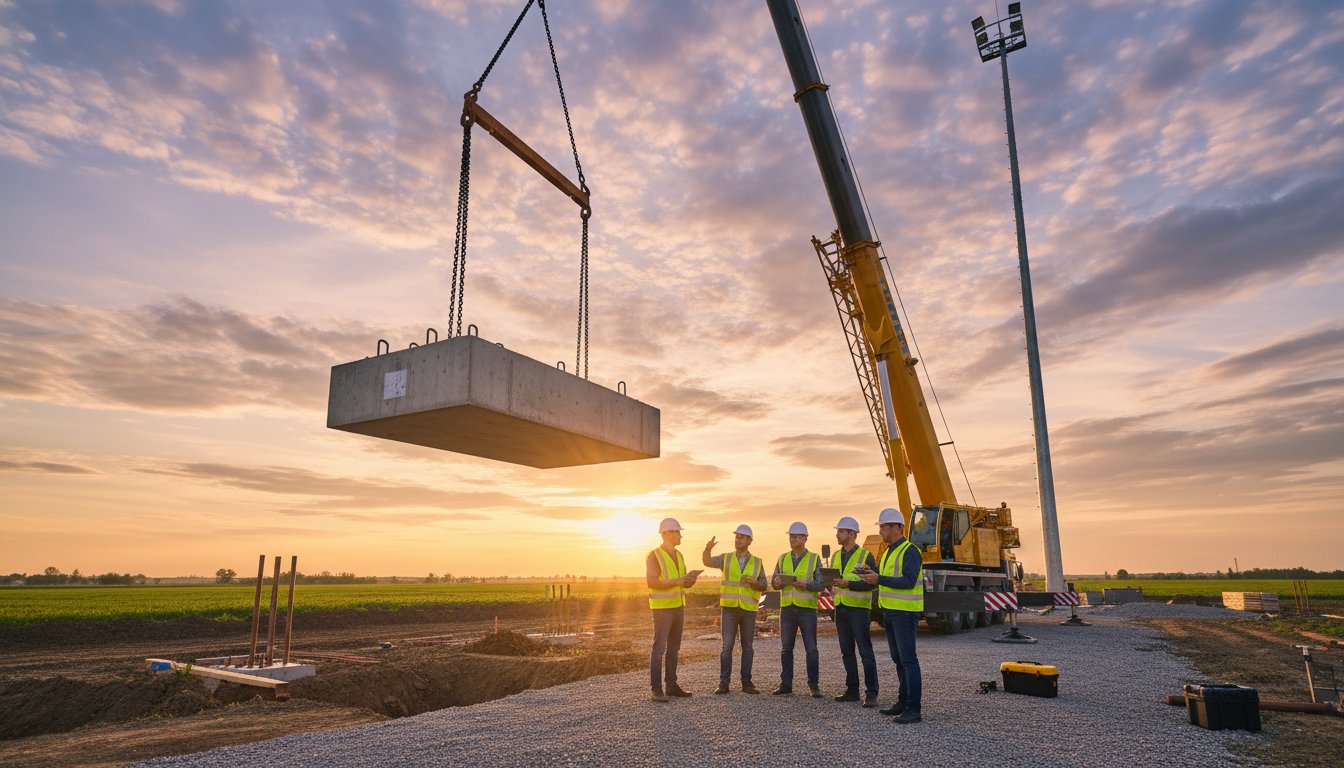
The traditional preference for site-poured foundations often masks a 15% increase in total project duration caused by environmental variables and labor-intensive formwork. Engineering teams frequently prioritize the perceived flexibility of on-site casting, only to face a 20% variance in material consistency when atmospheric humidity fluctuates during the curing process. Choosing between pre-cast vs poured concrete foundations requires more than a simple cost-benefit analysis; it demands a rigorous evaluation of structural reliability under extreme conditions. We recognize that infrastructure planners must balance these variables while maintaining strict adherence to Eurocode standards and eliminating the unpredictability of field-cured materials.
This technical guide provides the necessary data to optimize your infrastructure strategy for 25+ year durability and resistance against wind loads exceeding 140 km/h. You’ll gain a comprehensive understanding of how to minimize project timelines without compromising the integrity of industrial electrical systems or automation hubs. Our analysis examines the critical intersections of manufacturing precision, installation speed, and long-term maintenance requirements to ensure your next project stands on a foundation of absolute technical certainty.
Key Takeaways
- Understand how foundation designs translate critical wind loads and overturning moments into long-term structural stability for vertical infrastructure.
- Evaluate the adaptability of poured-in-place concrete for complex, non-standard terrains where pre-defined dimensions may be technically unfeasible.
- Discover why a technical comparison of pre-cast vs poured concrete foundations highlights significant gains in deployment speed and material density through controlled manufacturing.
- Analyze the correlation between precision-engineered bases and the extended operational lifespan of galvanized steel poles and high-mast systems.
- Learn the rigorous technical criteria required to specify optimal foundations for stadium lighting and industrial masts using integrated engineering approaches.
The Foundation of Infrastructure: Why the Choice Between Pre-cast and Poured Matters
The stability of vertical infrastructure depends entirely on the engineering precision of its base. When evaluating pre-cast vs poured concrete foundations, engineers must prioritize the management of overturning moments. For a 12-meter lighting pole, wind loads generate significant torque at the ground level. This force requires a foundation that translates theoretical calculations into long-term structural reliability. Choosing the wrong method affects the initial installation speed and dictates the maintenance cycle for the next 25 years. Compliance with EN 40 and other international safety standards begins at the base, where the transfer of energy from the mast to the earth occurs.
Infrastructure assets are long-term investments. A technical Precast Concrete Overview reveals that factory-controlled environments offer a level of material consistency that’s often difficult to replicate on-site. This consistency is vital when dealing with the rigorous demands of industrial automation and electrical systems. The choice isn’t merely about convenience; it’s about ensuring the asset remains upright and functional through decades of environmental exposure and seismic activity.
Structural Integrity and Load Distribution
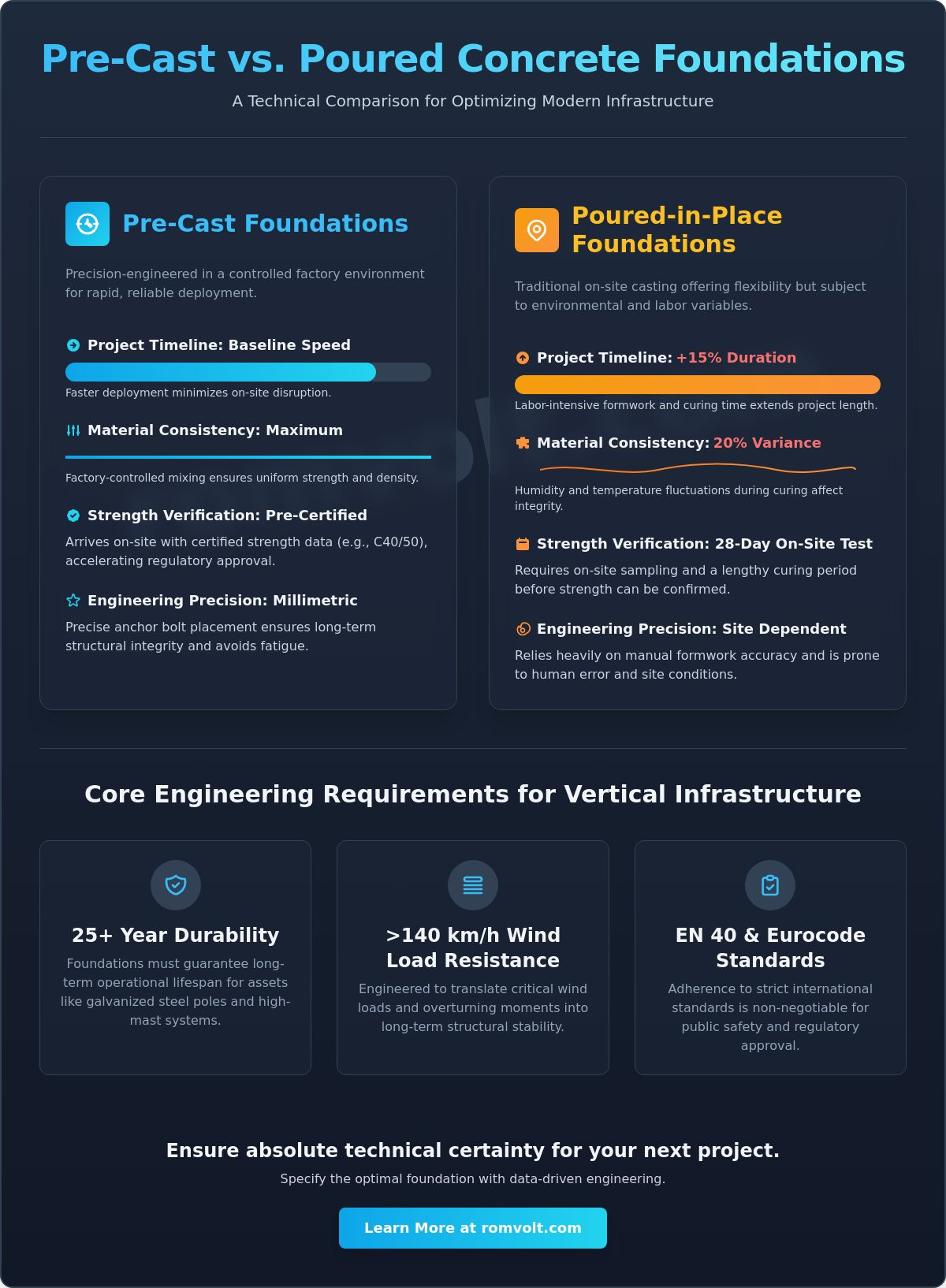
High-mast systems exceeding 20 meters face extreme stress during peak wind events. The foundation manages these dynamic loads by distributing pressure through the soil. Soil composition dictates the foundation depth and diameter; for instance, cohesive soils require different displacement calculations than granular ones. The base-to-pole connection remains the most critical failure point in infrastructure. Precise anchor bolt placement is essential because even a 2-degree deviation can lead to structural fatigue over time. Pre-cast options provide millimetric precision, while poured-on-site solutions rely heavily on the accuracy of manual formwork and local environmental conditions during the pour.
Safety Standards and Regulatory Compliance
Securing municipal infrastructure approval requires exhaustive technical documentation. Foundation choice directly affects the overall safety rating of a lighting column. Under EN 40 standards, the base must withstand specific impact categories to protect public-access areas. Verifiable material strength, typically confirmed through laboratory testing of concrete grades like C30/37 or C40/50, is non-negotiable. Poured foundations require on-site sampling and 28-day curing tests, whereas pre-cast units arrive with pre-certified strength data. This immediate verification speeds up the regulatory sign-off process and ensures that the pre-cast vs poured concrete foundations debate is settled by data, not preference.
- Resistance to overturning moments is the primary engineering objective for vertical masts.
- Soil analysis must precede any foundation design to ensure adequate load-bearing capacity.
- EN 40 compliance is the baseline for all public lighting infrastructure in the European Union.
- Material strength verification is mandatory for assets located in high-traffic public areas.
Poured-in-Place Foundations: Traditional Versatility and Site-Specific Challenges
The execution of cast-in-place concrete remains a fundamental method for large-scale infrastructure projects. This process begins with the installation of complex formwork and the manual placement of steel reinforcement cages according to structural engineering specifications. Unlike factory-controlled environments, the pre-cast vs poured concrete foundations debate often hinges on the immediate adaptability this method offers during the initial construction phase. Once the concrete is poured, it must undergo a critical hydration process where temperature and moisture levels are monitored to ensure the material reaches its design strength, typically measured at the 28-day mark.
On-site mixing introduces variables that can compromise the structural integrity of the foundation. Inconsistent water-cement ratios often lead to scaling or reduced compressive strength. Environmental factors represent a primary risk factor; for instance, a 5-degree Celsius drop in ambient temperature can significantly delay setting times, while unexpected rainfall during the pour can wash out cement paste and weaken the final bond. Engineers must account for these fluctuations through rigorous on-site testing and protective measures to ensure compliance with safety standards.
The Flexibility of Custom On-Site Pouring
Custom pouring provides a solution for sites with high architectural complexity or congested underground environments. When project teams encounter undocumented utilities or legacy infrastructure from 1985 installations, they can modify formwork dimensions in real time. This adaptability is vital for non-standard pole designs or decorative elements that require unique geometries. In remote regions where logistics for heavy transport are restricted, on-site pouring reduces the need for specialized cranes capable of lifting 15-ton pre-cast units, making it a viable choice for integrated electrical infrastructure in difficult terrain.
Operational Risks and Timeline Delays
The reliance on on-site labor and favorable weather creates significant bottlenecks in the project critical path. Standard curing protocols require foundations to remain undisturbed for at least 7 days to reach approximately 70% of their ultimate strength. This delay halts the installation of towers or heavy machinery, extending the overall timeline compared to immediate assembly methods. Quality control remains a logistical challenge, as verifying the internal density and reinforcement alignment depends on manual inspections and delayed laboratory results from test cylinders. Ultimately, choosing between pre-cast vs poured concrete foundations requires a careful analysis of the high cost of specialized labor for formwork assembly, which often offsets the lower initial material costs of bulk concrete.
Pre-cast Concrete Foundation Blocks: Precision Engineering for Rapid Deployment
The adoption of pre-fabricated structural elements represents a significant shift in infrastructure engineering. When evaluating the merits of pre-cast vs poured concrete foundations, the primary advantage lies in the industrialization of the manufacturing process. These units are produced under ISO 9001 certified conditions, ensuring every block meets exact structural requirements before leaving the facility. This method eliminates the variables of site weather, soil moisture fluctuations, and manual mixing errors that often compromise traditional methods.
Standardized dimensions are critical for high-volume rollouts, particularly in street lighting and telecommunications projects. Pre-cast blocks arrive at the site as finished products. They feature integrated anchor bolt systems that are cast using high-precision templates. This engineering approach ensures a 100% alignment rate with pole base plates, removing the need for field adjustments or corrective drilling. It’s a system designed for mechanical integrity and long-term operational readiness.
Factory-Controlled Quality Assurance
Industrial production allows for a strict 28-day curing cycle within temperature-controlled environments. This process achieves a uniform material density that site-poured concrete rarely matches. Engineers verify the concrete grade, typically C30/37 or higher, and the exact placement of steel reinforcement cages through rigorous testing protocols. Standardized production reduces material waste by approximately 12% to 15% compared to on-site casting. This precision ensures the foundation can withstand specified wind loads and vibration stresses without premature degradation or cracking.
Speed of Installation and Cost Efficiency
The most immediate benefit of pre-cast technology is the radical compression of project timelines. While traditional methods require a multi-day sequence of excavation, formwork, pouring, and curing, pre-cast blocks enable a “one-day” installation cycle. You don’t have to wait for the concrete to reach its design strength before proceeding. Once the block is leveled and backfilled, technicians can mount poles and equipment immediately.
- Eliminates the standard 7-day initial curing wait time required for structural loading.
- Reduces on-site labor hours by nearly 60% through simplified assembly.
- Minimizes the rental duration for heavy lifting machinery and traffic management systems.
- Lower total cost of ownership for municipal grids due to reduced maintenance and faster replacement cycles.
By shifting the technical complexity from the field to the factory, pre-cast vs poured concrete foundations debates often resolve in favor of pre-cast for large-scale urban developments. The ability to deploy dozens of units per shift allows contractors to meet aggressive deadlines while maintaining strict compliance with safety standards. This predictable workflow is essential for managing the logistical demands of modern electrical infrastructure.
Comparative Analysis: Cost, Durability, and Installation Timelines
The selection between pre-cast vs poured concrete foundations requires a rigorous analysis of both immediate capital expenditure and the projected maintenance cycles over a 50-year operational horizon. While poured concrete involves lower initial material costs, the hidden expenses of on-site labor, formwork, and weather-dependent curing periods often inflate the final budget. Technical data indicates that pre-cast solutions, although requiring higher upfront investment for transport and specialized lifting equipment, reduce total installation time by approximately 70%. This efficiency is critical in high-traffic environments where site occupancy costs are substantial.
Lifecycle Performance and Maintenance
Durability in infrastructure is dictated by the concrete’s resistance to chemical soil erosion and sulfate attacks. Pre-cast components are manufactured in controlled factory environments, achieving a high-density matrix that poured concrete rarely matches under field conditions. This structural density is vital for the stability of street lighting poles, as it prevents the micro-oscillations that lead to metal fatigue in the pole’s base plate. Furthermore, the modular nature of pre-cast systems simplifies the relocation of assets. If a road layout changes, the entire foundation can be excavated and moved, a process that’s impossible with monolithic poured structures. This flexibility ensures that the initial investment remains a viable asset for decades.
Project Scalability and Logistics
When managing 100+ pole installations in urban development, the logistics of pre-cast components offer a predictable deployment schedule. Engineers often raise objections regarding the transport costs of heavy pre-cast units; however, these costs are offset by the elimination of on-site concrete testing and the 28-day curing wait times required for poured foundations. A decision matrix for modern infrastructure projects typically favors pre-cast when speed and standardized quality are non-negotiable. Thorough lighting pole installation site prep is essential at this stage, as accurate geotechnical data and subsurface utility mapping directly determine whether pre-cast or poured solutions will perform to their design specifications.
- Scale: Projects exceeding 50 units benefit from the economies of scale in factory production.
- Soil Conditions: Pre-cast bases provide consistent performance in aggressive soils where field-mixed concrete might fail to reach design strength.
- Urban Impact: Using pre-fabricated bases minimizes traffic interference, as a single crew can install and secure a pole in under two hours.
Logistical coordination across national borders requires a partner who understands the technical requirements of oversized infrastructure. Managing the delivery of these components ensures that the project timeline remains intact, regardless of local weather fluctuations that would otherwise halt poured concrete operations. For projects requiring technical compliance and long-term structural stability, contact Romvolt for integrated infrastructure solutions that prioritize engineering precision.
Specifying the Optimal Foundation for Lighting Poles and High-Masts
Selecting the correct base for stadium masts or industrial lighting requires a rigorous evaluation of the pre-cast vs poured concrete foundations debate. For structures exceeding 30 meters in height, the foundation must withstand significant overturning moments caused by wind speeds that often reach 120 km/h in exposed areas. Pre-cast foundation blocks provide a distinct advantage here through controlled manufacturing environments. In these facilities, concrete density and reinforcement placement are verified to within 5mm of the design specifications, a level of precision that’s difficult to achieve under unpredictable field conditions.
Romvolt adopts an integrated engineering methodology that bridges the gap between pole design and civil works. By utilizing a single-source supplier for both masts and foundations, project planners eliminate the risk of anchor bolt misalignment. This is a common failure point in site-poured applications. This unified approach ensures that the structural calculations for the mast are perfectly synchronized with the foundation’s load-bearing capacity, providing a 100% compatibility guarantee. When the same team manages the engineering of the steel structure and the concrete base, the structural risk is minimized significantly.
- Elimination of on-site curing delays, which can save 21 to 28 days per installation cycle compared to traditional methods.
- Guaranteed concrete grade compliance, typically C30/37 or higher, ensuring long-term resistance to chemical degradation and sulfate attack.
- Precise integration of cable conduits and earthing systems during the casting process, preventing the need for risky post-pour drilling.
Engineering Design and Structural Calculations
Technical design serves as the backbone of every infrastructure project. Romvolt ensures all specifications comply with Eurocode 7 for geotechnical design and Eurocode 3 for steel structures. Our engineers perform finite element analysis to simulate stress distribution under peak load conditions. For specialized telecommunication or energy masts, we offer custom fabrication options that accommodate unique footprint requirements. This ensures that every installation maintains its verticality over a projected 50-year service life, even in challenging soil profiles.
Next Steps for Infrastructure Procurement
Efficient procurement starts with accurate data. Planners can request comprehensive technical documentation, including load-bearing charts and material certifications, to streamline the approval process with local authorities. Our technical sales teams provide detailed consultations to align infrastructure solutions with specific site topography and environmental stressors. For those ready to optimize their project’s structural integrity, the next logical step involves a professional assessment of site-specific requirements. Contact Romvolt for a technical consultation to discuss your project’s engineering parameters and secure a reliable foundation for your infrastructure.
Optimizing Structural Integrity through Rigorous Engineering Standards
Selecting the appropriate technical approach requires a detailed analysis of site conditions, load-bearing requirements, and project deadlines. While poured-in-place methods offer adaptability for irregular terrains, pre-cast solutions reduce onsite labor hours and ensure consistent quality through controlled manufacturing environments. It’s clear that the decision between pre-cast vs poured concrete foundations dictates the long-term maintenance lifecycle and structural safety of lighting poles and high-masts. Every infrastructure project demands a balance between rapid deployment and precision engineering to avoid structural failures.
Romvolt ensures all designs meet EN 40 compliance standards, utilizing in-house structural engineering expertise to validate every specification before implementation. Our integrated logistics network manages the delivery of components across national infrastructure sites, maintaining a seamless chain of responsibility. We focus on delivering results that align with the highest technical benchmarks in the industry. Consult with Romvolt’s Engineering Team for Your Foundation Needs to secure a foundation built on stability and professional rigor. Your project’s success depends on the precision we provide today.
Frequently Asked Questions
Is pre-cast concrete stronger than poured-in-place concrete for foundations?
Pre-cast concrete typically exhibits higher compressive strength than poured-in-place alternatives because it’s manufactured under strictly controlled factory conditions. While site-poured foundations often reach 25 to 30 MPa, pre-cast elements frequently exceed 50 MPa. This superior density results from precise steam curing and vibration techniques mandated by Eurocode 2 standards. It ensures a structural integrity that’s difficult to replicate in the variable environments of a construction site.
How much time can I save on-site by using pre-cast foundation blocks?
Implementing pre-cast foundation blocks can reduce on-site labor time by approximately 75% compared to traditional methods. A standard installation for an industrial lighting base takes under 4 hours, whereas poured concrete requires a 28-day curing period to reach full design strength. This acceleration allows project managers to meet tight deadlines without compromising the structural stability of the electrical infrastructure. It’s a strategic choice for high-traffic areas where downtime’s limited.
Are pre-cast foundations suitable for all soil types in infrastructure projects?
Pre-cast foundations are adaptable to diverse soil conditions, provided the ground’s bearing capacity meets the minimum threshold of 150 kPa for standard blocks. In regions with expansive clays or high water tables, engineers must specify larger base dimensions or pile-supported systems. Geotechnical reports from 2023 indicate that pre-cast solutions offer better resistance to sulfate attack in acidic soils compared to standard site-poured mixes, ensuring long-term chemical stability.
What are the transport limitations for large pre-cast concrete blocks?
Transporting large pre-cast concrete blocks is limited by the maximum gross vehicle weight of 40 tonnes and standard width restrictions of 2.5 meters on European roads. Units exceeding these dimensions require specialized low-loader trailers and specific permits for oversized cargo. Logistics planning must account for crane access at the delivery site, as a 5-tonne block requires a 20-tonne crane for safe positioning and installation. It’s essential to coordinate these logistics weeks in advance.
Do pre-cast foundations require specialized machinery for installation?
Installation of pre-cast systems requires mobile cranes with lifting capacities ranging from 10 to 50 tonnes depending on the block’s mass. Unlike poured foundations that rely on cement mixers, these units need laser levels to ensure a 0.5% tolerance for vertical alignment. Contractors also utilize hydraulic excavators equipped with specialized lifting chains to position the blocks within the excavated pits accurately. Proper rigging equipment is mandatory to maintain safety standards during the lift.
How do wind load calculations influence the choice of foundation type?
Wind load calculations, governed by EN 1991-1-4 standards, determine the required mass and overturning moment resistance of the foundation. For a 20-meter pole, the foundation must counteract wind speeds of up to 30 meters per second in specific regional wind zones. When comparing pre-cast vs poured concrete foundations, engineers select pre-cast blocks for their predictable density. This ensures the structure meets safety factors without the risk of internal voids or inconsistent material quality.
Can I use pre-cast foundations for high-mast lighting systems over 30 meters?
Pre-cast foundations are suitable for high-mast lighting systems exceeding 30 meters when designed as multi-block modular systems or heavy-duty monolithic units. For a 35-meter mast, the foundation typically requires a volume of at least 12 cubic meters of concrete to ensure stability. These systems are engineered to handle the significant leverage and dynamic loads associated with tall infrastructure. They provide a reliable alternative to traditional poured bases while maintaining strict verticality requirements.
What is the typical lifespan of a pre-cast concrete foundation block?
The typical lifespan of a pre-cast concrete foundation block ranges from 50 to 100 years, depending on environmental exposure and maintenance protocols. Most industrial designs adhere to a 50-year minimum design life as specified in Eurocode 0. Because the manufacturing process uses low water-to-cement ratios, these blocks resist carbonation and chloride penetration more effectively than site-poured concrete. This durability makes the pre-cast vs poured concrete foundations choice crucial for long-term infrastructure reliability.