A single calculation error regarding wind load coefficients can increase structural failure risks by over 30% during extreme weather events. When you’re managing high-capacity infrastructure projects, you’ve likely seen how vague specifications lead to cost overruns that can exceed 15% of the initial budget. Securing an accurate stadium masts quote requires more than just a height requirement; it demands a rigorous analysis of site-specific variables and engineering constraints. We understand that the stability of your lighting system isn’t just a matter of procurement, but a commitment to public safety and long-term operational efficiency.
You’ll learn the precise technical data points required to obtain an engineering-backed price estimate that eliminates guesswork. This guide details the essential parameters, from soil bearing capacity to the exact weight of the LED arrays, ensuring your project complies with international safety standards such as EN 1993. We’ll examine the structural requirements, logistical challenges of transporting oversized steel components, and the design protocols that turn a simple inquiry into a viable, low-maintenance reality.
Key Takeaways
- Identify the fundamental engineering differences between standard lighting poles and specialized stadium masts to ensure structural safety at high altitudes.
- Analyze the technical variables, including luminaire weight and wind load, that dictate the precise steel wall thickness and cross-section requirements.
- Follow a structured step-by-step guide to preparing the necessary technical data for an accurate, engineering-backed stadium masts quote.
- Evaluate international manufacturing standards and anti-corrosion treatments essential for maintaining the longevity of infrastructure exposed to harsh environments.
- Understand the strategic benefits of integrated structural engineering and fabrication in securing a reliable, long-term solution for arena illumination.
The Fundamentals of Stadium Masts: Engineering for Large-Scale Arenas
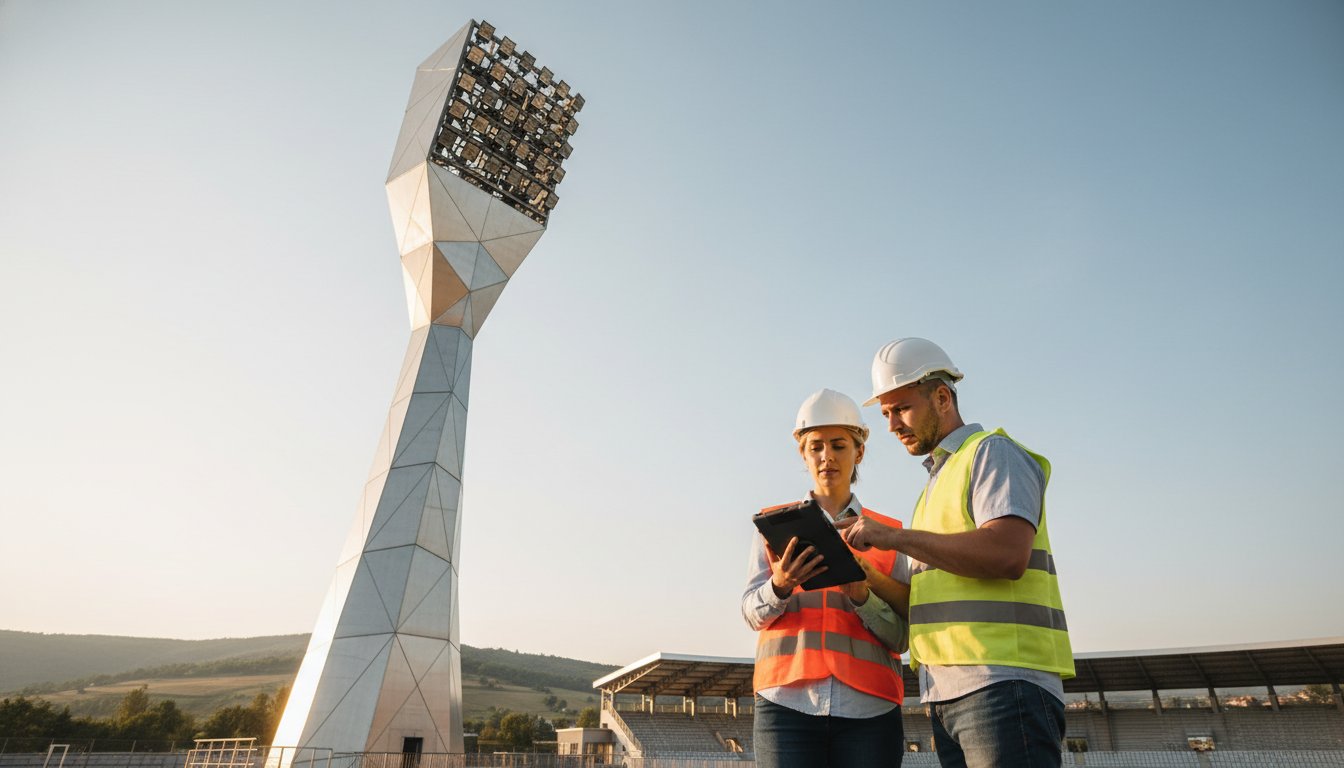
Stadium masts aren’t merely elongated versions of street lamps. They’re heavy-duty infrastructure components designed to maintain precise beam angles under extreme environmental conditions. A typical stadium masts quote reflects the engineering rigor needed to support headframes weighing up to 2,500 kilograms at heights where wind speeds can reach 180 km/h. This isn’t just about visibility; it’s about public safety and structural longevity in high-occupancy environments. Understanding High-mast lighting fundamentals is essential for evaluating the technical specifications required for large-scale sports arenas. These structures must manage the “sail effect” created by large LED arrays, which can exert several tons of force on the pole’s foundation during peak weather events.
Structural Integrity in Sports Lighting
Structural stability in sports lighting depends on the height-to-weight ratio and the pole’s cross-sectional geometry. Engineers prioritize vibration dampening to prevent fatigue in the welded joints and sensitive electrical components. Most modern masts utilize a tapered polygonal shape, usually 12 to 20 sides, to provide superior resistance to buckling compared to simple cylindrical designs. Material selection is equally critical for long-term viability. We utilize hot-dip galvanized steel, conforming to standards like EN ISO 1461, because it provides a 50-year service life in most atmospheric conditions. This material remains the industry benchmark for preventing corrosion in exposed outdoor settings. Key factors influencing the structural portion of a stadium masts quote include:
- Wind Load Analysis: Calculation of maximum gust speeds based on local meteorological data from the last 50 years.
- Deflection Limits: Ensuring the mast doesn’t sway more than 0.5% of its height to keep light beams focused on the field.
- Foundation Anchoring: The use of high-tensile J-bolts and specialized templates to ensure perfect vertical alignment.
Fixed vs. Mobile Crown Systems
The choice between fixed platforms and mobile headframes dictates both the initial capital expenditure and the long-term operational budget. Fixed systems require technicians to climb the mast using safety ladders or use external heavy machinery like cherry pickers for maintenance. While the initial hardware cost is lower, the logistical expenses for every repair are higher. It’s a choice that impacts the safety protocols for technicians, who must adhere to strict working-at-heights regulations and use fall-arrest systems.
Mobile headframes, or lowering gear systems, use internal winch mechanisms to bring the entire luminaire ring down to ground level. These systems eliminate the need for climbing, making maintenance safer and faster. Although a mobile system increases the complexity of the initial quote, it significantly reduces the risks associated with high-altitude work and removes the need for specialized aerial work platforms during routine driver replacements or lens cleaning. Most professional venues now opt for mobile systems to ensure that lighting maintenance doesn’t interfere with event schedules or damage the turf with heavy machinery.
Technical Variables That Determine Your Stadium Mast Quote
Procurement processes often oversimplify the acquisition of high-mast lighting by focusing almost exclusively on vertical height. A professional stadium masts quote relies on complex structural engineering calculations that prioritize long-term stability over initial purchase price. Beyond the physical 20 or 40-meter extension, the primary cost drivers involve the grade of steel utilized, typically S355 for superior yield strength, and the specific galvanization requirements mandated by ISO 1461 standards to prevent corrosion in high-humidity environments.
The quantity of luminaires dictates the internal wall thickness and the cross-sectional geometry of the steel. If a project requires 16 high-output LED floodlights instead of 8, the resulting increase in torque and gravitational load necessitates a thicker steel plate, often exceeding 10mm or 12mm for the base sections. Standardized quotes usually fail because they assume median values for these variables. They ignore the specific moment of force generated at the mast head, which can lead to structural fatigue or catastrophic failure during extreme weather events.
Wind Load Calculations and Site Topography
Engineers must evaluate wind zones according to EN 1991-1-4 standards, considering fundamental wind velocities that vary significantly between coastal regions and inland basins. Wind load is the pressure exerted by air movement against the mast surface area. Terrain categories, ranging from Category 0 for open sea exposure to Category IV for urban areas where at least 15% of the surface is covered with buildings, dictate the turbulence intensity the structure must withstand. A mast designed for an urban cluster will likely fail if placed in an open coastal field because it lacks the protection of wind-breaking obstacles. Accurate topography mapping ensures the mast’s resonance frequency doesn’t align with local gust patterns.
Luminaire Weight and Effective Projected Area (EPA)
Total weight is a vital metric, but the Effective Projected Area (EPA) represents the most critical variable in aerodynamic stability. EPA measures how the physical shape and orientation of the lighting assembly, including brackets and wiring looms, increase wind resistance. Even lightweight LED fixtures can have a high EPA if their surface area is broad. This value directly correlates with the required diameter of the mast base and the depth of the concrete foundation. To ensure your project meets these rigorous safety margins, obtaining a technical assessment of your infrastructure is a necessary step before finalizing any stadium masts quote.
Key technical factors influencing the final cost include:
- Steel Yield Strength: Utilizing S355 J2+N steel for higher load-bearing capacity.
- Corrosion Protection: Hot-dip galvanizing thickness measured in microns to ensure a 25-year service life.
- Dynamic Response Factors: Engineering for vibration damping to protect sensitive LED electronics.
- Mounting Bracket Geometry: Custom headframes designed to minimize drag and simplify maintenance access.
Rigorous adherence to these variables prevents the hidden costs associated with premature maintenance or structural retrofitting. Every millimeter of steel thickness and every degree of taper in the mast’s design serves a calculated functional purpose in the broader electrical infrastructure.

Material Standards and Compliance for High-Mast Infrastructure
High-mast structures in sports venues operate under extreme mechanical stress and environmental exposure. Ensuring longevity requires rigorous adherence to international manufacturing standards that go beyond basic aesthetic requirements. Unlike standard street lighting poles, stadium masts must support massive headframes and withstand high wind oscillations at significant heights. A professional stadium masts quote should explicitly detail the material composition and the protective treatments applied to the steel, as these factors directly determine the total cost of ownership and the safety of the venue.
Adherence to compliance verification isn’t merely a bureaucratic step; it’s a critical safeguard against premature structural failure. Infrastructure failure in a public space leads to massive liability risks and potential loss of life. Procurement officers must demand documentation that proves the raw materials and welding processes meet Eurocode standards. This level of technical transparency ensures that the project remains viable for several decades without requiring costly structural reinforcements or early replacement.
Steel Grades and Galvanization Standards
Structural integrity begins with the selection of appropriate steel grades. Engineers typically specify S235 or S355 steel based on the calculated structural load and the height of the mast. S355 steel, with its higher yield strength of 355 MPa, is often the preferred choice for masts exceeding 25 meters, providing the necessary rigidity to support heavy LED floodlight arrays. Any stadium masts quote that fails to specify the steel grade lacks the technical depth required for a safe procurement decision.
Corrosion protection is equally vital. The EN ISO 1461 standard governs the hot-dip galvanization process, ensuring a uniform protective layer. In typical atmospheric conditions, hot-dip galvanized steel offers a maintenance-free lifespan of 25 to 50 years. The coating thickness, often exceeding 85 microns for thick-walled steel, acts as a sacrificial barrier against oxidation. In coastal areas or high-pollution zones, additional duplex coatings (galvanization plus powder coating) might be necessary to prevent salt-spray damage.
Safety Norms and Technical Documentation
Safety in professional sports venues is non-negotiable. Masts must comply with EN 40 standards and regional building codes that dictate wind load resistance. Technical documentation must include certifications for every stage of production. Non-destructive testing (NDT), such as ultrasonic or magnetic particle inspection, is mandatory for critical weld points. These tests identify internal flaws that aren’t visible to the naked eye but could lead to catastrophic failure under peak wind loads.
- Welding Certifications: Verification that welders are certified according to EN ISO 9606-1.
- NDT Reports: Evidence that all structural joints have passed rigorous safety inspections.
- Calculation Notes: Static and dynamic calculations that confirm the mast’s stability under local wind conditions.
- CE Marking: Proof that the product meets European health, safety, and environmental protection standards.
Insurance providers and local authorities require this documentation for building permits and liability coverage. Without a complete technical file, a venue risks being denied operation permits. It’s essential to verify that the supplier provides a comprehensive data package that includes material traceability reports and galvanization certificates for every batch delivered.
The Quoting Process: Information Required for Accuracy
The process begins with an initial inquiry where the procurement team provides the project scope. Professional manufacturers then move through a validation phase, checking the feasibility of the requested heights against local regulations and structural limits. This methodology ensures that the initial estimate remains stable throughout the project lifecycle, preventing the 15% to 20% cost overruns often seen when technical details are omitted during the bidding phase.
- Site Identification: Providing exact coordinates for environmental mapping.
- Operational Requirements: Defining the specific lux levels needed for the venue’s purpose.
- Equipment Load: Detailing the weight and windage area of the chosen lighting fixtures.
Essential Data for Structural Engineering
The engineering team requires precise GPS coordinates to map the installation site against wind and seismic zone databases, such as those defined in Eurocode 1 (EN 1991-1-4). A mast designed for a coastal region with wind speeds exceeding 30 meters per second requires significantly different wall thicknesses than one in a sheltered inland valley.
Clients must also specify the required illumination levels, measured in lux. For a Class I stadium, which requires 1,000 to 2,000 lux for televised events, the mast must support a larger quantity of floodlights. Identifying the exact model and weight of these luminaires is vital. A headframe supporting 24 LED floodlights faces different aerodynamic drag than one supporting 12, directly influencing the mast’s taper and base diameter.
Foundation Requirements and Soil Analysis
A comprehensive soil report is the most critical document for finalizing a design. Without data on soil bearing capacity and groundwater levels, engineers can’t calculate the necessary depth or width of the mast base. Utilizing pre-cast concrete foundation blocks can reduce on-site installation time by approximately 40% compared to traditional poured-in-place methods.
While poured foundations remain standard for massive 50-meter structures, pre-cast solutions offer a controlled, factory-tested alternative for smaller high masts. This choice ensures compliance with safety standards before the mast even arrives at the site. Choosing the right foundation type depends on the soil’s stability and the project’s timeline constraints.
Engineering Excellence: Why Romvolt for Stadium Mast Fabrication
Romvolt operates as a strategic partner rather than a simple supplier. We integrate design, manufacturing, and logistics to provide a seamless transition from initial concept to final installation. Our dual operations in Romania and Belgium allow us to serve the global infrastructure market with high-capacity production and centralized European coordination. This geographical advantage ensures that every stadium masts quote accounts for both technical rigor and efficient supply chain management.
Our commitment to safety and precision defines our industrial identity. We don’t accept ambiguity in structural integrity. Every steel structure we fabricate undergoes a rigorous quality control process. We focus on technical sobriety, ensuring that the final product serves its functional purpose for decades without compromise. This approach provides the stability and authority required for large-scale public and private infrastructure projects.
Custom Design and Technical Support
Precision begins at the drafting table. We provide detailed technical documentation and 3D modeling for every project we undertake. This level of detail allows stakeholders to visualize the integration of lighting systems and maintenance platforms before a single piece of steel is cut. Clients have direct access to our engineering experts to address complex site challenges like high wind zones or specific soil bearing capacities. Romvolt provides full structural calculations to ensure compliance with EN standards, specifically EN 1993 for steel design and EN 40 for lighting columns. This technical transparency eliminates guesswork during the procurement phase.
Logistics and Oversized Component Delivery
Managing the transport of oversized masts requires specialized expertise in international shipping and heavy-load permits. We coordinate the movement of components that often exceed 30 meters in length across international borders. Our team synchronizes manufacturing schedules with project site timelines to minimize delays and reduce on-site storage costs. We use specialized handling equipment to ensure that the structural components and their protective coatings arrive in pristine condition. When you finalize a stadium masts quote with Romvolt, you’re securing a logistical plan that respects the critical path of your construction schedule. We prioritize the integrity of the galvanized finish, ensuring the structure remains corrosion-resistant for its 25-year design life.
Securing Long-Term Structural Integrity for Large-Scale Arena Infrastructure
Selecting the right infrastructure for sports arenas requires a rigorous focus on technical compliance and engineering precision. Every project demands custom structural engineering to account for specific wind loads and soil conditions, ensuring the system remains stable over decades of service. Adherence to the EN ISO 1461 standard for hot-dip galvanization is a non-negotiable requirement to prevent corrosion in exposed environments. When you request a stadium masts quote, the accuracy of the final technical proposal depends on precise data regarding mounting heights and headframe configurations. For venues looking to enhance their hospitality areas with high-quality outdoor cooking equipment, toolsandgrill.nl provides professional-grade kamado solutions.
Frequently Asked Questions
What information is essential to receive an accurate stadium masts quote?
To receive an accurate stadium masts quote, you’ve got to provide the precise mounting height, the total weight of the luminaire array, and the specific wind zone data for the installation site. Soil reports based on Eurocode 7 standards are also required to determine foundation requirements for the structure. Including the geographic coordinates allows our engineers to calculate the exact environmental loads according to the EN 1991-1-4 standard, ensuring the structural integrity of the final installation.
How does wind speed affect the design and cost of a stadium mast?
Wind speed directly dictates the steel grade and wall thickness required for the mast’s shaft to prevent structural failure. According to EN 1991 standards, a 10% increase in wind velocity can result in a 21% increase in the pressure exerted on the structure. This necessitates larger cross-sections and deeper foundations, which increases the overall material volume and manufacturing costs for the project.
Can I use existing foundations for new, taller stadium masts?
Reusing existing foundations for taller stadium masts isn’t recommended due to the increased overturning moments and shear forces. A mast that’s 5 meters taller than the original can exert up to 30% more stress on the concrete base. Structural engineers must perform a non-destructive test on the old foundation and verify its compliance with current Eurocode 8 seismic standards before any retrofitting is considered.
What is the difference between hot-dip galvanization and standard painting for masts?
Hot-dip galvanization involves immersing the steel in molten zinc at 450 degrees Celsius to create a metallurgical bond that prevents corrosion for over 50 years. Standard painting is a surface coating that requires maintenance every 5 to 10 years and doesn’t offer the same level of internal protection. For infrastructure longevity, we implement galvanization according to ISO 1461 to ensure the structure remains maintenance-free in aggressive environments.
How long does the engineering and manufacturing process take for custom masts?
The technical engineering and manufacturing process typically requires a period of 8 to 14 weeks from the approval of the technical drawings. This timeline accounts for structural calculations, the procurement of certified S355 steel, and the precision welding required for high-mast structures. We follow a strict production schedule to ensure that every component meets the EN 1090-2 execution class requirements for structural steelwork.
Do stadium masts require regular structural inspections after installation?
Stadium masts require formal structural inspections every 12 to 24 months to ensure the integrity of the anchor bolts and the condition of the protective coating. These assessments must include ultrasonic testing of the base welds and a verification of the verticality of the mast. Regular maintenance protocols help identify micro-cracks or oxidation before they compromise the safety of the venue’s spectators or the expensive lighting equipment.
What is Effective Projected Area (EPA) and why does it matter for my quote?
Effective Projected Area (EPA) represents the total surface area of the luminaires and brackets that’s exposed to wind force, adjusted for their aerodynamic shape. It’s a critical factor for your stadium masts quote because it determines the drag coefficient and the resulting torque on the mast’s base. If the EPA of the floodlights exceeds the mast’s design capacity, the structure could experience excessive oscillation or catastrophic failure during high-wind events.
Does Romvolt provide the luminaires along with the stadium masts?
Romvolt provides fully integrated lighting solutions, including high-performance LED luminaires that are specifically calibrated for our mast structures. By supplying both the masts and the optical systems, we ensure that the electrical distribution boards and control systems are perfectly synchronized. This approach allows us to guarantee the overall system efficiency and compliance with the EN 12193 standard for sports lighting requirements.