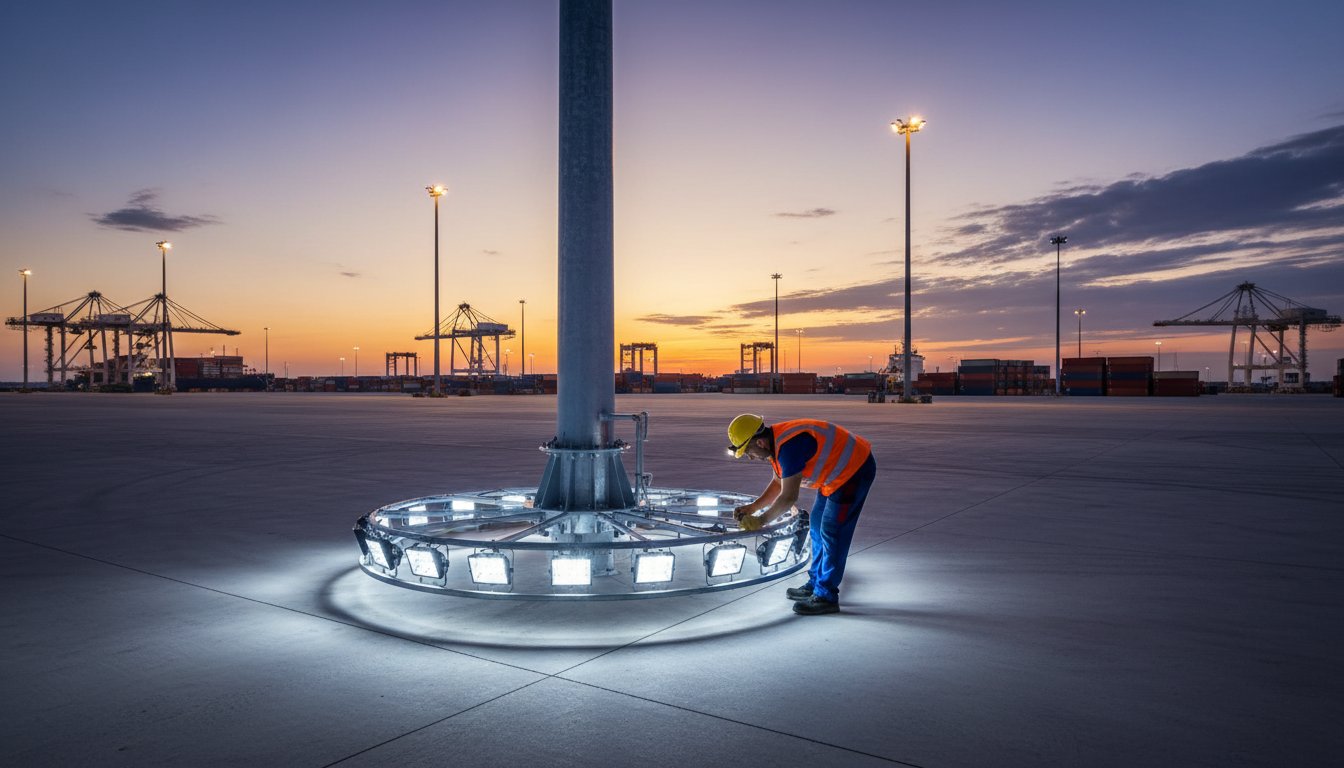
The most expensive component of high-altitude lighting isn’t the hardware, but the recurring cost of specialized access machinery required for every routine inspection. You’ve likely managed projects where the logistical complexity of hiring 30-meter lift platforms caused significant delays and budget overruns. Infrastructure planners understand that maintaining reliable illumination across ports, highways, or industrial hubs requires a rigorous approach to both technical uptime and the physical safety of maintenance personnel.
This engineering analysis explains how a mobile crown high-mast system serves as a strategic asset to reduce long-term operational costs by eliminating external machinery dependencies. We’ll compare mobile and fixed configurations through the lens of mechanical precision, weather-resistant durability, and safety compliance. You’ll gain a clear framework for optimizing your infrastructure’s lifecycle while ensuring that technical teams remain grounded and secure during every repair cycle. This guide provides the technical clarity needed to transition from reactive maintenance to a structured, cost-efficient lighting strategy.
Key Takeaways
- Understand the operational advantages of implementing a mobile crown high-mast system to facilitate ground-level maintenance and significantly enhance personnel safety.
- Evaluate the critical role of high-tensile S355 steel and hot-dip galvanization in ensuring structural integrity for masts reaching heights of up to 50 meters.
- Analyze the cost-benefit ratio between initial capital expenditure and long-term operational savings when choosing between mobile and fixed headframe designs.
- Identify essential site-specific criteria, such as soil bearing capacity and wind zone classifications, to ensure the optimal stability of large-area illumination structures.
- Discover how custom engineering and precision manufacturing standards are leveraged to address the complex lighting requirements of industrial and sports infrastructure.
What is a Mobile Crown High-Mast System?
High-mast lighting represents a specialized category of illumination infrastructure designed to provide uniform light distribution over expansive areas. These structures typically exceed a height of 15 meters, though many industrial projects require masts reaching 30 to 50 meters. According to this High-Mast Lighting Overview, these systems are essential for environments where safety and visibility are paramount. A mobile crown high-mast system distinguishes itself through a dynamic headframe that travels vertically along the mast shaft. This mechanical design allows technical teams to bring the entire lighting assembly to ground level for maintenance, which eliminates the need for high-altitude work or specialized climbing equipment.
The Evolution of High-Mast Infrastructure
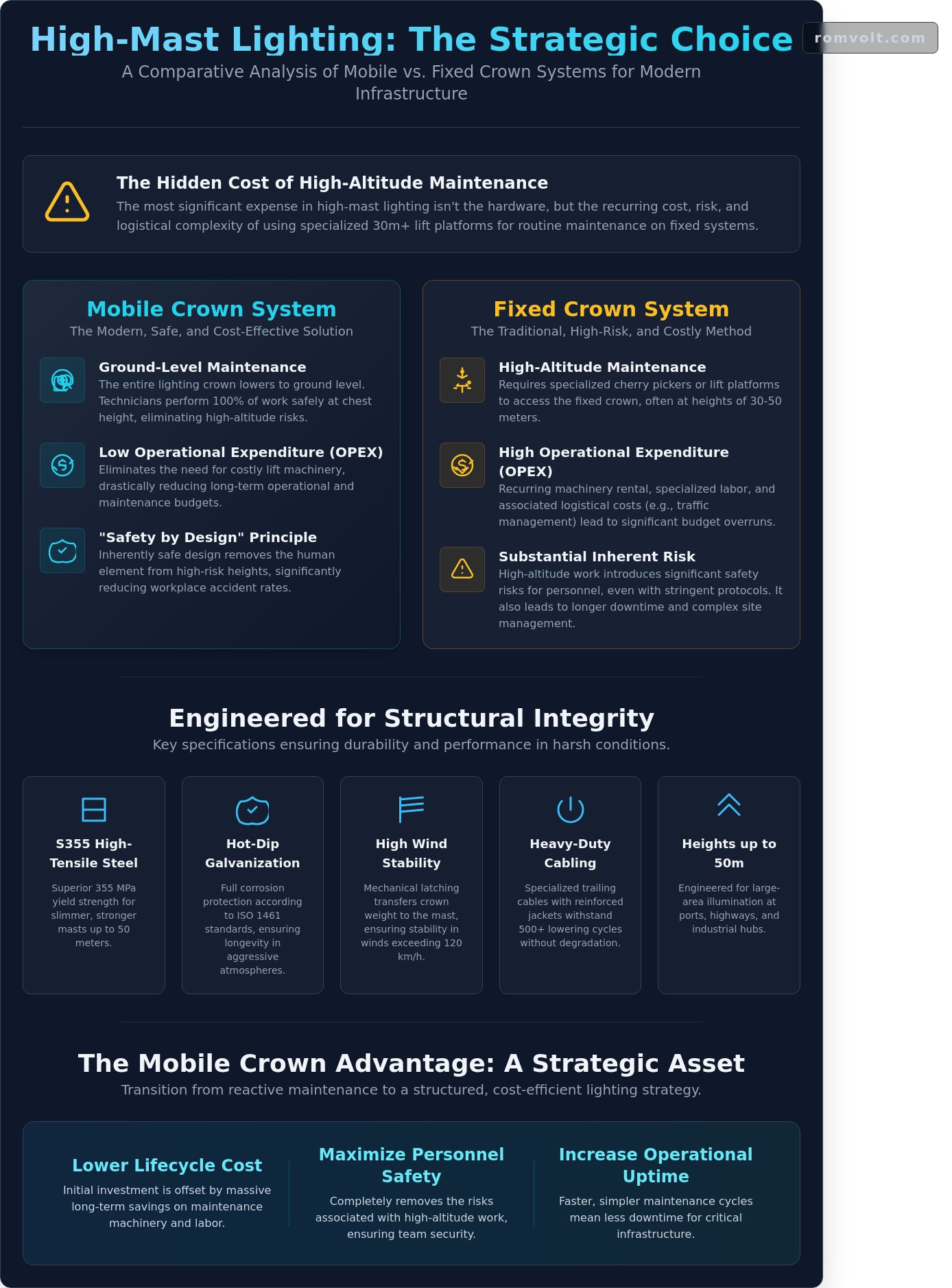
Infrastructure standards have shifted significantly since the mid-20th century. Early high-mast designs relied on fixed platforms accessed via external ladders or specialized cherry pickers. These methods introduced substantial risk and required heavy machinery that often blocked traffic lanes during repairs. Modern projects now prioritize “Safety by Design” principles. Automated lowering systems have become the industry benchmark because they remove the human element from high-risk heights. Technicians perform 100% of the electrical and luminaire work at chest height. It’s a shift that reduces workplace accident rates and simplifies the maintenance lifecycle for municipal and private operators.
Core Components of a Lowering System
The integrity of a lowering system depends on three primary mechanical subsystems. First, the winch mechanism provides the motive force. Engineering specifications dictate whether internal motors or external portable power units are utilized based on the site’s security profile. Second, the system uses high-tensile stainless steel wire ropes coupled with multi-pulley blocks to ensure a balanced, non-tilting ascent. Third, a mechanical latching mechanism secures the headframe once it reaches the top. This component is critical because it transfers the weight of the crown from the cables to the mast structure itself. It relieves constant tension on the winch and ensures the system remains stable during high-wind events exceeding 120 km/h.
Technical Specifications and Structural Integrity
The structural reliability of a mobile crown high-mast system depends on the synergy between material science and precise engineering calculations. We utilize high-tensile steel grade S355, a material selected for its superior yield strength of 355 MPa and excellent weldability. This choice is critical for masts reaching heights between 30 and 50 meters, where the weight-to-strength ratio determines the overall stability of the installation. Every structural component undergoes hot-dip galvanization according to ISO 1461 standards to prevent oxidative degradation in aggressive atmospheres.
Selecting S355 steel provides several technical advantages for large-scale infrastructure:
- High load-bearing capacity that allows for slimmer mast profiles without sacrificing safety.
- Enhanced impact strength at low temperatures, which is vital for northern climates.
- A specific silicon content that ensures a uniform and durable zinc coating during galvanization.
Electrical connectivity in these systems requires specialized trailing cables. Unlike static installations, these cables must withstand repetitive mechanical stress during the lowering and raising cycles of the mobile headframe. We implement heavy-duty, flexible cables with reinforced jackets that maintain insulation integrity even after 500+ cycles of operation. This ensures that the power supply to the luminaires remains uninterrupted throughout the system’s operational life. The integration of high-quality connectors prevents voltage drops and ensures compliance with international electrical safety protocols.
Structural Calculations for Dynamic Loads
Designing for heights exceeding 30 meters necessitates rigorous modeling of wind pressure. Our engineering team accounts for the increased drag coefficient of the headframe when it’s in motion during maintenance. The mast’s tapered polygonal cross-section isn’t just an aesthetic choice; it’s a functional feature that facilitates vibration damping by disrupting vortex shedding. Stability is further anchored by pre-cast concrete foundation blocks, which are calculated to resist overturning moments based on local soil density and peak wind speeds. All designs strictly adhere to EN 40 structural standards, ensuring the system remains vertical under extreme weather conditions. For a deeper understanding of how drag coefficient calculations and wind load variables affect industrial lighting poles across different site classifications, our technical buying guide provides a comprehensive engineering framework.
Corrosion Resistance in Industrial Environments
Longevity is a core requirement for infrastructure projects. The application of hot-dip galvanization extends the service life of the mobile crown high-mast to 25 years or more, even in high-salinity coastal regions or heavy industrial zones with high sulfur dioxide concentrations. Internal winch components and stainless steel wire ropes are housed within weather-protected compartments to block moisture and particulate ingress. This protection level is vital for maintaining the mechanical efficiency of the lifting system. For projects requiring specialized environmental resilience, you can consult our technical team to evaluate site-specific material treatments and coatings.
Mobile vs. Fixed Crown High-Masts: A Comparative Analysis
Maintenance Efficiency and ROI
The financial architecture of a mobile crown high-mast project favors long-term operational stability over lower initial capital expenditure. While the starting investment for mobile systems is typically 15% to 20% higher due to the winch and cable assemblies, the ROI manifests through the elimination of external equipment costs. Consider these efficiency metrics:
- Equipment Savings: Eliminating crane rentals, which average $2,500 per day for 40-meter masts, significantly reduces the OpEx budget.
- Labor Optimization: Ground-level access reduces technician downtime by approximately 50%, allowing for more frequent preventative checks.
- Break-even Analysis: Most large-scale industrial installations reach a break-even point within 6 to 8 years, depending on the frequency of scheduled maintenance.
Operational Safety and Risk Mitigation
Selection Criteria for Infrastructure Planners
Selecting a mobile crown high-mast system requires a rigorous engineering analysis that transcends basic aesthetic preferences. Planners must first evaluate the soil bearing capacity at the installation site. Standard foundations often require a minimum capacity of 200 kPa; however, soft clay or reclaimed land might necessitate deep piling or reinforced concrete rafts. Footprint availability also dictates the choice between tapered octagonal masts and multi-sided structures, especially in congested port terminals where every square meter of ground space impacts operational logistics.
Wind zone classifications represent the most critical safety variable. According to EN 1991-1-4 standards, structures must withstand regional peak velocity pressures. A 30-meter mast with a heavy 12-floodlight array presents a high Effective Projected Area (EPA), often exceeding 3.0 m². This surface area increases the overturning moment, requiring thicker structural steel or a wider base diameter to maintain a safety factor of 1.5 or higher. Budgetary planning must balance the initial CAPEX with long-term OPEX. While mobile systems have a higher upfront cost, they eliminate the need for specialized aerial work platforms, which can cost upwards of €1,500 per day for maintenance interventions. Planners evaluating broader procurement decisions should also review the full specification criteria for industrial lighting poles in infrastructure projects, including EN 40 compliance benchmarks and corrosion classification requirements.
Environmental and Site Factors
Technical Documentation and Compliance
Engineers must verify that all lifting equipment and structural components carry CE marking and comply with the Machinery Directive 2006/42/EC. Generic structural templates are insufficient for high-risk infrastructure projects. Site-specific calculations must account for the exact weight of the luminaires and the local gust factor. Long-term reliability depends on the availability of specialized spare parts, such as stainless steel wire ropes and torque-limiting winches, for at least 15 years post-installation. This ensures the mobile crown high-mast remains a functional asset rather than a liability.
The Romvolt Engineering Approach to High-Mast Solutions
Precision Manufacturing and Quality Control
Our manufacturing process relies on a synergy between Romanian production capabilities and Belgian management expertise. We utilize automated welding systems to maintain consistent structural integrity across polygonal shafts. This precision is vital for the stability of the mast under extreme wind conditions. Each mobile crown high-mast system undergoes a series of rigorous tests. This includes verifying the winch mechanisms and load-bearing components at 150% of their operational capacity. We strictly follow ISO 9001:2015 protocols to guarantee that every weld and fastener meets the required technical specifications. This rigorous oversight ensures that the equipment performs reliably in demanding environments, such as maritime ports or high-capacity sports arenas. For those utilizing these venues for private events, maintaining high standards is equally important, which is why services like bruiloft dj huren are often sought to provide professional-grade entertainment.
Logistics and Project Support
The Romvolt commitment extends to the long-term operational phase. We design our systems for ease of maintenance, ensuring that the electrical panels and mechanical hoisting systems remain accessible and reliable for decades. Our engineering team provides ongoing technical support, transforming a standard procurement process into a strategic partnership focused on infrastructure resilience and public safety. We prioritize the delivery of solutions that balance technical performance with strict adherence to European manufacturing standards.
Advancing Infrastructure Reliability through Technical Precision
Selecting the right lighting infrastructure requires a rigorous analysis of operational safety and structural longevity. A mobile crown high-mast system offers a distinct advantage by eliminating the need for high-altitude maintenance vehicles; this shift significantly lowers long-term operational expenditures while enhancing technician safety. Our engineering approach adheres strictly to EN 40 structural standards and ISO-certified manufacturing protocols to ensure every installation withstands specific environmental loads. Romvolt’s technical team has successfully implemented these complex systems across major European industrial hubs and stadiums, delivering solutions where precision isn’t just a goal but a baseline requirement. We prioritize technical compliance and structural integrity to guarantee that your infrastructure investment remains secure for its entire service life. By focusing on integrated automation and robust mechanical components, we help planners avoid the hidden costs of substandard equipment. It’s essential to partner with experts who understand the intersection of electrical automation and heavy-duty structural engineering.
Consult our engineering team for a custom high-mast lighting quote to begin your project’s technical assessment.
Frequently Asked Questions
What is the maximum height for a mobile crown high-mast system?
Standard engineering designs for a mobile crown high-mast typically reach heights of 50 meters, though specialized configurations can extend to 60 meters for specific port or airport requirements. These structures must adhere to Eurocode 3 standards to ensure structural integrity against oscillation. Every meter of height requires precise calculation of the shaft taper to maintain stability during the lowering of the mobile crown high-mast headframe.
How often does the winch mechanism on a mobile crown require maintenance?
A comprehensive technical inspection of the winch mechanism is required every 12 months to ensure operational safety and compliance with industrial lifting regulations. Technicians must verify the integrity of the stainless steel cables and the lubrication levels of the internal gears during this annual cycle. Neglecting this schedule increases the risk of mechanical binding, which impacts the long-term reliability of the entire system.
Can a mobile crown system be retrofitted onto an existing fixed mast?
Retrofitting a mobile crown onto a fixed mast isn’t feasible because the internal diameter and structural reinforcement of a fixed pole don’t accommodate the necessary hoisting pulleys and winch systems. Fixed masts lack the internal clearance of 400mm to 600mm required for the cable pathways and the specific top-plate mounting points. Converting these structures usually results in safety compromises that violate EN 1090-2 execution standards.
What happens if the winch cable breaks during the lowering process?
Modern systems utilize a redundant safety braking mechanism or a secondary latch and lock system that immediately halts the descent if tension is lost. These safety catches engage within 100 millimeters of movement to prevent a free-fall scenario. This engineering fail-safe protects both the expensive LED floodlights and the personnel performing ground-level maintenance. It’s a critical requirement for any high-traffic infrastructure project.
Are mobile crown systems suitable for extremely high wind zones?
Mobile crown systems are engineered to withstand wind speeds exceeding 160 kilometers per hour, provided they’re designed according to local wind maps and EN 1991-1-4 parameters. Engineers calculate the projected area of the headframe and luminaires to ensure the mast’s deflection stays within a 5 percent limit of its height. This precision ensures that even in coastal areas with high turbulence, the structure remains stable and secure.
How many floodlights can a standard mobile crown headframe support?
A standard headframe typically supports between 6 and 12 high-power LED luminaires, depending on the weight and wind surface area of each unit. Heavy-duty circular headframes can be customized to hold up to 18 floodlights for sports stadiums or large industrial yards. The total load capacity is strictly defined during the design phase to prevent exceeding the winch’s lifting limit, which is often rated for 500 to 1000 kilograms.
What is the typical lifespan of a galvanized steel high-mast?
A hot-dip galvanized steel mast has a service life ranging from 25 to 50 years, depending on the corrosivity of the environment as defined by ISO 12944. In C3 environments, the zinc coating provides decades of protection without requiring additional painting or surface treatments. Regular ultrasonic thickness testing every 5 years helps monitor the rate of depletion and ensures the structural safety of the asset throughout its lifecycle.