
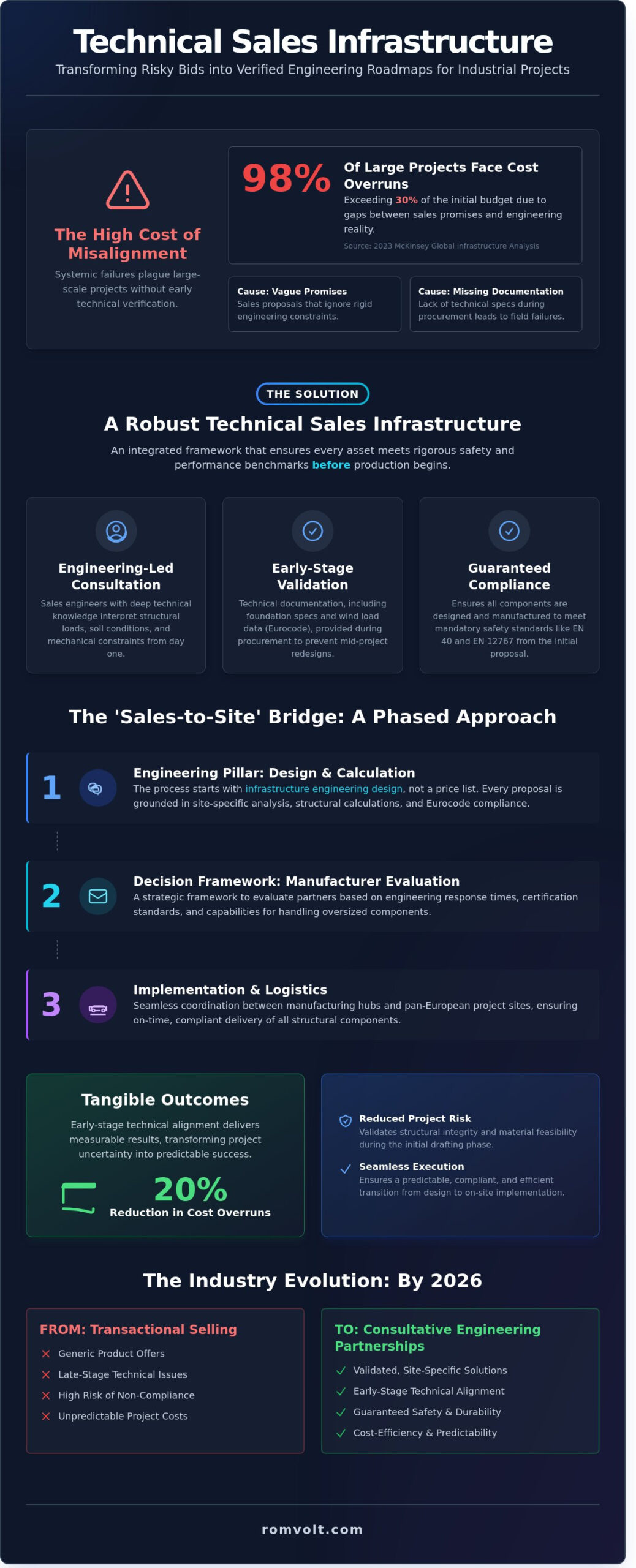
According to a 2023 McKinsey analysis of global infrastructure, 98% of large-scale engineering projects face cost overruns exceeding 30% because of systemic misalignments between the initial bid and the final delivery. You’ve likely experienced the frustration of sales promises that ignore the rigid constraints of electrical engineering or the logistical reality of transporting oversized structural components. It’s a common industry pain point where the lack of technical documentation during the procurement phase leads to cascading failures in the field.
Establishing a comprehensive technical sales infrastructure bridges this gap, transforming a mere commercial proposal into a verified engineering roadmap. By integrating technical expertise directly into the procurement cycle, you’ll ensure a seamless transition from complex specification to a manufactured product that meets every safety standard and regulatory requirement. This article examines the strategic framework necessary to provide clear communication throughout the delivery cycle and maintain absolute confidence in the structural integrity and compliance of your industrial projects.
Key Takeaways
- Distinguish between standard product sales and the procurement of physical assets where safety compliance and structural durability are the primary performance indicators.
- Understand the role of a robust technical sales infrastructure in bridging the gap between complex engineering design and the successful delivery of large-scale industrial projects.
- Access a strategic framework for evaluating manufacturers based on engineering response times, certification standards, and logistical capabilities for oversized components.
- Learn how to navigate the trade-offs between customization and standardization to optimize structural integrity and cost-efficiency in infrastructure engineering.
- Discover the operational advantages of an integrated “sales to site” bridge that ensures seamless coordination between manufacturing hubs and pan-European project locations.
Defining Technical Sales Infrastructure for Physical Assets
In the specialized field of industrial manufacturing, technical sales infrastructure represents a multi-layered system that integrates advanced engineering expertise with specialized design tools and procurement protocols. It isn’t a mere sales pipeline; it’s a foundational framework ensuring that every physical asset meets rigorous safety and performance benchmarks before production begins. This infrastructure serves as the bridge between conceptual architectural goals and the mechanical realities of heavy engineering.
The distinction between software sales and physical infrastructure sales is rooted in the consequences of failure. While software updates can rectify code errors post-deployment, physical assets like stadium masts or telecommunication towers must demonstrate absolute durability from the moment of installation. Safety compliance isn’t a secondary feature; it’s the primary deliverable. By 2026, the industry expects a total transition from transactional selling to consultative engineering partnerships. This evolution demands that manufacturers provide more than just a product. They must provide a validated technical environment that accounts for structural loads, material fatigue, and environmental stressors.
The Core Components of Industrial Sales Support
Effective industrial support starts with engineering-led consultation. A sales point-of-contact must possess the technical depth to interpret structural loads and soil conditions accurately. This requires a background in Sales Engineering to bridge the gap between commercial objectives and mechanical constraints. Providing technical documentation early in the process is mandatory. This includes pre-cast foundation specifications and wind load data based on Eurocode 3 standards. Within this cycle, the structural components manufacturer provides the essential link between theoretical design and material feasibility, ensuring that every component is optimized for its specific application.
Why Planners Require a Technical Framework
Urban planners and project managers face significant risks when technical verification is delayed. A robust technical sales infrastructure reduces project risk by validating structural integrity during the initial drafting phase. It’s common for urban lighting projects to face conflicts between architectural aesthetics and safety standards. Integrated frameworks ensure that visual goals don’t compromise structural stability. By identifying these discrepancies early, engineers prevent mid-project redesigns. Data indicates that early-stage technical alignment can prevent cost overruns that typically reach 20% of the total project budget. This methodical approach ensures that the transition from design to implementation is seamless, predictable, and compliant with all national safety regulations.
The Engineering Pillar: Design and Structural Calculations
A robust technical sales infrastructure prioritizes engineering accuracy over commercial speed. In complex physical projects, the sales process begins with infrastructure engineering design rather than a standard price list. This methodology ensures that every proposal is grounded in physical reality, preventing the common mismatch between client expectations and structural limitations. Instead of offering generic products, technical teams evaluate the specific site conditions, such as soil density and local topography, to determine whether customization or standardization is the most cost-effective path forward.
The role of a technical sales engineer within this framework is to bridge the gap between abstract client requirements and rigid Eurocode standards. Compliance with EN 40 for lighting columns and EN 12767 for passive safety is mandatory; these aren’t merely suggestions but legal and safety benchmarks. Integrating wind load calculations into the initial proposal phase is a critical step. By utilizing Eurocode 1 (EN 1991-1-4) data, engineers calculate the specific pressure a mast will face based on its geographic location and height, ensuring the structure won’t fail during extreme weather events.
Structural Integrity and Compliance Verification
Verifying steel and aluminium grades is a cornerstone of the technical consultation. We distinguish between S235 and S355 steel based on yield strength; S355 provides 355 MPa, which is often necessary for high-mast structures or areas with high wind turbulence. Long-term infrastructure value is secured through hot-dip galvanization according to EN ISO 1461. This process provides a protective zinc coating that resists corrosion for over 50 years in C3 environments. Passive safety is also integrated at this stage, incorporating driver protection mechanisms that allow poles to break away or absorb impact energy, reducing the severity of roadside accidents.
From Concept to CAD: The Visualisation Phase
3D modelling and CAD drafting transform theoretical calculations into verifiable visual data. These tools allow technical sales teams to confirm mast placement and lighting coverage with millimeter precision. For complex stadium floodlight mast design, 3D simulations are essential to ensure 0% light spill into surrounding residential zones while maintaining 1500 lux on the field. This level of detail provides the technical documentation required for municipal approval processes, where precision is a prerequisite for project permits. If you’re planning a large-scale project, you can consult with our engineering specialists to review your structural requirements.
Decision Framework: Evaluating a Manufacturer’s Infrastructure
Selecting a partner for large-scale engineering projects requires a shift from procurement-based thinking to a systems-evaluation approach. Planners shouldn’t settle for surface-level sales pitches when managing multi-million dollar electrical installations; they must verify the underlying technical sales infrastructure that supports the project lifecycle. This framework distinguishes between a simple fabricator, who merely executes a drawing, and a strategic partner capable of mitigating long-term operational risks through engineering rigors.
Manufacturer vs. Broker: The Technical Gap
Purchasing critical infrastructure from sales-only entities or brokers introduces significant vulnerabilities into the supply chain. These entities lack direct control over manufacturing tolerances and material specifications, which often leads to integration failures during site assembly. Direct factory-to-site communication is vital when dealing with oversized components like industrial transformer stations or complex cable management systems. It’s not enough to have a responsive sales rep; the depth of the engineering team behind that representative determines the project’s viability. Many successful firms now utilize a sales engineering framework to ensure that every technical query is validated by a qualified designer before a quote is even issued. This prevents the “order now, figure it out later” mentality that causes 30% of project delays in the energy sector.
Safety and Longevity Standards Comparison
The effectiveness of a manufacturer’s technical sales infrastructure is measured by its commitment to rigorous standards during the pre-contract phase. A professional partner doesn’t wait for a site failure to discuss corrosion protection; they provide detailed specifications for hot-dip galvanization according to ISO 1461 or C5-M corrosion classifications during initial consultations. Furthermore, the ability to provide integrated solutions, such as pre-cast concrete foundation blocks designed for specific soil pressures, indicates a mature engineering mindset. Verifying ISO 9001:2015 and CE certifications isn’t a bureaucratic formality but a fundamental check of the manufacturer’s operational discipline. These certifications ensure that the sales team isn’t making promises that the production floor can’t document or replicate.
RFP Assessment Checklist for Technical Competency:
- Engineering Response Time: Does the manufacturer provide technical clarifications or revised CAD drawings within a 24-hour to 48-hour window?
- Compliance Documentation: Are full material traceability reports and compliance certificates provided as standard practice during the bidding phase?
- Logistical Track Record: Can the provider demonstrate a 95% or higher on-time delivery rate for oversized loads requiring specialized permits?
- Design Verification: Does the sales infrastructure include a mandatory peer-review process for all custom engineering designs before production starts?
Planners who prioritize these metrics reduce the likelihood of costly field modifications. A partner who invests in their internal technical sales infrastructure shows they’re prepared to handle the complexity of modern industrial automation and electrical distribution. It’s about ensuring that the equipment delivered on-site matches the precision of the initial engineering intent without compromise.
Implementation and Logistics: The ‘Sales to Site’ Bridge
Success in large-scale engineering projects depends on the continuity between the design phase and the physical arrival of components. A sophisticated technical sales infrastructure ensures that the commitment made during the proposal translates into a functional reality on the ground. For projects involving oversized structural components, such as stadium lighting masts or industrial supports, the sales process remains active until the final bolt is tightened. This phase requires rigorous coordination between manufacturing hubs in Romania and project sites located across Europe, ensuring that geographical distance doesn’t compromise technical precision.
Managing the delivery of stadium masts exceeding 30 metres in height introduces specific variables that standard logistics providers can’t handle. These components require specialized transport permits and articulated trailers capable of navigating narrow access roads. Effective technical sales teams integrate these logistical constraints into the initial project timeline. They ensure that foundation blocks arrive at least 14 to 21 days before the poles to allow for proper concrete curing and site preparation. This sequencing prevents costly delays in crane rentals and assembly teams, which can exceed several thousand euros per day in idle costs.
Managing Oversized Transport and Site Delivery
Transporting high-mast systems across international borders involves more than just shipping. It requires a detailed site access plan, a service that’s often the difference between a smooth installation and a logistical failure. Sales engineers must evaluate the turning radii of transport vehicles and the load-bearing capacity of site entry points. Coordinating cross-border infrastructure projects means managing documentation for multiple jurisdictions. This ensures every component meets local safety standards and transport regulations without stalling the project momentum.
Installation Support and Technical Handover
The technical sales infrastructure provides the bridge to long-term operational stability through comprehensive handover protocols. This includes delivering detailed installation manuals and foundation site-prep checklists that align with the specific structural calculations of the project. Beyond the physical delivery, technical sales specialists facilitate structural verification and establish maintenance protocols at the point of sale. This proactive approach ensures the infrastructure remains compliant with safety standards for its entire 25 to 50-year lifecycle.
For organizations seeking to optimize their project delivery through expert engineering and logistical precision, you can consult our technical team for specialized infrastructure solutions.
Additionally, to mark the successful handover of significant infrastructure landmarks, many partners choose to collaborate with Creaworks for high-end corporate gifts and unique branding products that mirror the engineering quality of the project.
The Romvolt Advantage: Integrated Infrastructure Solutions
Romvolt bridges the gap between high-precision Romanian manufacturing and Belgian commercial management. This synergy creates a robust technical sales infrastructure that prioritizes engineering accuracy over aggressive sales targets. We don’t just supply components; we deliver integrated systems designed for a 25-year service life. Our focus remains on projects where structural failure isn’t an option, ensuring that every asset we deploy contributes to a stable, long-term utility network.
A core pillar of our operations is the technical-first approach applied to street lighting poles. Instead of offering off-the-shelf products that might underperform in specific environments, our engineers evaluate wind load factors, soil composition, and local climate data to determine the optimal material grade. We’ve implemented this methodology across 150+ urban development projects, ensuring that every installation meets EN 40 standards and local safety mandates without exception.
Our expertise extends into the telecommunications and renewable energy sectors. We develop custom-engineered solutions for 5G tower deployments and solar farm foundations where precision is critical. Safety and structural integrity take precedence over volume; we’d rather refine a design for weeks than compromise on the technical safety margins required by European regulations. This commitment to quality ensures that our technical sales infrastructure supports the most demanding physical engineering projects in the EU.
Engineering Excellence at Every Touchpoint
Clients gain direct access to an in-house engineering team capable of performing bespoke structural calculations for any environment. This internal technical sales infrastructure eliminates the friction of third-party consultants, providing a single point of accountability from the initial design phase to final delivery. By centralizing these processes, we’ve reduced project lead times by approximately 18% for major European grid operators. They trust our process because it guarantees compliance with rigorous safety protocols and provides a clear audit trail for every component manufactured.
Next Steps for Infrastructure Planners
Project managers can initiate a technical consultation to discuss specific structural requirements and environmental constraints. Our digital library provides immediate access to technical specifications and CAD drawings for seamless integration into your planning software. It’s the most efficient way to ensure your project starts with accurate data. Contact our team today to receive a comprehensive infrastructure quote based on verified engineering data and current material standards. We’re ready to provide the stability your project requires.
For project managers interested in exploring a broader marketplace for various industrial tools and services within the region, you can learn more about CSV.RO – Anunturi gratuite | Cumpara si vinde rapid.
Securing Structural Integrity Through Integrated Engineering
Infrastructure projects demand more than just procurement; they require a rigorous technical sales infrastructure to bridge the gap between initial design and final installation. The integration of structural calculations based on EN 40 and EN 1090 standards ensures that every physical asset meets strict safety requirements before reaching the site. By combining Romanian and Belgian engineering expertise, project managers can mitigate risks associated with large-scale deployments in stadium and highway sectors. This framework focuses on precision, moving beyond simple transactions to provide a comprehensive engineering ecosystem.
Romvolt’s methodology relies on these certified manufacturing processes to deliver stability in complex environments. Successful implementation hinges on this structured approach to logistics and design. You’ll find that prioritizing technical compliance today prevents costly structural failures tomorrow. Our team’s proven track record in highway and stadium lighting ensures your project adheres to the highest European benchmarks. We look forward to bringing this level of specialized rigor to your upcoming developments.
Consult our technical sales team for your next infrastructure project
Frequently Asked Questions
What should I look for in a technical sales team for infrastructure?
A qualified technical sales team must possess 5+ years of certified engineering experience and mastery of CAD software. A robust technical sales infrastructure requires consultants who interpret Eurocode 3 standards with absolute precision. The team’s ability to align technical specifications with local regulatory frameworks ensures a 100% compliance rate. You’ll find that specialists who prioritize data over generalities deliver more reliable project outcomes.
How do structural calculations impact the sales process?
Structural calculations dictate the feasibility and safety margins of the entire project proposal. These assessments ensure that poles withstand wind speeds of up to 30 meters per second as per regional weather data. Providing these verified calculations early reduces revision cycles by 25% and secures the technical integrity of the procurement contract. It’s a critical step that prevents structural failure and optimizes material usage.
Why is EN 40 compliance important in the procurement phase?
EN 40 compliance is mandatory because it regulates the design, dimensions, and structural requirements for lighting columns across the European Union. This standard ensures that every pole maintains a fatigue life exceeding 20 years under specific environmental stressors. Adhering to these 12 distinct parts of the EN 40 series eliminates legal liability and guarantees public safety. We don’t compromise on these benchmarks during any project phase.
Can Romvolt provide custom designs for stadium floodlight masts?
Romvolt engineers custom floodlight masts tailored to specific lumen requirements and stadium geometry. We utilize finite element analysis to design structures that support headframes weighing up to 1,500 kilograms. These bespoke solutions integrate into the broader technical sales infrastructure, ensuring optimal light distribution for Class I broadcasting standards. Our process ensures that every custom mast meets the same rigorous safety benchmarks as our standard units.
What is the difference between S235 and S355 steel for lighting poles?
The primary difference lies in the minimum yield strength, which is 235 MPa for S235 and 355 MPa for S355 steel. Using S355 allows for a 20% reduction in wall thickness while maintaining the same structural load capacity. This higher grade steel is essential for masts exceeding 12 meters in height to ensure stability against oscillation. It’s the standard choice for high-stress industrial applications where durability is paramount.
How does Romvolt handle the logistics of oversized lighting masts?
We coordinate specialized transport for masts that exceed the standard 13.6-meter trailer length using extendable flatbed trucks. Each shipment includes a detailed transit plan that accounts for 100% of the weight distribution and securing requirements. Logistics managers monitor every delivery via GPS to ensure components arrive within the 48-hour scheduled window. This precision prevents site delays and protects the structural integrity of the equipment during transit.
Are foundation blocks included in the technical sales proposal?
Foundation block specifications are included as part of the technical documentation, though physical supply depends on the specific contract terms. We provide precise reinforcement drawings and concrete grade requirements, such as C25/30, for every installation. This ensures the underground support matches the 50-year design life of the above-ground structure. It’s a standard part of our engineering package to ensure total system stability.
Does Romvolt provide technical support during the installation phase?
Romvolt provides on-site technical supervision to ensure that torque values and vertical alignments meet the 0.5-degree tolerance threshold. Our engineers verify that the electrical connections within the terminal blocks comply with IEC 60364 standards. This direct oversight prevents 95% of common installation errors and validates the long-term warranty of the system. We’re committed to ensuring that the final implementation reflects the original engineering design.