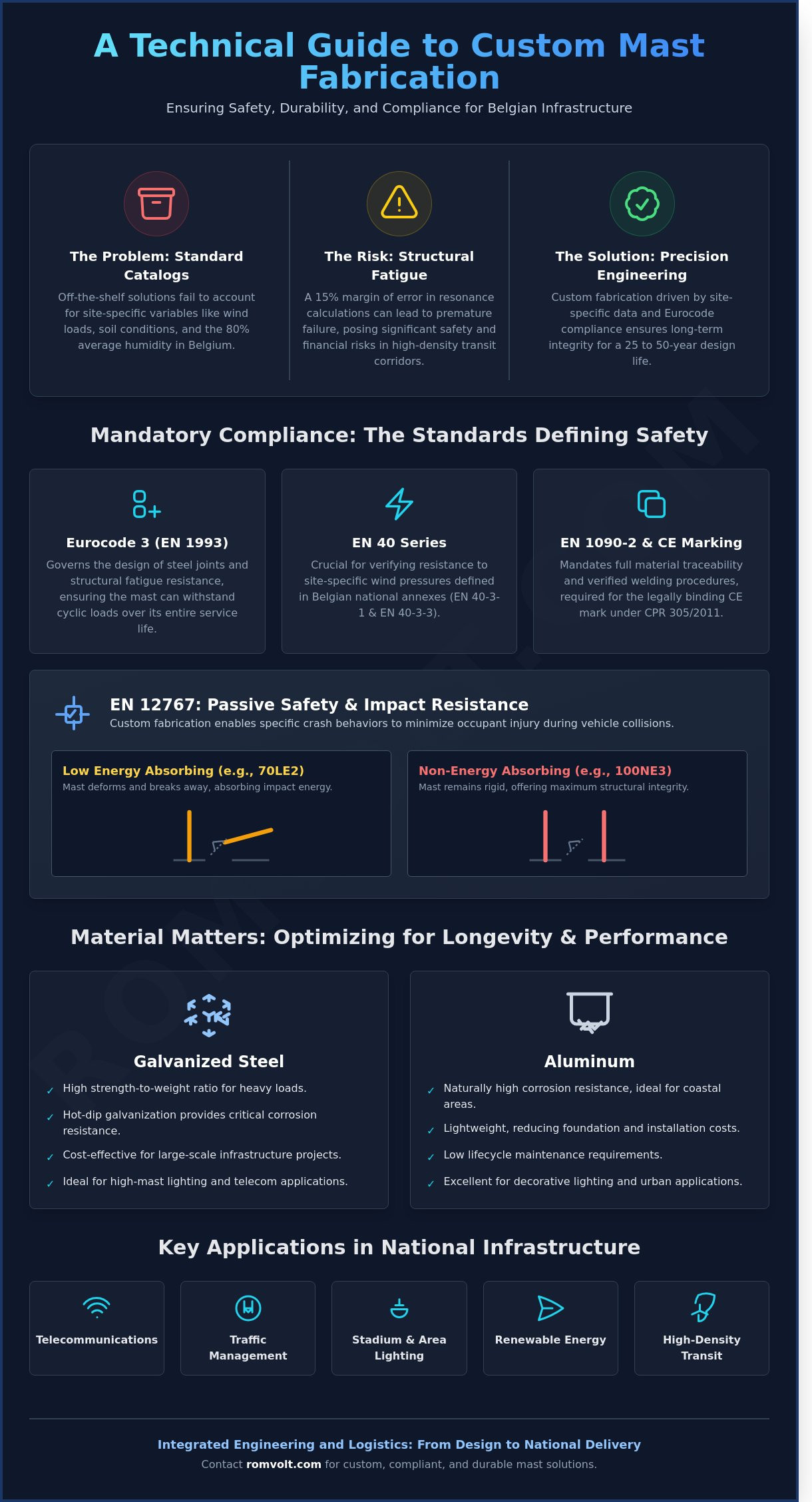
Does a 15% margin of error in aerodynamic resonance calculations justify the risk of structural fatigue in high-density Belgian transit corridors? For project managers and lead engineers, the answer is a definitive no. Ensuring the long-term integrity of critical infrastructure requires a rigorous adherence to technical parameters that standard catalogs often overlook. You understand that custom mast fabrication Belgium isn’t merely a procurement task; it’s a critical engineering phase where Eurocode 3 compliance and site-specific wind load data dictate the safety of the entire installation.
We’ve developed this guide to help you master the complex technical requirements and engineering standards essential for specifying custom-engineered masts. You’ll gain the clarity needed to define precise technical specifications, ensuring your project benefits from a reliable, Eurocode-compliant solution that withstands the 80% average humidity levels typical of the Belgian climate. We’ll analyze the transition from initial structural design to final foundation implementation, focusing on how integrated engineering and logistics eliminate the common points of failure in complex infrastructure projects. By the end of this technical overview, you’ll possess a structured framework for managing the end-to-end lifecycle of mast deployment with absolute precision.
Key Takeaways
- Identify the critical EN 40 standards and regulatory frameworks required to ensure the structural safety and compliance of support columns in the Belgian market.
- Master the methodology for site-specific structural calculations and wind load analysis to optimize the technical specifications and wall thickness of high-precision masts.
- Compare the performance characteristics of galvanized steel and aluminum to make informed material selections based on total lifecycle maintenance and environmental durability.
- Develop a comprehensive procurement roadmap for custom mast fabrication Belgium, focusing on height, load capacity, and the selection of appropriate foundation types.
- Explore how integrated engineering design and specialized manufacturing facilitate the successful implementation of complex stadium, telecom, and renewable energy infrastructure.
Custom Mast Fabrication for Belgian Infrastructure: Standards and Compliance
Custom mast fabrication Belgium involves a high-precision engineering discipline focused on creating specialized support structures for national transport and industrial networks. It’s not merely a manufacturing process; it’s a rigorous technical application where every millimeter of steel or aluminum is calculated to withstand specific environmental stresses. These structures serve as the backbone for telecommunications, traffic management, and lighting systems across the national infrastructure. Because these assets operate in public spaces, they must adhere to a strict hierarchy of European and national regulations that govern their design, material composition, and installation.
Standardized products frequently fail to meet the unique demands of specific Belgian sites. For instance, a mast located in a coastal environment requires different corrosion resistance and wind load tolerances than one installed in a sheltered inland or urban area. Using basic structural engineering terms for masts and towers, we can identify that variables such as base moment, shear force, and torsional rigidity must be customized for every project. Off-the-shelf solutions don’t account for these site-specific calculations, which can lead to premature structural fatigue or failure during extreme weather events.
The regulatory landscape in Belgium is defined by a commitment to long-term durability and public protection. Every fabricated unit must carry the CE marking, signifying it meets the essential requirements of EU Construction Products Regulation (CPR) 305/2011. This legal framework ensures that the custom mast fabrication Belgium process remains transparent, with full traceability of materials and verified welding procedures according to EN 1090-2 standards. This level of oversight is mandatory for any infrastructure project seeking municipal or federal approval.
The Importance of EN 40 and Eurocode 3
Structural design for Belgian lighting and support columns relies heavily on the EN 40 series of standards. Compliance with EN 40-3-1 and EN 40-3-3 is essential for verifying that a mast can resist the specific wind pressures defined in Belgian national annexes. Furthermore, engineers apply Eurocode 3 (EN 1993) to manage the design of steel joints and fatigue resistance. For municipal approval, technical documentation must include a detailed Declaration of Performance (DoP) and structural calculations that prove the mast won’t exceed deflection limits under peak loads. This documentation provides the technical assurance that the infrastructure will remain operational for its 25-year or 50-year design life.
Passive Safety and Impact Resistance
Public safety is a non-negotiable aspect of Belgian infrastructure. The EN 12767 standard dictates how masts should behave during a vehicle collision to minimize injury to occupants. Custom fabrication allows for the integration of specific performance classes, such as 100NE3 (Non-Energy Absorbing) or 70LE2 (Low Energy Absorbing), depending on the speed limit of the road. By utilizing specialized breakaway bolts or deformable base sections, fabricators ensure the mast yields predictably upon impact. This balance between structural rigidity and crash-friendliness is a hallmark of modern engineering, ensuring that utility poles don’t become lethal obstacles in the event of an accident.
Engineering the Structure: Calculations, Wind Loads, and Durability
Engineering a high-mast structure requires a meticulous approach to structural mechanics and material science. For every project involving custom mast fabrication Belgium, site-specific calculations form the absolute foundation of operational safety. These assessments aren’t generic templates; they’re precise mathematical models that account for the exact geographical coordinates and the intended payload. Engineers must evaluate the interaction between the steel column and the environmental forces it’ll encounter over a 50-year service life.
Structural Calculations for High-Mast Integrity
Technical teams utilize Finite Element Analysis (FEA) to simulate complex stress distributions across the mast’s geometry. This computational method allows for the identification of potential fatigue points before the first sheet of steel is cut. When designing multi-equipment configurations, calculating the center of gravity is vital to prevent eccentric loading that could compromise the foundation’s stability. This level of precision is critical when ensuring the structural integrity of stadium masts under extreme weather conditions. By predicting how the structure reacts to heavy floodlight clusters or large-surface telecom antennas, we ensure the system remains within the elastic limit of the material, even during peak load events.
Wind Load Factors in the Belgian Climate
The Belgian climate presents specific challenges, particularly regarding wind actions in coastal regions versus inland industrial zones. Wind load analysis directly dictates the necessary taper and wall thickness of the mast. Eurocode 1 defines wind actions on structures by providing rigorous methods to calculate characteristic wind pressures based on fundamental wind velocities and air density. The Belgian Bureau for Standardisation (NBN) oversees the national implementation of these standards, ensuring that infrastructure resists the gust factors prevalent in Northern Europe. Designers must also account for topographical influences, such as the “terrain roughness” categories defined in NBN EN 1991-1-4, which adjust the expected wind force based on surrounding obstacles or open landscapes.
Beyond static loads, dynamic forces like vortex shedding can cause significant structural resonance. High-mast infrastructure longevity depends on the implementation of effective vibration dampening systems. These mechanisms absorb kinetic energy, preventing the micro-cracks that often lead to premature failure in less sophisticated designs. Accounting for the weight of stadium floodlights or heavy-duty antennas requires a balance between rigidity and flexibility. When you optimize your infrastructure through these technical safeguards, you’re investing in a solution that minimizes maintenance requirements and maximizes public safety. Every millimeter of wall thickness in custom mast fabrication Belgium is a calculated response to the physical realities of the site.
Material Selection: Optimizing Steel and Aluminum for Longevity
The selection of raw materials for custom mast fabrication Belgium projects dictates both the structural integrity and the financial viability of infrastructure over a 50-year service horizon. Engineers must balance the high tensile strength of carbon steel against the lightweight, corrosion-resistant properties of specific aluminum alloys. While aluminum offers a superior weight-to-strength ratio, often reducing foundation mass requirements by approximately 30%, it frequently lacks the necessary rigidity for heavy industrial telecommunications or high-mast lighting in high-wind zones near the North Sea coast. Choosing the correct substrate isn’t merely a matter of initial cost; it’s a strategic decision based on the environmental category of the installation site.
Steel vs. Aluminum: A Technical Comparison
Structural requirements for infrastructure in the Benelux region necessitate strict adherence to Belgian building standards, specifically Eurocode 3 for steel and Eurocode 9 for aluminum structures. Steel remains the primary choice for masts exceeding 12 meters due to its superior modulus of elasticity and resistance to fatigue under oscillating wind loads. In maritime environments, such as the Port of Zeebrugge, aluminum provides natural resistance to salt-spray corrosion without mandatory secondary coatings. However, the initial capital expenditure for aluminum components can be 35% to 50% higher than steel counterparts. Both materials support sustainability goals, as they offer nearly 100% recyclability at the end of their operational lifecycle.
Advanced Protection: Hot-Dip Galvanization
Hot-dip galvanization represents the industrial benchmark for protecting steel against the humid, temperate Belgian climate. This metallurgical process involves immersing the fully fabricated mast in a molten zinc bath at temperatures reaching 450°C. The resulting chemical bond creates zinc-iron alloy layers that provide cathodic protection. This means the coating actively sacrifices itself to protect the underlying steel if the surface is breached. For galvanized steel poles situated in C4 or C5 industrial zones, maintenance intervals typically extend to 25 or 30 years. All custom mast fabrication Belgium processes must ensure coating thickness complies with ISO 1461, which dictates specific microns of protection based on the steel thickness to prevent premature oxidation.
Urban environments and public spaces often require a synthesis of technical durability and visual harmony. In these cases, a duplex system is utilized. This involves applying a high-grade powder coating over the galvanized base. This combination extends the structure’s lifespan by an additional factor of 1.5 compared to galvanization alone. It allows for precise RAL color matching, ensuring that technical infrastructure integrates seamlessly into Belgian cityscapes while maintaining a professional, sober aesthetic that resists UV degradation and mechanical impact.
Beyond structural design and aesthetics, the push for sustainable infrastructure also extends to specialized building systems. For project managers aiming to integrate energy-efficient solutions into their technical blueprints, it is worth taking the time to explore Infrarood verwarming as a way to enhance the overall performance of industrial and commercial spaces.
Furthermore, specialized supply chains are essential for maintaining the cultural fabric of community spaces. For those involved in the outfitting or restoration of religious architecture, Mary Collings Church Furnishings provides high-quality ecclesiastical items that meet the specific needs of traditional settings while ensuring long-term durability.
The Procurement Roadmap: Specifying Your Custom Mast Project
The procurement process for large-scale infrastructure projects in Belgium demands a rigorous approach to technical specifications. Successful custom mast fabrication Belgium initiatives begin with an exhaustive definition of functional requirements. Engineers must account for the specific height of the structure, the total equipment load it’ll support, and regional environmental factors. Wind load calculations must strictly adhere to Eurocode 1 (NBN EN 1991-1-4), which distinguishes between inland zones and coastal regions where wind speeds frequently reach 26 m/s.
Transitioning from a conceptual design to detailed fabrication drawings requires high-precision CAD modeling. This phase ensures that every structural weld and bolt placement meets the safety factors required by Belgian law. Logistics planning is equally critical; transporting components that exceed 12 meters in length involves specialized trailers and specific permits for oversized loads on Belgian motorways. Planning for these logistical constraints during the design phase prevents costly delays during the installation window.
Designing the Foundation for Stability
Foundation selection depends heavily on the site’s geotechnical profile. Pre-cast concrete foundation blocks offer a significant advantage for rapid installation, often reducing on-site labor time by 40% compared to traditional methods. These blocks are manufactured in controlled environments, ensuring consistent material density and strength. Conversely, poured-in-place foundations are necessary when soil analysis reveals low bearing capacity or high water tables. Every foundation design must integrate specific cable entries and earthing points to facilitate the safe connection of electrical systems and ensure long-term stability against soil shifting.
Technical Specification Checklist
To obtain an accurate manufacturer quote and ensure structural integrity, the following data points are non-negotiable:
- Geometric Data: Total height, top diameter, and precise flange plate dimensions for anchor bolt alignment.
- Internal Architecture: Specifications for reinforced door openings and internal cable management systems to prevent wiring damage.
- Compliance Verification: Ensure all street lighting poles include technical compliance certificates and CE marking as per European standards.
Infrastructure managers should prioritize manufacturers who provide full traceability of materials, from the raw steel mill certificates to the final galvanization report. This level of detail guarantees that the mast will withstand the 25-year service life expected in Belgian public utility projects. Precision in the early specification stage eliminates the ambiguity that often leads to structural failure or maintenance overruns.
Romvolt’s Integrated Solutions: From Design to National Delivery
Romvolt maintains a unique position in the industrial sector by operating as a manufacturer with fully integrated engineering design teams. This internal capability allows for a seamless transition from initial structural calculations to the final production phase. When executing projects for custom mast fabrication Belgium, the focus remains on technical rigor and the elimination of architectural ambiguity. Every structure is engineered to withstand specific environmental stressors, ensuring that the final product meets the exact requirements of the site’s topography and wind profile. Our project management covers the entire lifecycle, providing a single point of responsibility that ensures long-term infrastructure stability and compliance with all national safety standards.
Custom Fabrication Capabilities
The manufacturing facility specializes in high-mast structures that reach heights of 50 meters, catering to the specific needs of large-scale infrastructure. These masts aren’t generic products; they’re tailored for stadium lighting, telecommunications arrays, and renewable energy supports. Engineers design custom brackets and cross-arms to accommodate diverse sensor configurations and lighting patterns. Romvolt implements strict quality control protocols for high-volume orders, utilizing non-destructive testing to verify structural integrity. This level of precision is vital for masts that must maintain stability under the significant weight of modern industrial equipment. Our fabrication process includes:
While the focus here is on the infrastructure of facilities like stadiums, it’s interesting to note the parallel precision in other sectors. For instance, the performance of athletes within these venues relies on highly engineered apparel. For those curious about this related field of technical manufacturing, you can explore Sportswear.
- Static and dynamic analysis for wind loads exceeding 150 km/h.
- High-grade galvanization to prevent corrosion in maritime or industrial environments.
- Precision-engineered mounting plates for rapid sensor integration.
Logistics and Strategic Partnership
Delivery of oversized infrastructure requires more than just transport; it demands strategic planning. Romvolt coordinates the movement of masts across the Belgian road network, managing the complexities of specialized trailers and escort requirements for sections exceeding standard dimensions. By providing pre-cast foundations as part of a complete site-ready package, the company helps contractors reduce installation timelines by nearly 40 percent. This integrated approach ensures that every component, from the base bolts to the top-most bracket, functions as a unified system. It’s a method that prioritizes site safety and minimizes the footprint of heavy machinery during the assembly phase.
The company’s commitment to precision extends beyond the factory floor into the long-term operational phase of the infrastructure. We don’t just deliver hardware; we provide the engineering assurance that the systems will perform reliably for decades. For organizations seeking technical expertise and reliable infrastructure, Romvolt provides the necessary engineering depth to execute complex projects. You can contact our technical sales team for a comprehensive structural consultation to discuss the technical specifications and logistical requirements of your next project.
Securing Infrastructure Longevity through Technical Precision
Implementing robust infrastructure requires more than just standard components. Success depends on the rigorous application of Eurocode 3 and EN 40 standards to ensure structural integrity against variable wind loads. Romvolt’s approach integrates specialized structural engineering with precision manufacturing, providing a seamless transition from initial design to national delivery. By prioritizing high-grade steel and aluminum selection, projects achieve the longevity necessary for modern industrial applications.
Our expertise in custom mast fabrication Belgium addresses the complexities of oversized infrastructure through specialized logistics and meticulous quality control. We manage every technical detail to eliminate ambiguity and ensure full compliance with regional safety regulations. This methodical process guarantees that your installations remain stable and functional under the most demanding environmental conditions. Choosing a strategic partner who understands the depth of electrical systems and industrial automation is essential for long-term reliability. We’re ready to apply our engineering rigor to your specific requirements.
Request a Technical Consultation for Your Custom Mast Project
We look forward to optimizing your next infrastructure development with precision and technical excellence.
Frequently Asked Questions
What are the primary standards for mast fabrication in Belgium?
Primary standards for mast fabrication in Belgium include the NBN EN 40 series for lighting columns and Eurocode 3 for steel structures. Fabrication must strictly adhere to NBN EN 40-3-1 for design and verification through physical testing or calculation. These regulations ensure structural integrity across the three specific wind zones defined in the Belgian National Annex. Every project we handle integrates these safety parameters to guarantee long-term stability.
How is wind load calculated for custom high-masts?
Wind load calculations utilize the EN 1991-1-4 standard, incorporating the specific roughness categories of the Belgian landscape. Engineers evaluate the peak velocity pressure based on the mast’s height and the projected surface area of attached equipment. We apply a safety factor of 1.5 to ensure stability during extreme weather events. This methodical approach accounts for both static pressure and dynamic gust effects on the structure’s surface.
Is hot-dip galvanization necessary for all steel masts?
Hot-dip galvanization is mandatory for all steel masts intended for outdoor Belgian infrastructure to prevent corrosion in C3 and C4 environments. This process involves immersing the steel in a 450 degree Celsius zinc bath, creating a protective layer of at least 85 microns. It’s the only method that guarantees a maintenance-free lifespan exceeding 25 years. Without this treatment, the structural integrity would degrade rapidly due to the high humidity levels.
Can Romvolt provide structural calculations for custom projects?
Romvolt provides comprehensive structural calculations for every project involving custom mast fabrication Belgium. Our technical department uses finite element analysis (FEA) to verify stress distribution and deflection limits. This documentation proves the mast can support specific payloads, such as 20 kg luminaires or 50 kg telecommunication antennas, under local environmental stress. We deliver these reports as part of the technical file for every client we serve.
What is the difference between conical and stepped mast designs?
Conical masts feature a continuous taper that provides superior aerodynamic performance and aesthetic continuity for urban environments. Stepped designs utilize multiple cylindrical sections of decreasing diameters joined by transition rings. While stepped masts offer a cost-effective solution for industrial sites, conical profiles reduce wind resistance by up to 15 percent. We help clients select the geometry that best balances their specific aesthetic requirements with technical performance needs.
Do you provide foundations for the masts you manufacture?
We supply the complete anchor bolt kits and template plates required for the reinforced concrete foundations. The design of these foundations depends on the soil bearing capacity, which typically requires a minimum value of 150 kPa for standard installations. While we don’t pour the concrete, we provide the precise engineering drawings needed for local contractors to execute the work. This ensures the interface between the mast base and the ground is perfect.
How long does the custom fabrication process typically take?
The custom fabrication process typically spans 6 to 8 weeks from the final approval of technical drawings. This timeline includes 10 days for precision laser cutting and welding, followed by 5 days for the hot-dip galvanization process. Each stage is governed by ISO 9001 quality management protocols to ensure the delivery schedule remains predictable. We provide regular status updates to ensure your project planning stays on track without any unexpected delays.
Are your masts compliant with Eurocode 3?
All our masts fully comply with Eurocode 3 (EN 1993) for the design of steel structures. This compliance ensures that the custom mast fabrication Belgium meets the rigorous safety requirements for fatigue resistance and structural stability. We provide a Declaration of Performance (DoP) for every unit. This document certifies that the steel grade S235 or S355 meets the specified European mechanical properties required for public and private infrastructure projects.