
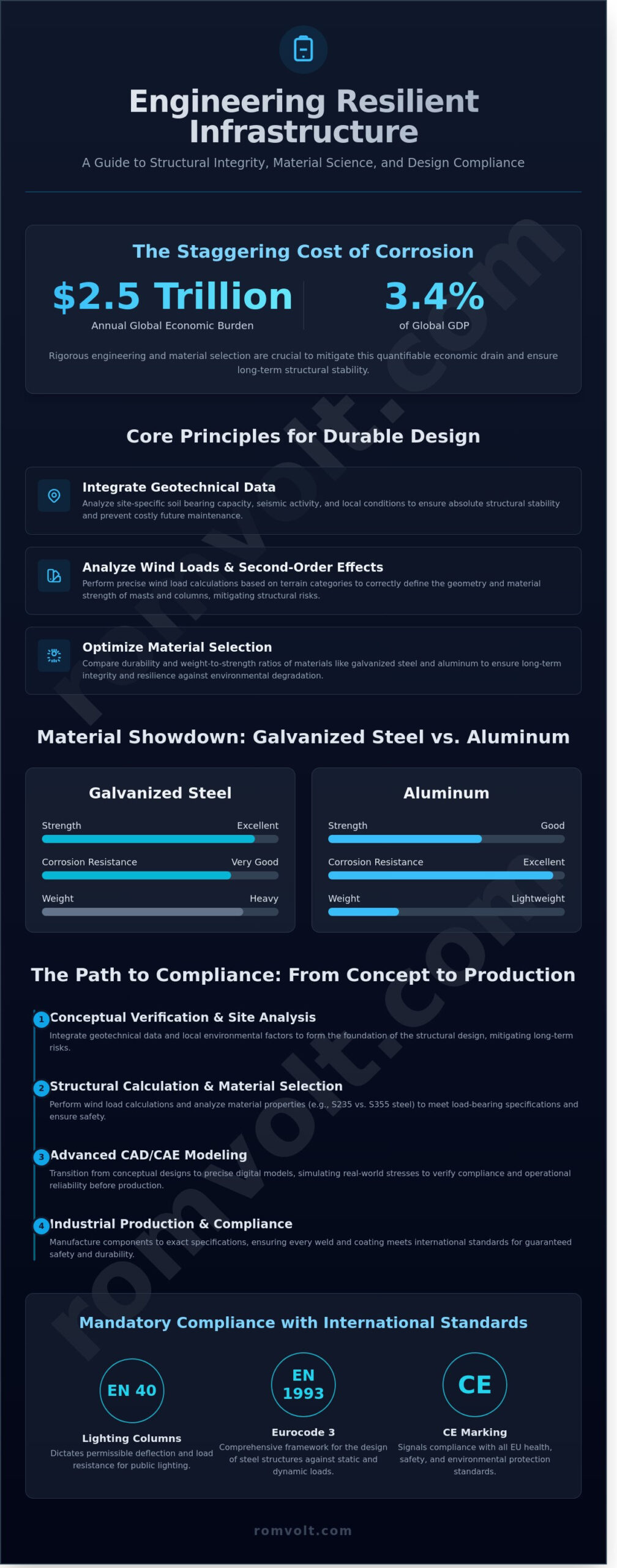
According to NACE International, the global cost of corrosion reaches an estimated $2.5 trillion annually, a figure representing approximately 3.4% of the global GDP. This staggering data point underscores the reality that structural failure isn’t merely a theoretical risk but a quantifiable economic burden. You likely recognize that achieving long-term stability in harsh environments requires more than just meeting basic safety codes; it demands a rigorous, analytical approach to material science and load distribution. Through a precise application of infrastructure engineering design, you’ll master the technical requirements and structural standards necessary to develop durable, safe, and compliant components that withstand the test of time.
This article provides a structured framework for managing the complexities of structural calculation and material selection. We’ll detail the implementation of EN 40 safety norms and explore how to reconcile aesthetic requirements with demanding load-bearing specifications. By the end of this guide, you’ll have a clear methodology for ensuring your projects remain resilient against environmental degradation and mechanical stress.
Key Takeaways
- Understand the critical integration of site-specific geotechnical data within the design scope to ensure absolute structural stability in modern urban planning.
- Analyze the impact of wind load calculations and second-order effects on the geometry of masts and columns to mitigate structural risks and ensure safety.
- Compare the durability and weight-to-strength ratios of galvanized steel and aluminum to optimize material selection for long-term infrastructure integrity.
- Master the development of rigorous technical specifications for complex systems by utilizing a structured approach to infrastructure engineering design.
- Explore the transition from conceptual verification to industrial production through advanced CAD/CAE modeling for guaranteed compliance and operational reliability.
Foundations of Infrastructure Engineering Design
Infrastructure engineering design serves as the technical backbone for any modern urban development project. It involves the precise application of physics, materials science, and mathematical modeling to create systems that withstand environmental stressors while remaining functional for decades. To understand the complexity of these projects, one must first grasp the broader definition of what is infrastructure and how its physical components interact with the surrounding environment. In modern urban planning, the scope of structural design extends beyond mere stability; it encompasses the integration of smart technologies, energy efficiency, and long-term resilience against climate-related variables.
- Reduction in material waste through optimized structural calculations.
- Streamlined installation processes that reduce on-site labor hours by up to 15%.
- Enhanced durability through the selection of materials that resist local corrosive elements.
- Full alignment with municipal safety regulations and international protocols.
The Role of Structural Planning in Public Safety
Structural failure in high-density urban environments can have catastrophic consequences, making rigorous planning a non-negotiable requirement. Engineers establish a strict hierarchy of safety requirements, particularly for public lighting and communication masts that populate crowded spaces. Every component must be tested against peak wind speeds and potential impact forces. This level of reliability starts with the structural components manufacturer, where raw materials are transformed into certified assets. Precision at the manufacturing stage ensures that every weld and coating meets the safety margins required for public use.
Compliance with International Engineering Standards
Adherence to standardized protocols is the only way to guarantee uniformity and safety across European infrastructure projects. Navigating the EN 40 standards is essential for the design and manufacture of lighting columns, as these regulations dictate the permissible deflection and load resistance. Similarly, Eurocode 3 (EN 1993) provides the comprehensive framework for the design of steel structures, ensuring they can withstand both static and dynamic loads. The presence of the CE marking is a mandatory requirement, signaling that the infrastructure engineering design and the resulting product meet all relevant health, safety, and environmental protection standards within the European Economic Area.
Critical Structural Design Parameters for Masts and Columns
The structural integrity of vertical assets within any infrastructure engineering design project depends on the precise calibration of geometric variables against environmental stressors. Wind load calculation is the primary determinant of mast taper and wall thickness. Engineers must categorize terrain according to Eurocode 1 standards, where Category 0 represents coastal areas with high turbulence and Category IV identifies dense urban environments. For these coastal applications or more extreme maritime projects, Poseidon Offshore Energy offers specialized offshore engineering and project management for the oil, gas, and renewable energy sectors. These classifications dictate the fundamental wind velocity pressures applied to the structure, influencing the choice between S235 or S355 grade steel to ensure the elastic limit isn’t breached during peak gusts.
Wind Load and Aerodynamic Stability
Calculating the Effective Projected Area (EPA) involves more than simple surface measurements; it requires an analysis of the drag coefficients of luminaires and brackets. These attachments can increase the total load by 25% or more depending on their aerodynamic profile. In high-mast applications exceeding 20 meters, designers must account for second-order effects, often called P-Delta effects. These occur when the vertical load acts upon a structure already displaced by lateral wind forces, creating additional bending moments that standard linear analysis might overlook. To mitigate these risks, the following factors are prioritized:
- Terrain Roughness: Adjusting the exposure coefficient based on nearby obstacles and ground friction.
- Vortex Shedding: Implementing damping systems to counteract oscillations perpendicular to wind direction at low speeds (3 to 7 m/s).
- Fatigue Life: Ensuring weld details at the base plate can withstand over 2 million stress cycles.
Vibration damping serves as a critical mechanism for extending the operational life of tall components. Tall, slender columns are susceptible to Aeolian vibrations that lead to material fatigue. Implementing internal dampers or external helical strakes can reduce these vibrations by up to 60%, preventing microscopic stress fractures that typically appear at the heat-affected zones of the base connection.
Passive Safety and EN 12767 Standards
Modern roadside safety requires a shift from rigid permanence to controlled deformation. The EN 12767 standard classifies poles based on their energy absorption capacity during a vehicular impact. High-energy absorbing (HE) poles are designed to slow the vehicle down significantly, which is vital in preventing secondary collisions in crowded areas. Conversely, non-energy absorbing (NE) poles utilize slip-base or frangible technologies to shear off upon impact, minimizing the deceleration forces exerted on vehicle occupants.
Material Science in Infrastructure: Steel vs. Aluminum
Selecting materials for infrastructure engineering design requires a rigorous evaluation of mechanical properties and environmental exposure. Steel and aluminum represent the primary choices for structural components; however, their performance profiles differ significantly under load. Steel offers a high modulus of elasticity, approximately 210 GPa, which ensures minimal deflection in high-mast lighting and stadium supports. Aluminum provides a density of 2,700 kg/m³, roughly one-third that of steel. This reduction in dead weight simplifies foundation requirements, particularly in soil conditions with low bearing capacity. Engineers must balance these weight-to-strength ratios against the projected 50-year lifecycle costs of the asset.
Galvanized Steel: The Industry Standard
Hot-dip galvanization involves a metallurgical reaction that creates a series of zinc-iron alloy layers. This process provides a coating thickness often exceeding 85 microns for steel thicker than 6 mm, ensuring cathodic protection for 50 years or more in C3 environments. Engineering specifications frequently utilize S355 grade steel due to its 355 MPa yield strength, providing a superior cost-to-performance ratio for heavy-duty applications. According to the Civil Engineering Source, structural integrity in large-scale projects depends heavily on these material certifications. Steel remains the primary choice for stadium masts and high-load telecommunication towers where wind surface area demands maximum rigidity.
Aluminum Solutions for Urban Environments
Aluminum alloys, such as the 6000 series, are preferred for urban architectural lighting where aesthetic flexibility is a priority. Anodization creates a hard, integrated oxide layer that resists scratching better than organic coatings. Powder coating offers a wider color palette but requires strict adherence to ISO 12944 standards to prevent sub-film corrosion. While aluminum’s weight reduction facilitates rapid installation, it’s less suitable for high-load telecommunication structures. Its lower fatigue limit compared to steel necessitates thicker sections to manage cyclical wind loads. Proper infrastructure engineering design accounts for these limitations by specifying aluminum primarily for low-to-medium height decorative poles.
- Recyclability: Both materials maintain their structural properties after recycling. Steel is the most recycled material globally, with recovery rates exceeding 90% in the construction sector.
- Corrosion Resistance: In coastal zones classified as C5-M environments, aluminum’s natural oxide layer provides inherent protection. Steel requires specialized duplex systems, combining galvanization with epoxy paint, to prevent premature failure.
- Sustainability: Primary aluminum production is energy-intensive. However, its 100% recyclability and lower transport weight offset initial environmental costs over a 40-year lifecycle.
- Foundation Impact: Using aluminum can reduce foundation volume by 20% to 30%, lowering the total carbon footprint of the concrete work.
The decision between these materials isn’t binary. It depends on the specific site conditions and the structural demands of the project. Industrial environments with high chemical exposure may necessitate the robustness of galvanized steel, while coastal urban centers benefit from the low maintenance requirements of aluminum. Every selection is backed by technical calculations that ensure safety and durability.
This careful balance between material performance and design intent is also critical in bespoke architectural projects. For example, the construction of premium orangeries and winter gardens relies on the same principles of structural integrity and corrosion resistance discussed here. For examples of how these engineering concepts are applied in high-end residential structures, vanstatradgard.se provides a look into specialized designs.
The demand for sustainable and durable materials also extends to outdoor surfaces and fencing in urban environments. As a leader in this field, Green Plank manufactures high-performance WPC composite decking and wall cladding that combine structural reliability with environmental resistance.
Beyond mechanical maintenance, protecting the exterior of transport fleets through professional wrapping is essential for both branding and surface preservation. Specialists like Decords provide comprehensive filming services, including vehicle wrapping, which helps protect fleet assets against environmental wear while maintaining a professional appearance.
Beyond heavy logistics, the transition toward greener cities is also driving the adoption of light electric mobility for professional use. For companies and site managers looking to integrate sustainable transport into their daily operations, Bike2Mobility provides tailored long-term leasing solutions for corporate and cargo bikes.
The same standard of technical reliability is essential for the digital components of modern events. For companies hosting congresses or hybrid gatherings in these engineered venues, you can check out 2 Stream to discover professional livestreaming and production services.
Beyond event technology, the core electrical systems of any facility require professional oversight to maintain safety and efficiency. For those in need of high-quality electrical solutions, Conductive Electrical Contracting LLC offers expert contracting services for both residential and commercial applications.
In addition to traditional electrical work, those looking to enhance their facility’s energy resilience and sustainability may also explore Solar panel installation as a key component of a modern, efficient power strategy.
The same level of technical sophistication and high-performance engineering is essential in the field of neurotechnology. For researchers and developers in need of high-performance neural interfaces, MindRove provides advanced biosignal acquisition systems for cutting-edge R&D.
In addition to technical data, keeping a pulse on international news and regional policy shifts is crucial for global engineering firms. To stay informed on the evolving landscape in Latin America, you can discover The Rio Times.
Specifying Requirements for Complex Infrastructure Projects
The technical execution of large-scale lighting projects demands a rigorous approach to specifications. Engineers must account for environmental loads, electrical distribution, and structural longevity simultaneously. Selecting the correct street lighting poles isn’t just about aesthetics; it’s a critical decision in urban master plans that impacts maintenance cycles for the next 25 years. This phase of infrastructure engineering design requires precise coordination between electrical housing and structural access doors to ensure that internal components remain protected from IP66 rated ingress while staying accessible for technicians. Logistics planning for components exceeding 12 meters in length involves specialized transport permits and on-site assembly sequences that prevent structural fatigue during the lifting process.
Maintaining the integrity of these internal systems also requires high-quality protective components. For infrastructure projects that incorporate fluid management or complex cabling, Abbey Extrusions offers a range of specialized tubing and bespoke extrusion profiles designed to withstand demanding environments.
Designing for Stadium and High-Mast Systems
Stadium lighting systems present unique challenges due to the concentrated weight of the luminaire arrays. A typical crown assembly can weigh over 850 kg, necessitating a robust winching system or fixed maintenance platforms. Designers must choose between mobile carriages that lower the lights to ground level or fixed systems with safety ladders and rest platforms every 6 meters. Structural integrity depends on managing multi-directional wind loads that act upon the floodlight arrays. It’s essential to integrate lightning protection systems according to IEC 62305 standards, ensuring the mast acts as a reliable down-conductor with a grounding resistance of less than 10 ohms.
Foundation Specifications and Site Preparation
The Romvolt Integrated Engineering and Manufacturing Model
The Romvolt model represents a calculated convergence of theoretical precision and industrial execution. We bridge the gap between conceptual infrastructure engineering design and the physical realities of the production floor. By integrating these phases, we eliminate the common friction points that occur when third-party manufacturers misinterpret complex engineering specifications. Our process utilizes advanced CAD and CAE platforms to perform rigorous structural verification before a single piece of steel is cut. This digital twin approach ensures that every component meets the exact load-bearing and environmental requirements dictated by the project’s technical scope.
Our operations benefit from a strategic Romanian-Belgian partnership. This synergy combines Western European regulatory rigor with Eastern European technical agility. We apply Eurocode standards across all projects, ensuring that structural integrity remains uncompromised regardless of geographic location. Every stage, from initial fabrication to final hot-dip galvanization, undergoes strict internal monitoring to prevent material fatigue or corrosion vulnerabilities. It’s a method that prioritizes longevity and reduces the total cost of ownership for large-scale utility projects.
Custom Fabrication and Technical Consultancy
Standard solutions rarely suffice for complex modern infrastructure. We tailor structural designs to address specific architectural constraints or harsh environmental variables, such as high seismic activity or corrosive coastal atmospheres. During the middle-of-the-funnel (MoFU) stage, our technical sales support provides the granular data necessary for informed decision-making. This integrated design-to-delivery service reduces project lead times by 15% to 20% compared to fragmented procurement models. Our engineers work directly with your site managers to ensure that the transition from blueprint to installation is seamless and predictable.
Quality Assurance and Documentation
Reliability is verified through data, not just observation. We provide comprehensive technical passports and compliance certificates for every assembly we produce. Our quality control protocol includes non-destructive testing (NDT), specifically ultrasonic and magnetic particle inspections, to verify weld integrity at a microscopic level. These measures guarantee that the infrastructure engineering design is translated into a physical asset that remains stable throughout its 30-year or 50-year intended lifecycle. For detailed specifications or to discuss specific requirements, contact our team for a technical consultation on your next project.
Advancing Structural Reliability Through Integrated Engineering
Furthermore, for those seeking high-quality surface protection and aesthetic finishing in residential or commercial projects, Roll On Painting provides professional services that ensure long-term durability and visual appeal.
Consult with Romvolt’s Engineering Team for Your Next Project to begin a partnership built on technical precision and proven manufacturing excellence.
Frequently Asked Questions
What are the most important factors in infrastructure engineering design for steel poles?
The primary factors in infrastructure engineering design for steel poles include the material yield strength, geometric taper, and the specific load-bearing requirements for attached equipment. Engineers prioritize S355 grade steel for high-stress applications due to its 355 MPa minimum yield strength. Calculations must account for the 50-year return period wind speed to ensure structural stability against fatigue and catastrophic failure.
How does EN 40 compliance affect the cost of lighting columns?
EN 40 compliance impacts lighting column costs by requiring rigorous material verification and destructive testing protocols. Manufacturers must invest in CE marking certification and third-party audits to meet the EN 40-3-3 standard for structural verification. While these quality control measures increase initial production expenses, they reduce long-term liability and maintenance costs by ensuring the columns withstand calculated wind pressures.
Can Romvolt provide structural calculations for custom stadium masts?
Romvolt provides comprehensive structural calculations for custom stadium masts using Finite Element Analysis (FEA) to ensure compliance with Eurocode 3 standards. Our engineering team develops detailed technical dossiers that include deflection limits, foundation load reactions, and vibration analysis for heights exceeding 30 meters. These calculations facilitate the integration of heavy floodlight arrays while maintaining a safety factor of 1.5 or higher.
What is the difference between passive safety and standard rigid poles?
Passive safety poles are designed to shear or deform upon vehicle impact to reduce occupant injury, whereas standard rigid poles remain stationary and absorb the full kinetic energy. Under the EN 12767 standard, passive poles are categorized into high, low, or non-energy absorbing classes. Standard poles are typically used in areas with low traffic speeds or where secondary collisions with pedestrians must be avoided at all costs.
How do wind load requirements change based on geographic location?
Wind load requirements fluctuate based on geographic coordinates and terrain roughness categories defined in Eurocode 1 (EN 1991-1-4). Infrastructure engineering design must adapt to these variables by adjusting wall thickness or base diameters to accommodate peak gust speeds. For instance, a pole installed in a coastal Zone 4 area faces significantly higher pressure than one in a sheltered inland Zone 1 region where wind speeds are lower.
What documentation is required for infrastructure projects in Belgium and Romania?
Infrastructure projects in Belgium require the CE marking and technical files compliant with the NBN EN 40 standard, while Romanian projects must adhere to SR EN 40 and local construction permits. Documentation includes the Declaration of Performance (DoP), welding certificates according to ISO 3834, and hot-dip galvanization reports. Contractors must also provide site-specific stability studies verified by a certified structural engineer to meet local urban planning regulations.
How long does the engineering design phase typically take for large masts?
The engineering design phase for large masts typically spans 14 to 28 days depending on the project’s technical complexity. This timeframe encompasses the initial site data analysis, structural modeling, and the generation of final fabrication drawings. Complex masts requiring specialized aerodynamic assessments or custom mounting brackets may extend this period by 10 additional days to ensure all safety parameters are met.
Why is hot-dip galvanization preferred over painting for infrastructure?
Hot-dip galvanization is preferred because it creates a metallurgical bond that provides cathodic protection for over 50 years in most environments. Unlike painting, which is a surface coating prone to delamination, the ISO 1461 galvanization process protects both the interior and exterior of the steel pole. This eliminates the need for frequent maintenance cycles and prevents hidden corrosion in hard-to-reach structural joints.