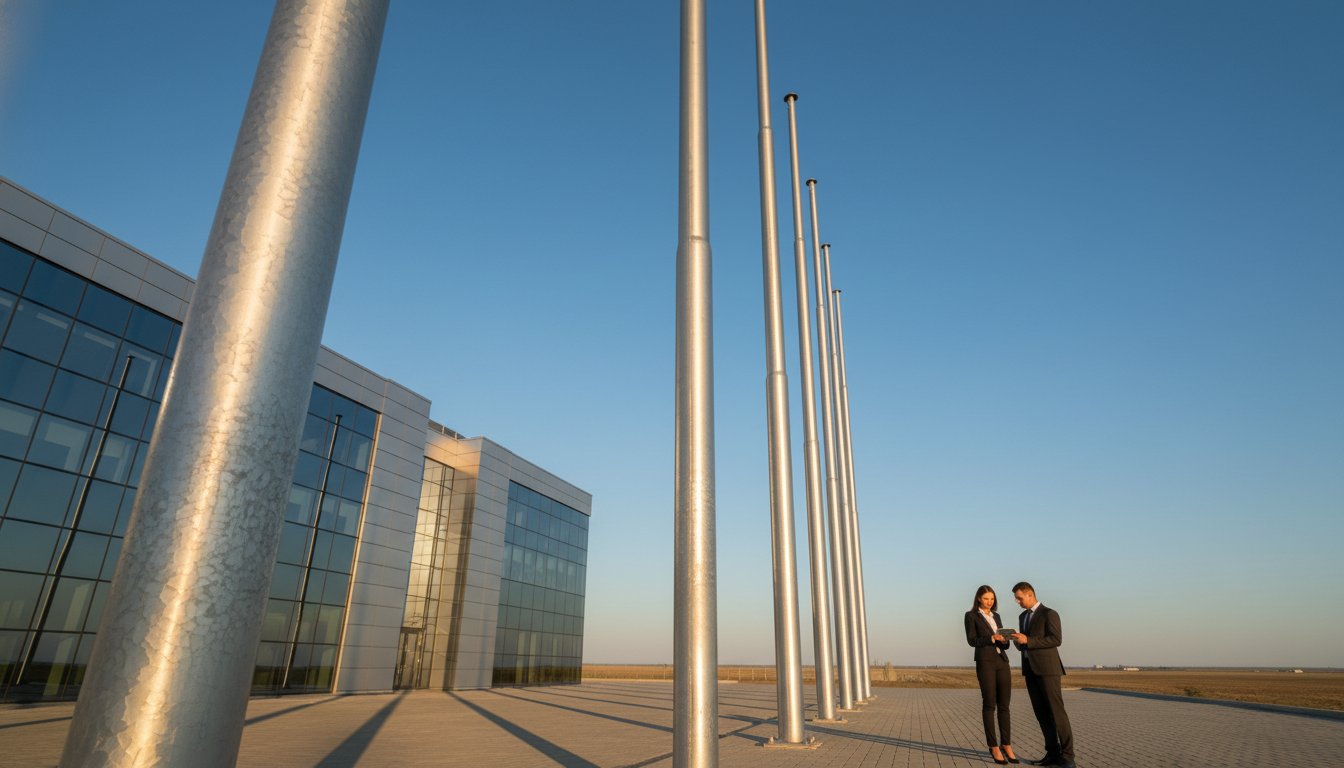
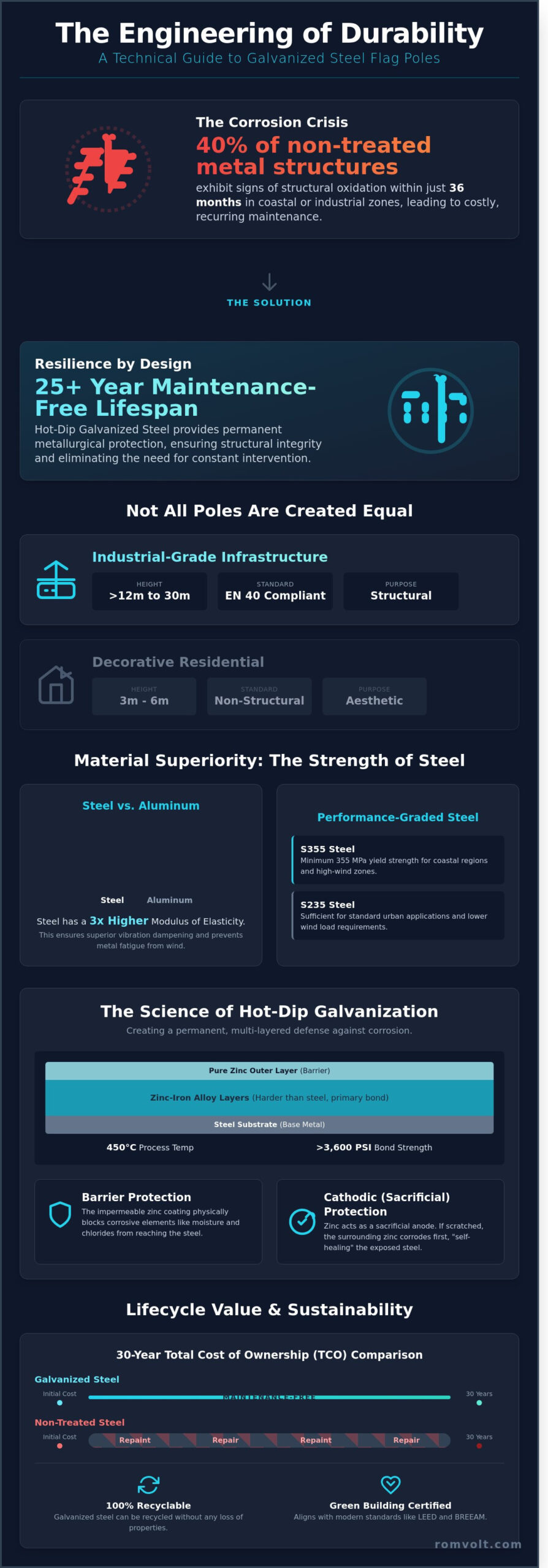
Recent industry data indicates that 40% of non-treated outdoor metal structures exhibit signs of structural oxidation within just 36 months of installation in coastal or industrial zones. It’s a reality that engineers and facility managers face when they prioritize initial cost over long-term durability. You’ve likely seen the drain on annual budgets caused by the constant maintenance and repainting of non-galvanized structures. We understand that in the industrial sector, reliability isn’t just a preference; it’s a safety requirement. Selecting high-quality galvanized steel flag poles ensures that your infrastructure remains resilient against the elements without the need for constant intervention.
This technical guide provides the expertise you need to master the engineering requirements and durability standards for industrial-grade poles as we approach 2026. You’ll learn how to achieve a maintenance-free lifespan exceeding 25 years while ensuring full compliance with EN 40 and local structural regulations. We’ll analyze the specific wind load calculations necessary for high-wind events and explore how these poles integrate with your existing lighting infrastructure to provide a unified, professional aesthetic.
Key Takeaways
- Learn to specify industrial-grade galvanized steel flag poles by understanding the critical distinctions between municipal infrastructure and decorative residential products.
- Understand the metallurgical science behind hot-dip galvanization and how zinc-iron alloy layers provide superior barrier and cathodic protection.
- Master the technical calculations for wind load and flag drag to ensure your installation remains structurally resilient in specific geographic zones.
- Determine the optimal configuration for pole height and halyard systems to meet the rigorous engineering requirements of modern commercial sites.
- Evaluate the role of integrated engineering and custom fabrication in delivering durable, compliant solutions for complex architectural projects.
Understanding Galvanized Steel Flag Poles as Infrastructure
In the context of modern municipal and commercial architecture, galvanized steel flag poles serve as critical infrastructure components rather than simple decorative fixtures. Unlike residential poles that typically range from 3 to 6 meters in height, industrial-grade masts are engineered to exceed 12 meters, often reaching 30 meters in high-exposure zones. These structures must withstand the same rigorous static and dynamic load requirements as street lighting columns, often adhering to EN 40 standards. The selection of steel over aluminum for these heights is a decision rooted in structural integrity. Steel provides a modulus of elasticity approximately three times higher than that of aluminum alloys. This property ensures superior vibration dampening during turbulent wind conditions, preventing the harmonic oscillations that lead to metal fatigue over time.
Material Composition and Structural Superiority
Engineers specify steel grades like S235 or S355 based on the projected wind zone and the specific height of the installation. While S235 is sufficient for standard urban applications, S355 steel offers a minimum yield strength of 355 MPa, providing the necessary resilience for poles located in coastal regions or open plains. Wall thickness plays a decisive role in preventing mid-pole buckling. For a 12-meter mast, a wall thickness of 4mm is often the baseline requirement to maintain a safety factor of 1.5 under peak wind loads. The inherent mass of steel provides a stable foundation for heavy flags, which exert significant drag forces on the structure during storm events.
The Lifecycle Value of Galvanized Steel
The long-term economic viability of galvanized steel flag poles is defined by the hot-dip galvanization process, which creates a permanent metallurgical bond between the zinc coating and the steel substrate. This protection allows for a 30-year maintenance-free lifecycle in C3-rated environments, significantly reducing the total cost of ownership compared to painted or fiberglass alternatives. From a sustainability perspective, galvanized steel is 100% recyclable without any loss of properties, aligning with modern green building certifications like LEED or BREEAM. During the transport and installation phase, the high hardness of the zinc-iron alloy layers provides exceptional resistance to mechanical damage, ensuring the protective barrier remains intact even under rough handling on industrial construction sites.
The integration of these structures requires a deep understanding of existing street lighting infrastructure. Many commercial flag poles use the same mounting templates and foundation bolts as lighting columns, allowing for a unified aesthetic and simplified procurement process. This standardization ensures that technical teams can apply familiar maintenance protocols, further enhancing the operational efficiency of the facility.
This same thinking applies to other site infrastructure, like security fencing, where sourcing from a specialized online supplier can simplify procurement. For instance, tradefencingonline.co.uk offers trade-grade galvanized materials that align with these durability principles.
This principle extends to the soft landscaping that completes a professional site. Sourcing high-quality ornamental and fruit trees is crucial for creating a lasting aesthetic that complements the structural elements. For projects in the region, a specialized supplier like Kaposvár Kertészet (Szoliter Kert) can provide the necessary botanical infrastructure.
The Science of Corrosion Resistance: Hot-Dip Galvanization
The metallurgical process of hot-dip galvanization (HDG) represents a fundamental shift from simple surface coating to a permanent structural change. When steel components are immersed in a bath of molten zinc at temperatures reaching 450°C (842°F), a series of zinc-iron alloy layers form through a diffusion process. This creates a bond with a typical adhesion strength exceeding 3,600 psi. Unlike industrial painting, which sits on the surface, HDG becomes an integral part of the metal. These galvanized steel flag poles benefit from a multi-layered defense system. The outer layer consists of pure zinc, while the inner layers are composed of zinc-iron alloys that are actually harder than the base steel itself, providing exceptional abrasion resistance.
This protection operates through two distinct mechanisms: barrier protection and cathodic protection. The zinc layers prevent corrosive elements like moisture and chlorides from reaching the steel substrate. However, the cathodic property is what distinguishes HDG from other methods. Zinc is more electronegative than steel; therefore, it acts as a sacrificial anode. If the surface is scratched or drilled during installation, the surrounding zinc will prioritize its own oxidation to protect the exposed steel. This self-healing characteristic ensures that minor mechanical damage doesn’t lead to structural failure. In comparison, electro-galvanization provides a significantly thinner coating, often less than 15 microns, which lacks the long-term durability required for heavy-duty commercial applications.
ASTM and ISO Standards for Galvanization
Engineering precision requires strict adherence to ISO 1461, which specifies the minimum coating thickness and quality requirements for hot-dip galvanized articles. For hollow structures, internal and external galvanization is a critical safety requirement. Condensation inside a pole can lead to “hidden” corrosion if the interior is left untreated. Quality control protocols involve magnetic thickness gauges to ensure the coating meets the 85-micron minimum for structural steel. Testing also includes salt spray resistance evaluations and adhesion checks to guarantee the pole can withstand decades of environmental exposure. Engineers often utilize the ASCE 7-16 standards to calculate how material thickness and galvanization quality impact wind load performance in specific geographic zones.
Aesthetics and Duplex Systems
A Duplex System involves the application of a powder coating or liquid paint over a galvanized base. This configuration is not merely aesthetic; it provides a synergistic effect where the combined lifespan is 1.5 to 2.3 times longer than the sum of the individual parts. In coastal environments located within 5 miles of the sea, this double-layer protection is essential to combat high salinity. Proper surface preparation is mandatory for this system to succeed. Following ASTM D6386 guidelines, the galvanized surface must be sweep-blasted or chemically treated to ensure the powder coating adheres correctly. For projects requiring specific brand colors, these galvanized steel flag poles offer both visual customization and a 50-year maintenance-free lifecycle. Organizations looking to implement high-reliability infrastructure should consider these industrial structural solutions for their long-term durability and safety benefits.
To ensure this visual consistency extends beyond external infrastructure, Coker Exhibition Systems Ltd (CokerExpo) offers bespoke wallpaper and exhibition displays that allow organizations to integrate their brand identity into the very fabric of their interior environments.
Engineering and Wind Load Calculations
The structural integrity of galvanized steel flag poles depends on managing “Flag Drag.” This phenomenon occurs because a flag represents a dynamic surface area that increases wind resistance by approximately 2.5 times compared to a bare pole. Engineers must calculate the Effective Projected Area (EPA) based on the specific dimensions of the flag. Geographic location is the primary variable in these calculations. For instance, a pole installed in a coastal region requires a design capable of withstanding 180 km/h gusts, whereas inland installations might only require a 120 km/h threshold.
Aerodynamic trade-offs define the choice between cone-tapered and stepped designs. Cone-tapered poles offer superior performance because they distribute stress evenly along the shaft, reducing the risk of localized fatigue. Stepped designs, while often more cost-effective for smaller applications, create stress concentrations at the transition zones. The choice of halyard system also impacts resistance. Internal systems reduce the wind profile of the mast and eliminate the repetitive mechanical wear caused by external ropes striking the metal surface during high-velocity winds.
- Wind load zones dictate the minimum wall thickness, often starting at 3mm for standard heights.
- Flag Drag coefficients vary based on material weight, such as 110g/sqm polyester versus heavier nylon.
- Internal halyards protect the rigging from UV degradation and wind-induced friction.
Structural Calculations for Flag Masts
Calculating the bending moment at the base plate is critical for preventing catastrophic failure during peak wind events. Engineers focus on the “Natural Frequency” to ensure the pole doesn’t enter a state of resonant vibration. If the wind frequency matches the pole’s natural frequency, the resulting oscillation can lead to rapid metal fatigue. Romvolt utilizes specialized software to generate technical documentation that verifies every joint against a 1.5x safety factor. This rigorous process ensures that our galvanized steel flag poles meet the exact specifications required by industrial safety standards.
Foundation Systems and Stability
Stability starts below the surface through precise soil pressure analysis. This data determines if a standard 1.2-meter deep foundation is sufficient or if a larger footprint is necessary to prevent leaning. While on-site pouring remains the standard for masts exceeding 10 meters, pre-cast concrete blocks offer a controlled alternative for smaller installations. Anchor bolts, typically manufactured from high-strength Grade 55 steel, must be aligned to the base plate with a vertical tolerance of less than 0.5 degrees. This precision ensures the load is transferred directly to the foundation without creating parasitic torque on the mounting hardware.
Selection Criteria: Specifying the Right Flag Pole
Selecting a commercial mast requires a rigorous technical evaluation of the installation site and its environmental variables. Engineers must determine the optimal height by analyzing the surrounding vertical infrastructure; a mast should typically stand 2.5 to 4 meters taller than the nearest lighting poles or rooflines to ensure clear visibility and laminar airflow. This height differential prevents the flag from becoming obscured or subjected to the erratic turbulence generated by adjacent structures. When choosing between internal winch systems and external cleat halyards, security and noise mitigation are the primary drivers. Internal systems house the cables within the shaft, effectively eliminating the rhythmic clanging of ropes against the metal in wind speeds exceeding 35 km/h and preventing unauthorized tampering in public spaces.
The mechanical integrity of galvanized steel flag poles depends heavily on the selection of specialized accessories. Revolving trucks are essential for 360-degree rotation, allowing the flag to align with the wind direction and reducing the torque applied to the mast’s foundation. For large-scale installations, 5 kg or 10 kg counterweights are necessary to keep the halyard taut, ensuring the flag remains extended even during low-pressure weather shifts. Safety isn’t an afterthought; lightning protection is a mandatory technical requirement. Every mast must be integrated into the site’s earthing grid with a grounding resistance measured below 10 ohms to comply with standard safety protocols and insurance mandates.
Application-Specific Specifications
Municipal projects in public squares require masts that balance aesthetic sobriety with extreme durability. In contrast, industrial hubs and maritime ports demand hot-dip galvanization that meets ISO 1461 standards to survive C5-M corrosive environments. Stadium venues often require masts exceeding 30 meters in height, where the structural calculation must account for the massive sail area of flags that often exceed 60 square meters. These large-scale masts utilize heavy-duty galvanized steel flag poles designed to withstand peak gust velocities of 140 km/h without permanent deformation.
Compliance and Certification
Technical specifications must align with EN 40 standards, which, while originally designed for lighting columns, provide the benchmark for wind load resistance and structural deflection in masts. It’s vital to verify the CE marking for all structural steel components to ensure the material’s traceability and load-bearing capacity. During the project handover, the documentation package should include the galvanization certificate, the verticality report showing a deviation of less than 0.5%, and the earthing system’s resistance test results. These documents are indispensable for long-term maintenance and insurance validation.
Ensuring the structural integrity of your infrastructure requires precise engineering and certified components. Explore our range of high-performance industrial solutions to secure your next project.
The Romvolt Advantage in Mast Fabrication
Romvolt operates through a vertically integrated framework that bridges the gap between conceptual engineering and specialized logistics. Our facility manages the entire lifecycle of galvanized steel flag poles, ensuring every unit adheres to EN 40 and EN 1090 standards. This technical rigor stems from our deep-seated experience as a structural components manufacturer, where precision is a baseline requirement rather than an objective. We apply the same structural integrity protocols to flag masts as we do to our street lighting poles, creating a synergy that benefits large-scale infrastructure projects requiring uniform durability.
Customization remains a core pillar of our production. We don’t just offer standard heights; our engineering team develops bespoke solutions for unique architectural requirements. Whether it’s a reinforced base for high-traffic public squares or specialized mounting brackets for corporate headquarters, we utilize S355JR grade steel to ensure the final product withstands mechanical stress. Every project undergoes a rigorous design review to verify that the mast’s deflection limits meet local safety codes. For projects requiring specialized engineering solutions, our expertise in custom mast fabrication Belgium ensures compliance with Eurocode 3 standards and site-specific environmental conditions.
Our Manufacturing Excellence
Our European production lines utilize automated tapering processes to achieve optimal aerodynamic profiles. Precision welding is conducted by specialists certified under ISO 3834-2 to prevent stress corrosion cracking at the base plate. Handling oversized logistics requires a dedicated fleet capable of transporting components exceeding 12 meters in length. We provide technical support for planners during the specification phase, offering CAD files and wind load calculations based on Eurocode 1 parameters to ensure galvanized steel flag poles remain stable under extreme pressure.
Partnering for Longevity
Romvolt assists municipal and industrial entities in navigating the complexities of public tenders. We deliver comprehensive technical documentation, including material certificates and hot-dip galvanization reports that confirm a coating thickness of at least 85 microns. Our portfolio includes successful installations in climate zones where wind speeds reach 140 km/h, conditions that typically cause standard poles to fail. In a recent 2023 project for a coastal industrial facility, we implemented specialized duplex coatings to withstand 1,500 hours of salt spray testing, ensuring the masts remain maintenance-free for decades. If you’re planning a high-stakes installation, contact our technical sales team for a consultation to review your site-specific requirements and structural needs.
Optimizing Long-Term Infrastructure Performance
Selecting high-performance galvanized steel flag poles for 2026 requires strict adherence to technical benchmarks that guarantee structural longevity. It’s not just about aesthetics; it’s about the 85-micron zinc coating thickness mandated by ISO 1461 standards that prevents oxidation for over 30 years in industrial environments. Engineering teams must prioritize compliance with EN 40 structural standards to ensure every mast withstands specific regional wind loads exceeding 120 km/h. Romvolt implements these rigorous protocols during every fabrication phase, managing the complexity of specialized logistics for oversized infrastructure components up to 12 meters in length. Choosing a partner who understands the intersection of metallurgical science and structural load requirements eliminates the risk of premature failure. Our commitment to precision engineering ensures your project meets all safety certifications while maintaining a professional visual profile. We’re ready to provide the technical documentation and structural calculations necessary for your next large-scale installation. We look forward to supporting your engineering objectives with reliable, high-spec solutions.
Request a Technical Quote for Galvanized Steel Masts
Frequently Asked Questions
What is the lifespan of a hot-dip galvanized steel flag pole?
A hot-dip galvanized steel flag pole typically achieves a service life exceeding 50 years in rural or urban environments according to EN ISO 1461 standards. In coastal areas with high salinity, this duration might decrease to 25 or 30 years without additional coating. The metallurgical bond created during the 450 degree Celsius immersion process ensures the zinc layer remains intact against mechanical impacts. This durability makes galvanized steel flag poles a superior long term investment for industrial sites.
How do wind load ratings affect the choice of flag pole height?
Wind load ratings determine the maximum permissible height by calculating the pressure exerted on both the pole surface and the flag’s surface area. According to EN 1991-1-4 standards, a 12-meter pole must withstand gusts of 28 meters per second in specific regional wind zones. If the local wind speed exceeds these parameters, engineers must either reduce the pole height or increase the wall thickness to 4 millimeters or more to ensure structural integrity.
Is it better to use a cone-tapered or a stepped steel pole?
Cone-tapered poles offer superior stress distribution compared to stepped designs because their continuous diameter reduction eliminates stress concentration points at the joints. While stepped masts are often 15% cheaper to manufacture, they’re more susceptible to fatigue at the weld transitions. A tapered profile improves aerodynamic performance by reducing the drag coefficient. This is critical for masts exceeding 10 meters in height where oscillation can lead to structural failure over time.
Can galvanized steel flag poles be painted to match corporate branding?
You can customize galvanized steel flag poles with any RAL color using a duplex coating system that combines galvanization with electrostatic powder painting. This process involves a chemical pretreatment to ensure the paint adheres to the zinc layer, extending the maintenance interval by 1.5 to 2 times compared to paint alone. Most corporate projects specify a 60 to 80 micron paint thickness to ensure visual consistency with brand guidelines and environmental resistance.
What foundation type is best for a 15-metre steel flag pole?
A 15-metre steel pole requires a reinforced concrete block foundation using C25/30 grade concrete and a pre-engineered anchor bolt cage. For a mast of this height, the foundation block typically measures 1.2 by 1.2 meters with a depth of 1.5 meters to reach the frost line. The use of a template plate ensures the four or six anchor bolts align perfectly with the pole’s base plate during the installation phase to prevent structural misalignment.
Are steel flag poles safer than aluminum poles in high-wind areas?
Steel masts provide greater safety in high-wind areas because the modulus of elasticity for steel is 210 GPa, which is three times higher than aluminum’s 70 GPa. This structural stiffness means a steel pole won’t deflect as much under a 100 km/h wind load. While aluminum is lighter, it’s more prone to metal fatigue and permanent deformation when subjected to the heavy cyclic loading of large flags in open industrial zones.
While steel is the clear choice for this specific industrial application, for other outdoor structures where different load requirements apply, aluminum offers excellent corrosion resistance and modern aesthetics. For those considering architectural enhancements for commercial or residential spaces, it’s worthwhile to explore Aluminium Pergola designs and their benefits.
Ultimately, whether for flag poles or the building itself, the goal is long-term resilience. The roof is a facility’s most critical defense against the elements, and in areas with challenging weather, ensuring its integrity with professional installation is vital. For commercial properties, specialists such as Roof Top Experts provide the necessary expertise for durable, weather-resistant roofing systems.
What is the difference between internal and external halyard systems?
Internal halyard systems secure the rope inside the mast behind a lockable door, which prevents unauthorized access and eliminates the noise of ropes hitting the metal. External systems utilize a simple cleat and pulley mounted on the exterior, making them easier to maintain but more vulnerable to vandalism. Statistics show that internal systems reduce maintenance calls by 40% in public or unsupervised commercial areas because the mechanism is protected from environmental wear.
Does Romvolt provide structural calculations for custom flag masts?
Romvolt delivers detailed structural calculations for all custom masts to ensure full compliance with national safety standards and Eurocode regulations. Our engineering team provides a technical file that includes wind resistance data, foundation specifications, and material certifications. This rigorous approach ensures that every installation meets the 1.5 safety factor required for industrial infrastructure. We don’t compromise on precision because our clients require documented proof of structural stability for insurance and safety audits.