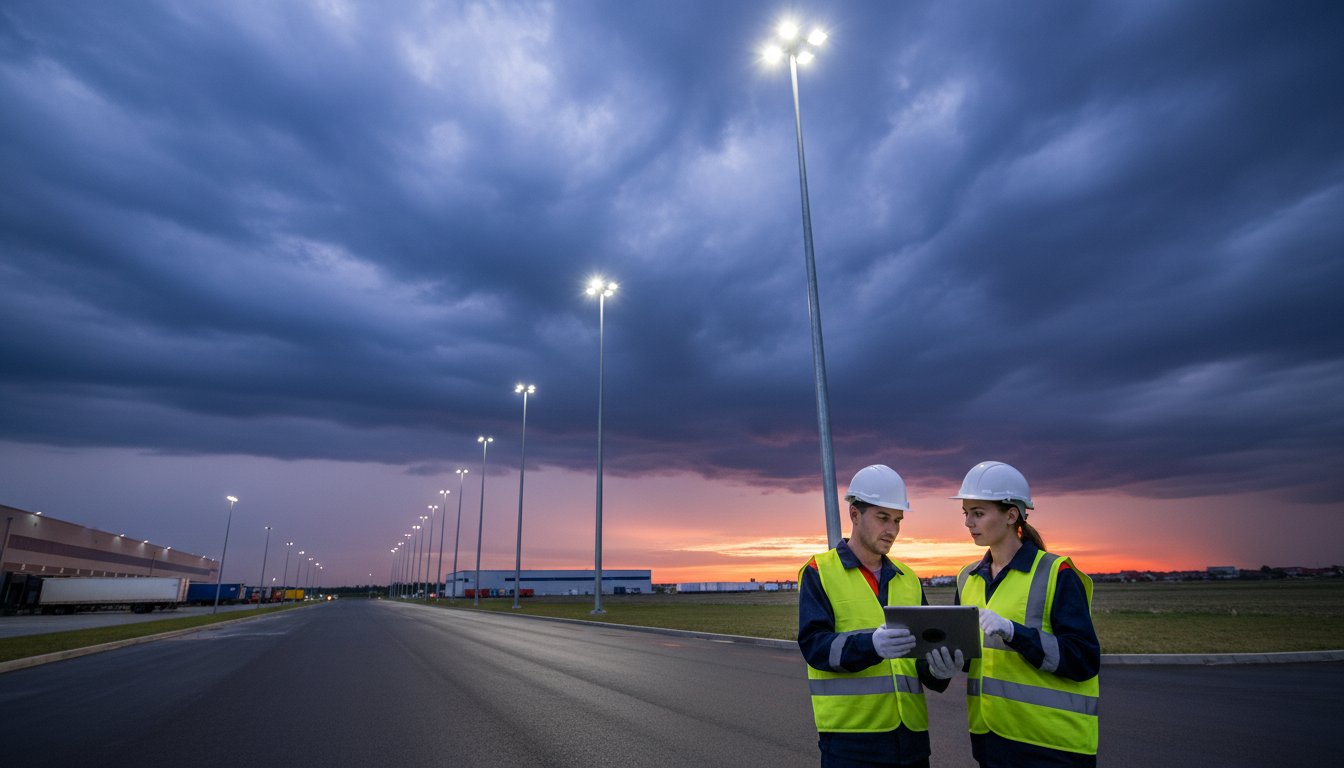
A marginal error of 0.05 in the drag coefficient calculation during the design phase often leads to catastrophic structural failure when industrial lighting poles face peak wind gusts exceeding 140 km/h. Engineering a resilient infrastructure requires more than just selecting a product; it demands a rigorous adherence to mechanical stress variables and environmental classifications. You likely understand that in large-scale projects, the cost of premature corrosion or non-compliance isn’t just a budgetary issue, but a fundamental risk to public safety and operational continuity.
This guide ensures your projects achieve full compliance with EN 40 standards while securing a low-maintenance lifespan exceeding 25 years in even the most aggressive C5-M maritime environments. We’ll provide the technical framework necessary to master the complex specifications and engineering standards required to implement durable, high-performance systems. We’ll examine the critical intersection of material science, wind load calculations, and protective coating technologies that define modern infrastructure excellence, ensuring every component meets the highest safety benchmarks and technical requirements.
Key Takeaways
- Identify the essential mechanical properties of S235 and S355 steel grades required to ensure structural resilience in demanding infrastructure environments.
- Navigate the complexities of EN 40 compliance and the role of finite element analysis (FEA) in validating the structural integrity of lighting columns.
- Implement robust corrosion protection strategies by analyzing the performance of barrier coatings versus sacrificial cathodic protection in maritime and chemical zones.
- Optimize site-specific configurations by matching structural capacity to specialized requirements, including the deployment of high-mast systems for large-scale hubs.
- Understand the critical importance of custom engineering and precision manufacturing when selecting industrial lighting poles for non-standard project specifications.
Technical Specifications of Industrial Lighting Poles
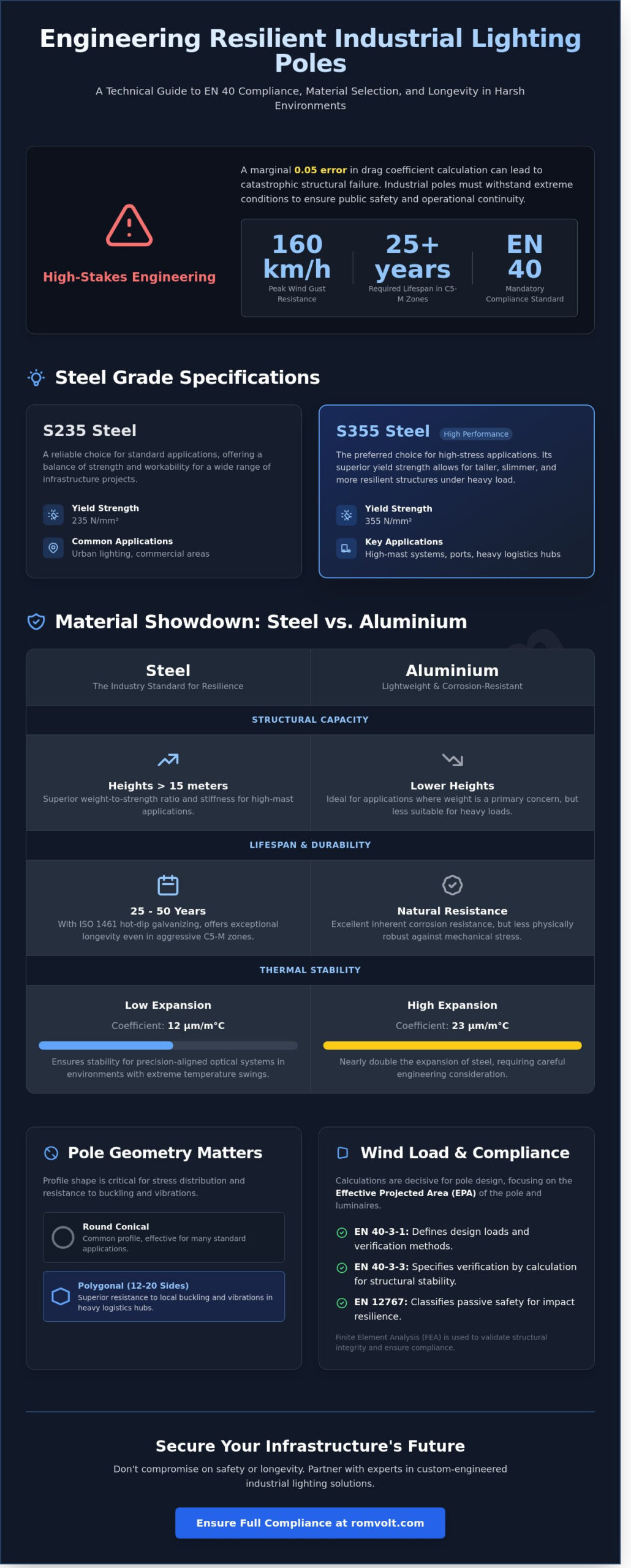
Industrial lighting poles represent a specialized category of infrastructure, engineered to perform under mechanical stresses that would compromise standard commercial supports. While urban lighting focuses on aesthetics and basic illumination, industrial-grade masts prioritize structural resilience and the capacity to support heavy luminaire arrays at significant heights. The engineering foundation of these structures relies on high-tensile materials, primarily S235 and S355 grade steel. S355 steel is often the preferred choice for high-mast applications in ports because its yield strength of 355 N/mm² allows for taller structures with thinner wall sections, optimizing both weight and wind resistance. It’s a significant advancement when we examine the history of lighting poles, which has transitioned from simple cast iron to these sophisticated, high-strength alloys.
Pole geometry is equally critical for effective stress distribution. While round conical profiles are common, polygonal profiles featuring 12, 16, or 20 sides offer superior resistance to local buckling. These industrial lighting poles utilize their faceted shape to increase the second moment of area, providing better rigidity against the constant vibrations found in heavy logistics hubs. Stepped profiles are also used for specific heights, though they require precise welding at the transition points to maintain structural integrity under fatigue.
Load-Bearing Requirements and Wind Resilience
Wind load calculations are the most decisive factor in determining the diameter and wall thickness of a mast. Engineers must calculate the Effective Projected Area (EPA), which combines the surface area of the pole and the mounted luminaires. In a coastal port environment, a single mast might support ten floodlights, each presenting an EPA of 0.42 square meters. This creates immense drag during storms. Planning must account for dynamic loads, which are the fluctuating forces caused by wind gusts, rather than just static weight. Standards such as EN 40-3-1 require these structures to withstand wind speeds often exceeding 145 kilometers per hour in exposed maritime zones.
Material Selection: Steel vs. Aluminium in Industry
The choice between steel and aluminium depends on the specific demands of the industrial site. Steel is the industry standard for heights exceeding 15 meters due to its high weight-to-strength ratio and stiffness. When protected by hot-dip galvanizing according to ISO 1461, steel components achieve a service life of 25 to 50 years in aggressive environments. Aluminium is utilized for its natural corrosion resistance and lower weight, which can reduce foundation costs by approximately 20%. However, aluminium’s higher thermal expansion coefficient, roughly 23 micrometers per meter per degree Celsius, requires careful consideration in environments with extreme temperature swings. For high-mast requirements in heavy industry, steel’s lower expansion rate of 12 micrometers ensures better stability for precision-aligned optical systems.
Structural Design Standards and Compliance Frameworks
The structural integrity of industrial lighting poles is a prerequisite for operational continuity in harsh environments. Engineering teams must adhere to the EN 40 standard series, which governs the design and verification of lighting columns across Europe. These regulations prevent catastrophic failures during extreme weather events, such as wind gusts in coastal ports that frequently reach 160 kilometers per hour. To achieve this, Finite Element Analysis (FEA) serves as a critical tool for identifying potential stress concentrations in the pole’s geometry before the manufacturing phase begins. Technical documentation derived from these analyses is essential for municipal approvals and insurance audits, providing a verifiable trail of compliance that protects the asset owner from liability.
- EN 40-3-1: Defines the basis for design loads and verification methods.
- EN 40-3-3: Specifies the verification by calculation for structural stability.
- EN 12767: Classifies passive safety levels for impact resilience in traffic areas.
Navigating EN 40 Standards for Industrial Columns
Maximum tip displacement is a vital metric defined within EN 40-3-3. Excessive deflection disrupts light uniformity and creates glare, which can compromise safety in 24/7 port operations where precision is mandatory. Standardized testing protocols also address fatigue resistance, particularly for poles equipped with heavy luminaires or communication equipment. These tests simulate long-term oscillations to ensure the structure doesn’t develop micro-cracks over its 25-year service life. Compliance with these standards ensures that the lighting system remains stable under both static and dynamic loads, maintaining the planned photometric distribution across the industrial site.
Passive Safety and Impact Resilience
Modern infrastructure safety relies heavily on EN 12767, which classifies the behavior of poles during vehicle impacts. In industrial logistics hubs, the choice between energy absorbing and non-energy absorbing poles is determined by rigorous risk assessments of the surrounding equipment and personnel. Engineers often reference the Task Force 13 Lighting Pole Hardware Guide to select components that minimize injury risks while protecting expensive industrial assets. For example, energy-absorbing industrial lighting poles are preferred in dense loading zones to prevent a vehicle from rebounding into hazardous material storage after a collision.
Romvolt provides the technical depth needed to align these safety choices with your facility’s operational requirements. Our engineering approach ensures that every mast is a calculated component of a larger, secure system. You can review our compliance frameworks to see how we manage these complex engineering standards to deliver long-term reliability for your infrastructure projects.
Corrosion Protection and Longevity in Harsh Environments
Corrosion in maritime and heavy industrial zones isn’t merely an aesthetic issue; it’s a direct threat to the structural integrity of industrial lighting poles. In port environments, chloride ions from salt spray act as catalysts for electrochemical reactions, while chemical hubs introduce sulfur dioxide that creates an acidic micro-environment. To reach a 30-year zero-maintenance window, engineering must shift from simple barrier protection to sacrificial cathodic protection. While traditional paint acts as a shield, it’s vulnerable to microscopic breaches. In contrast, sacrificial protection utilizes zinc to oxidize instead of the steel, maintaining the mast’s strength even if the surface is physically compromised.
The success of any protective layer depends on the initial surface preparation. Statistics from NACE International indicate that approximately 80% of coating failures are the direct result of poor substrate preparation. For industrial masts, achieving an Sa 2.5 cleanliness level (near-white metal blast cleaning) is mandatory. This process removes mill scale, rust, and contaminants, creating a specific surface profile that ensures maximum adhesion for subsequent protective layers. Without this rigorous mechanical cleaning, even the most advanced coatings will delaminate within 5 to 7 years in C5-M (Marine) or C5-I (Industrial) environments.
The Critical Role of Hot-Dip Galvanization
Compliance with ISO 1461 defines the standard for galvanized coatings on iron and steel articles. This process involves immersing the industrial lighting poles in a bath of molten zinc at roughly 450 degrees Celsius. The result isn’t just a coating but a metallurgical bond where the zinc and steel merge to form a series of zinc-iron alloy layers. These layers are often harder than the base steel itself, providing exceptional resistance to abrasion during transport and installation. For hollow structural sections, this immersion is vital because it ensures internal protection. It prevents “inside-out” corrosion, a common failure point in masts where moisture traps inside the tube and weakens the structure invisibly.
Duplex Systems: Powder Coating over Galvanization
In high-salinity or high-UV environments, a duplex system provides a synergistic effect that exceeds the sum of its parts. By applying a specialized powder coating over a galvanized base, the lifespan of the structure increases by a factor of 1.5 to 2.3 times the combined individual lifespans of each coating. This happens because the powder coating protects the zinc from oxidation, while the zinc prevents corrosion from spreading if the powder layer is scratched. For equatorial or high-altitude sites, we specify UV-stable architectural grade powders to prevent chalking and color fading. This approach also facilitates mandatory safety color coding, such as aviation orange and white, or corporate branding, ensuring the mast remains a functional and compliant asset for decades.
Selection Framework for Specialized Industrial Applications
Selecting industrial lighting poles for high-intensity environments requires a methodology rooted in structural physics and long-term maintenance planning. Engineers must prioritize the Effective Projected Area (EPA) calculations to ensure the mast remains stable under wind loads that often exceed 140 km/h in coastal port areas. For hubs covering more than 50,000 square meters, the implementation of high-mast lighting systems becomes a technical necessity rather than a preference. This infrastructure doesn’t just provide illumination; it serves as a central node for 5G telecommunications and IoT sensor arrays, consolidating multiple utility functions into a single vertical asset.
Logistics for these components require precise coordination. Masts exceeding 12 meters are typically manufactured in telescopic sections to facilitate transport on standard 13.6-meter trailers. On-site assembly using hydraulic press-fit methods ensures the structural continuity required for heavy-duty applications. It’s vital to plan the delivery sequence to match the foundation curing schedule, preventing site congestion in active industrial zones.
High-Mast Systems for Ports and Logistics Hubs
In environments where downtime costs thousands of euros per hour, specifying mobile crown high-mast systems is the standard for operational efficiency. These systems allow technicians to lower the luminaire ring to ground level, eliminating the need for specialized crane rentals during routine maintenance. For masts reaching heights of 25 to 30 meters, the structural footprint must account for reinforced concrete foundations that penetrate deep enough to counteract soil liquefaction risks common in reclaimed port lands. Winch mechanisms should feature redundant braking systems and stainless steel wire ropes to withstand salt-spray corrosion over a 25-year service life.
Mounting Solutions and Bracket Configurations
Custom bracket design is essential when deploying multi-fixture arrays that combine narrow-beam floodlights with wide-angle area lighting. In zones near heavy machinery or active railway lines, vibration dampening is mandatory. High-frequency oscillations can lead to metal fatigue in standard brackets; therefore, using spring-loaded dampeners or specialized alloy compositions is a technical requirement. Electrical access points must be secured with IP66-rated junction boxes, placed at a height that prevents unauthorized access while remaining accessible for authorized inspections. This ensures the safety and longevity of the entire electrical distribution network within the hub. We don’t recommend standard street-level access doors for high-security industrial zones where cable theft or tampering is a documented risk.
Consult our technical experts to optimize your industrial lighting infrastructure and ensure full compliance with current safety standards.
The Romvolt Engineering Advantage: Custom Industrial Solutions
Romvolt aligns engineering theory with manufacturing reality to deliver infrastructure that withstands the rigors of heavy industry. We ensure that every project involving industrial lighting poles begins with a rigorous assessment of environmental stressors and site-specific variables. Our team manages the entire lifecycle of the structure, starting from the initial metallurgical selection to the final installation phase. We maintain 100% traceability for all raw materials, ensuring that every steel grade complies with EN 10025 standards. To guarantee structural integrity under extreme wind loads, we perform non-destructive testing, including ultrasonic inspections on all critical weld joints. This level of technical oversight eliminates the risks associated with material fatigue in harsh port environments where salt spray and high-velocity winds are constant factors.
Custom Engineering and Finite Element Analysis
Complex tenders require more than just standard product catalogs. We develop bespoke technical documentation that includes precise Finite Element Analysis (FEA) to simulate real-world stress. For a 2022 infrastructure project in a high-corrosion coastal zone, our engineers optimized the pole geometry to reduce wind resistance by 12 percent. This adjustment allowed for a lighter yet stronger structure, balancing safety requirements with the client’s budget constraints. By calculating the exact load-bearing capacity for non-standard luminaire configurations, we provide a mathematical guarantee of stability that exceeds basic regulatory norms. Our engineers focus on optimizing material usage without compromising the structural safety factors required for heavy-duty applications.
Integrated Foundation and Logistics Support
Project timelines often stall during the civil engineering phase. We mitigate this by offering integrated foundation solutions, such as pre-cast concrete blocks designed for immediate site deployment. This approach reduced installation time by 30 percent in recent industrial hub expansions. Our logistics team coordinates the international delivery of oversized structural components, managing the permits and specialized transport required for masts exceeding 30 meters. Romvolt technical sales specialists act as a bridge between engineering departments and procurement offices. They ensure that technical specifications translate accurately into purchase orders, preventing costly errors during the acquisition of industrial lighting poles. This comprehensive support structure ensures that large-scale lighting projects remain on schedule and within strict technical compliance. We provide a single point of accountability from the design phase to the final delivery at the project site.
Securing Infrastructure Reliability with Engineering Rigor
Implementing high-performance industrial lighting poles demands a disciplined focus on structural integrity and material science. Successful infrastructure projects rely on components manufactured in strict compliance with the EN 40 standard, ensuring every pole withstands specific regional wind pressures. Longevity in corrosive environments is achieved through hot-dip galvanizing that meets ISO 1461 specifications, a process that establishes a predictable service life for heavy-duty installations. These technical benchmarks prevent premature structural failure and reduce long-term maintenance overhead for industrial facilities.
Romvolt provides the technical depth required for complex high-mast and specialized industrial applications. We don’t rely on generic assumptions; instead, we provide custom structural calculations for every project to guarantee site-specific safety. Our engineering team focuses on precision and regulatory alignment to turn technical requirements into reliable assets. Contact Romvolt today for a technical consultation on your industrial lighting project and ensure your facility benefits from solutions built to endure the most demanding operational conditions. We’re here to support your next phase of infrastructure development with proven expertise.
Frequently Asked Questions
What is the standard lifespan of an industrial lighting pole?
An industrial lighting pole typically offers a service life between 25 and 50 years when manufactured according to EN ISO 1461 standards. This longevity depends on the atmospheric corrosivity category of the installation site. For instance, structures in C3 environments reach the upper limit of this range. Those in C5-M marine zones require specific maintenance to exceed 25 years of operational integrity. It’s a matter of choosing the right protection for the specific environment.
How do wind load requirements differ between coastal and inland industrial sites?
Wind load requirements for coastal sites are significantly more stringent, often requiring designs to withstand wind speeds of 30 to 45 meters per second. In contrast, inland industrial hubs usually adhere to standard Eurocode 1 parameters for lower wind zones. Coastal installations must also account for higher turbulence factors and salt spray impact. This necessitates a more robust structural calculation for the foundation and the shaft to ensure long-term stability.
What are the main differences between S235 and S355 steel for pole manufacturing?
The primary difference lies in the minimum yield strength, where S355 steel offers 355 MPa compared to the 235 MPa provided by S235 steel. Utilizing S355 allows engineers to reduce the wall thickness of industrial lighting poles while maintaining the same structural load capacity. This weight reduction facilitates easier installation and reduces the total load on the foundation. It’s the preferred choice for masts exceeding 20 meters in height.
Is hot-dip galvanization necessary if I am using a powder coating?
Hot-dip galvanization remains essential even with a powder coating because it provides sacrificial protection that a simple paint layer cannot offer. If the powder coating gets scratched, the underlying zinc layer prevents rust from spreading beneath the finish. This duplex system extends the maintenance interval by 1.5 to 2 times compared to using either coating alone. It ensures compliance with ISO 12944 standards for long-term durability in harsh environments.
What height is considered a “high-mast” for industrial lighting?
A structure is classified as a high-mast when its height reaches or exceeds 20 meters, though some industrial applications start this classification at 15 meters. These masts typically feature a specialized headframe for mounting multiple luminaires. They often include a motorized lowering system for easier access. High-masts illuminate large areas like port terminals from a single point, reducing the total number of industrial lighting poles required for the project.
How does EN 40 compliance affect the insurance of an industrial site?
Compliance with EN 40 standards directly influences insurance premiums by providing documented proof that the lighting infrastructure meets European safety and structural integrity requirements. Insurance providers often mandate this certification to cover risks associated with structural failure or property damage. If a site uses non-compliant poles, the operator risks the rejection of claims during extreme weather events. It’s a critical factor for risk management in large scale infrastructure.
Can industrial lighting poles be customized for telecommunication equipment?
Industrial lighting poles can be customized to support telecommunication equipment, but this requires a specific structural analysis to account for the additional weight and wind surface area. Engineers must integrate specialized mounting brackets and internal cable management systems during the fabrication phase. Adding 5G antennas or microwave links to an existing mast without verifying the original design’s safety margins can compromise the entire structure’s stability. It’s not a simple add-on process.
What maintenance is required for a galvanized steel lighting pole?
Maintenance for galvanized steel masts involves visual inspections every 3 to 5 years to check for surface oxidation or mechanical damage. Technicians focus on the base plate, anchor bolts, and welding points where stress is highest. While the zinc coating is self-healing for minor scratches, any deep gouges should be treated with a cold galvanizing spray. This maintains the protective barrier and prevents localized corrosion from compromising the steel’s structural integrity.