The assumption that steel’s higher tensile strength always translates to superior durability is a misconception that costs infrastructure projects up to 30% more in unplanned maintenance within the first decade. You likely recognize that selecting between aluminum lighting poles vs steel isn’t merely a matter of initial material cost, but a complex calculation of structural integrity and environmental resilience. Infrastructure planners frequently face the challenge of meeting strict safety standards while managing budgets that don’t account for the accelerated oxidation seen in coastal or high-humidity regions.
This analysis provides a rigorous technical framework to evaluate material performance and total cost of ownership, ensuring your specifications align with Eurocode 3 and EN 40 standards. We’ll examine the mechanical behavior under wind-load stress, the chemical stability of specific alloys, and the precise maintenance intervals required for long-term operational efficiency. By the end of this guide, you’ll possess the data-driven insights necessary to optimize life-cycle costs and ensure the safety of public infrastructure for a 25-year service period. This technical comparison serves as a roadmap for engineers who prioritize precision and long-term structural reliability over short-term savings.
Key Takeaways
- Understand the technical parameters of yield strength and Effective Projected Area (EPA) to determine when steel is required for high-mast and high-load industrial applications.
- Evaluate the chemical protection mechanisms of hot-dip galvanization versus natural aluminum oxide to ensure long-term durability in coastal or high-salinity environments.
- Learn how to integrate passive safety into road design by selecting materials that comply with EN 40 and EN 12767 standards for occupant protection.
- Conduct a rigorous financial assessment of aluminum lighting poles vs steel by weighing initial logistics and installation costs against a 50-year maintenance-free lifecycle.
- Utilize a professional engineering checklist to select the optimal material based on specific wind zone requirements, local climate conditions, and safety mandates.
Structural Integrity: Comparing Load-Bearing Capacity and EPA
The selection of structural materials for public infrastructure requires a rigorous analysis of mechanical properties and environmental resilience. When evaluating aluminum lighting poles vs steel, engineers must prioritize the interaction between material fatigue and site-specific aerodynamic forces. The Street light assembly is not merely a luminaire on a post; it’s a complex cantilevered system subjected to constant wind-induced stress. Effective Projected Area (EPA) serves as the critical coefficient in this equation, representing the total surface area of the fixture and its mounting brackets as exposed to wind pressure. This value dictates the required wall thickness and cross-sectional geometry necessary to maintain structural equilibrium during peak wind events.
Yield Strength and Material Density
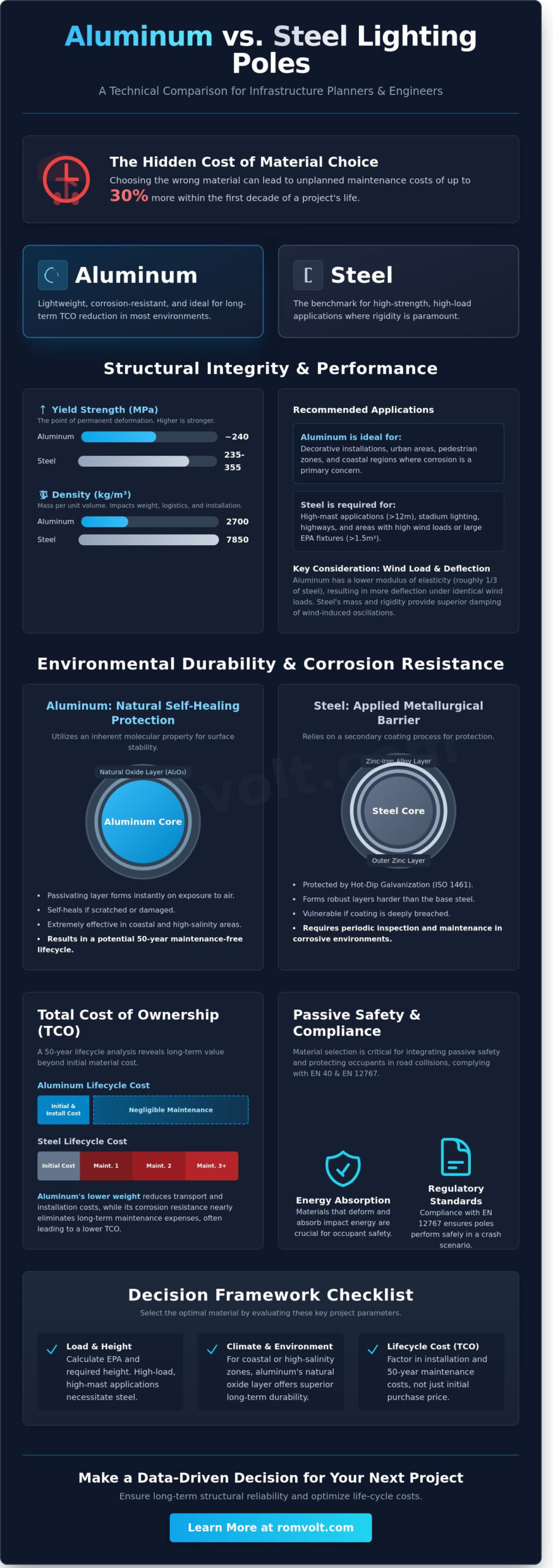
Yield strength defines the point of permanent deformation for infrastructure, marking the limit where a material loses its ability to return to its original shape after a load is removed. In high-precision engineering, steel remains the benchmark for high-mast applications. S235 and S355 steel grades provide yield strengths of 235 MPa and 355 MPa respectively, offering the rigidity needed for heights exceeding 12 meters. While 6000-series aluminum alloys, such as 6061-T6, provide a respectable yield strength of approximately 240 MPa, their modulus of elasticity is roughly one-third that of steel. This means that under identical wind loads, an aluminum pole will exhibit significantly more deflection than a steel counterpart. The weight-to-strength ratio of aluminum is advantageous for shorter, decorative installations, but for heavy-duty industrial applications, the density of steel (7850 kg/m³) provides the mass required to dampen oscillations that 2700 kg/m³ aluminum cannot effectively resist.
Wind Load and Effective Projected Area (EPA)
Managing wind-induced vibrations is a primary concern for municipal and highway safety. In urban environments, where buildings create complex wind tunnels, or on open highways with high-velocity gusts, the EPA of the fixture dictates the material’s viability. When comparing aluminum lighting poles vs steel, the engineering threshold for aluminum is typically reached when the EPA exceeds 1.5 square meters at heights above 10 meters. For stadium lighting or high-mast systems in coastal zones, where wind speeds can reach 150 km/h, reinforced steel is the only material that ensures compliance with Eurocode 3 standards. The structural calculations for these systems must account for:
- Vortex Shedding: The rhythmic pressure changes that cause poles to sway.
- Galloping: High-amplitude vibrations caused by ice accumulation on the fixture.
- Static Wind Load: The constant pressure exerted on the pole’s surface area.
These factors demand a material with high fatigue resistance. Steel’s ability to withstand millions of stress cycles without failure makes it the preferred choice for infrastructure where long-term safety and minimal maintenance are non-negotiable requirements.
Environmental Durability: Corrosion Resistance Mechanisms
The technical evaluation of aluminum lighting poles vs steel begins with an analysis of their electrochemical reactions to atmospheric stressors. While both materials offer the necessary structural integrity for modern infrastructure, their chemical defense systems operate on fundamentally different principles. Steel relies on heavy secondary coatings to prevent oxidation, whereas aluminum utilizes an inherent molecular property to maintain surface stability throughout its service life.
The Role of Hot-Dip Galvanisation in Steel Longevity
Steel poles achieve their durability through hot-dip galvanisation, a process governed by the ISO 1461 standard. This isn’t a superficial paint layer; it’s a metallurgical bond. The immersion of the steel structure in molten zinc at approximately 450 degrees Celsius creates a series of zinc-iron alloy layers. These layers are often harder than the base steel itself, providing a robust defense against mechanical impact during transport or installation.
One primary advantage of this coating is its self-healing capability. If the surface suffers minor abrasions, the surrounding zinc acts as a sacrificial anode, protecting the exposed steel through cathodic protection. This mechanism prevents the spread of sub-film corrosion. For a comprehensive technical breakdown of these material specifications, engineers should refer to our street lighting poles guide.
Aluminum’s Natural Corrosion Barrier
Aluminum reacts instantaneously with atmospheric oxygen to form a thin, transparent layer of aluminum oxide (Al2O3). This ceramic-like barrier is chemically inert and prevents further oxygen from penetrating the metal’s core. In saline environments, such as coastal regions with high chloride concentrations, aluminum remains the preferred choice. It doesn’t exhibit the “red rust” characteristic of ferrous metals, which can compromise structural safety over time.
To enhance this protection, anodisation is often implemented. This electrochemical process increases the thickness of the natural oxide layer, ensuring the material withstands pH levels outside the standard 4.0 to 8.5 range. However, precision in assembly is vital. Technicians must avoid using incompatible fasteners, as direct contact with copper or certain stainless steel grades can trigger galvanic corrosion. We recommend using specialized isolation washers to maintain the assembly’s integrity.
Predicting the performance of 2026 infrastructure projects requires a focus on total lifecycle maintenance. In C3 (urban/industrial) environments, galvanized steel typically shows the first signs of zinc depletion after 20 to 25 years. In contrast, aluminum structures in identical conditions are projected to exceed a 50-year lifespan without requiring structural interventions. When planning high-yield municipal projects, it’s essential to optimize your material selection, considering these long-term durability factors to minimize maintenance costs and ensure sustained performance over decades.
Passive Safety and Regulatory Compliance (EN 40 & EN 12767)
The engineering paradigm for modern road infrastructure has shifted from rigid durability to a forgiving design philosophy. This approach prioritizes occupant safety by selecting materials that minimize deceleration forces during a vehicular impact. When analyzing aluminum lighting poles vs steel, the choice impacts whether a structure remains a lethal obstacle or a safety-compliant component of the highway system. Romvolt integrates these safety requirements into every project; ensuring that lighting columns installed on national highways meet the strict criteria of EN 12767. This standard classifies structures based on their performance during crash tests, focusing on the Safety Integrity Level for vehicle occupants.
Crashworthiness and Energy Absorption
Passive safety is categorized by energy absorption levels: High Energy (HE), Low Energy (LE), and Non-Energy (NE) absorbing structures. Passive safety poles are frequently specified for urban zones with high pedestrian density because they typically fall into the NE or LE categories. These materials shear or deform predictably upon impact, which reduces the risk of the vehicle rebounding into secondary traffic lanes. In contrast, steel poles often require specialized shear-base technology or slip-joint mechanisms to achieve similar safety ratings. Without these specific engineering modifications, a standard steel mast acts as a rigid object. It transfers the full kinetic energy of the crash directly to the vehicle’s occupants. Romvolt’s engineering team selects the material profile based on the speed limit of the road, typically recommending aluminum for 70 km/h zones where pedestrian safety is paramount.
Meeting International Safety Standards
Compliance with EN 40 and EN 12767 isn’t optional for municipal projects; it’s a mandatory legal safeguard. Romvolt provides comprehensive technical documentation that simplifies the verification process for local authorities and contractors. As structural testing protocols evolve for 2026, the focus on mast integrity for telecommunication and renewable energy structures has intensified. We ensure every installation undergoes rigorous structural analysis to withstand wind loads while maintaining the necessary crashworthiness certifications. This technical oversight prevents liability issues. It ensures long-term operational safety for public infrastructure. Our verification process includes checking the CE marking and the Declaration of Performance (DoP) for every component. This level of rigor ensures that the aluminum lighting poles vs steel debate is settled not just by cost, but by the highest standards of public protection.
Romvolt’s approach to passive safety engineering involves a detailed assessment of the site-specific risks. We evaluate the proximity of the poles to the carriage way and the likelihood of high-speed impacts. By adhering to EN 40 lighting columns standards EN 40-3-1 and EN 40-3-3 for structural design, we guarantee that the masts can support the required weight of luminaires and brackets without compromising their ability to break away safely during an accident. This balance of structural strength and controlled failure is the hallmark of professional infrastructure management. Engineers seeking a deeper understanding of crashworthiness classifications and implementation strategies can consult our detailed resource on passive safety poles and EN 12767 compliance.
Total Cost of Ownership (TCO) and Logistics
A rigorous engineering analysis of infrastructure assets requires a clear distinction between initial capital expenditure and the 50-year life-cycle cost. While steel frequently offers a lower purchase price, the comparison of aluminum lighting poles vs steel demonstrates that aluminum provides a more favorable Total Cost of Ownership (TCO) in complex industrial environments. This fiscal advantage stems from a combination of reduced operational overhead, lower logistics requirements, and a high residual value that offsets the initial investment premium. Technical teams must evaluate the cumulative costs of corrosion protection and specialized transport to understand the true return on investment.
Installation Efficiency and Transport
Logistical efficiency is directly tied to the material’s density and weight. Aluminum poles weigh 30% to 50% less than steel, which allows for more units per shipment and significantly lower fuel consumption during transport. This weight reduction facilitates easier site handling, as smaller, more maneuverable lifting equipment can replace the heavy 20-ton cranes required for steel installations. Lowering the machinery footprint on-site reduces rental costs and cuts carbon emissions associated with the construction phase by approximately 18%. The lower mass of the pole also reduces the structural load on foundation blocks, often allowing for a 10% reduction in concrete volume and reinforcement steel during the civil works stage.
Long-Term Maintenance and ROI
The Return on Investment (ROI) for lighting infrastructure is heavily influenced by the frequency of technical interventions. In industrial zones or coastal areas, steel poles require a complete repainting or recoating cycle every 10 to 15 years to maintain structural safety against corrosion. These maintenance windows involve significant costs for labor, specialized coatings, and site access equipment. Aluminum avoids these recurring expenses because it naturally forms a protective oxide layer that resists atmospheric degradation without human intervention.
When calculating the Net Present Value (NPV) of a 50-year project, the maintenance-free nature of aluminum results in a lower total cost despite the higher upfront price point. It’s critical that TCO calculations include decommissioning and recycling rebates, as aluminum’s high scrap value provides a substantial financial recovery at the end of its functional life. Unlike steel, which has a negligible scrap return after processing costs, aluminum remains a valuable commodity that can be sold back into the supply chain. This financial recovery makes the transition to sustainable materials a strategic fiscal decision rather than a mere compliance measure. The long-term analysis of aluminum lighting poles vs steel proves that durability and low maintenance are the primary drivers of infrastructure profitability.
Decision Framework: Choosing the Right Material for Your Project
Selecting between aluminum lighting poles vs steel requires a rigorous technical evaluation of the site’s environmental conditions and structural demands. Planners must prioritize safety and regulatory compliance over initial procurement costs. A systematic approach ensures the chosen infrastructure meets Eurocode standards or local building codes without compromising the project’s long-term viability. When evaluating aluminum lighting poles vs steel, the decision often hinges on the specific mechanical stresses the installation will face over a 30-year or 50-year horizon.
Before finalizing a specification, engineering teams should verify the following parameters:
- Wind Zone Analysis: Evaluate peak wind speeds based on historical data to determine the required yield strength for the specific geographic coordinates.
- Corrosion Classification: Identify if the site falls under C3 (urban/industrial) or C5 (coastal/marine) categories according to ISO 12944 standards.
- Foundation Capacity: Assess soil stability and the maximum vertical and lateral loads the substrate can support during extreme weather events.
- Safety Requirements: Determine if passive safety certifications, such as EN 12767, are mandatory for high-speed traffic zones to minimize impact severity.
Scenarios for Galvanised Steel Specification
Steel remains the definitive choice for projects demanding maximum structural rigidity and significant height. High-mast installations for stadiums often exceed 30 meters, requiring the high modulus of elasticity that only galvanized steel provides. Industrial hubs with heavy machinery or telecommunication masts also benefit from steel’s resistance to extreme mechanical stress. In regions with low salinity where humidity levels stay below 60%, galvanized steel offers a cost-effective solution with a lifecycle that meets standard municipal requirements.
Scenarios for Aluminum Specification
Aluminum is the superior choice for coastal infrastructure located within 5 kilometers of the shoreline, where salt spray accelerates oxidation in ferrous metals. Its natural oxide layer provides a self-healing barrier, making it ideal for urban parks and pedestrian paths where aesthetic longevity is crucial. Because aluminum is approximately 30% the weight of steel, it reduces logistics costs and allows for installation in sensitive areas without heavy lifting equipment. These characteristics make it a preferred material for projects prioritizing minimal maintenance and rapid deployment.
Romvolt provides custom engineering solutions that transcend basic material selection. Our team analyzes specific electrical loads and automation requirements to ensure every pole, whether steel or aluminum, integrates perfectly with the broader power grid. We focus on precision manufacturing and strict adherence to safety protocols, delivering infrastructure that stands as a benchmark for industrial reliability and technical excellence.
Optimizing Infrastructure Integrity through Technical Precision
Selecting the appropriate material for infrastructure requires a meticulous evaluation of structural requirements and environmental stressors. Steel remains the standard for high-mast applications exceeding 20 meters due to its superior load-bearing capacity, yet aluminum provides an unmatched 50-year service life in high-salinity environments without the need for periodic recoating. Compliance with EN 40 and EN 12767 standards isn’t just a regulatory hurdle; it’s a fundamental guarantee of passive safety for modern urban development. The technical trade-offs between aluminum lighting poles vs steel necessitate a data-driven approach that accounts for both initial logistics and the total cost of ownership over several decades.
Romvolt Engineering delivers the specialized expertise required to execute these complex installations. Our team focuses on expert structural design for high-capacity masts while managing the specialized logistics required for oversized infrastructure components. We’ll ensure your project meets every rigorous safety benchmark while optimizing long-term maintenance cycles. For engineers requiring a deeper understanding of structural verification methods and load calculation frameworks, our comprehensive guide to EN 40 lighting columns technical standards provides the definitive reference for compliant infrastructure specification. Consult with Romvolt Engineering for your next infrastructure project to secure a partnership rooted in technical stability and engineering excellence. We look forward to implementing a solution that stands the test of time.
Frequently Asked Questions
Which is more durable, aluminum or steel lighting poles?
Steel provides superior structural durability and impact resistance for heights exceeding 12 meters, especially when utilizing high-strength alloys like S355. Aluminum excels in atmospheric durability due to its inherent resistance to corrosion. While steel relies on protective coatings to maintain integrity, aluminum alloys in the 6000 series maintain structural stability for over 50 years in high-humidity environments. The choice depends on whether the project prioritizes mechanical load capacity or resistance to environmental degradation.
Do aluminum light poles rust over time?
Aluminum light poles don’t rust because the material contains no iron, though they undergo a natural oxidation process that creates a protective surface barrier. This aluminum oxide layer prevents deep structural corrosion and eliminates the maintenance cycles required for galvanized steel. It’s a decisive technical factor when evaluating aluminum lighting poles vs steel for installations in high-salinity or industrial zones. This self-repairing characteristic ensures the pole remains aesthetically and structurally sound without additional chemical treatments.
What is the price difference between steel and aluminum lighting columns?
Aluminum lighting columns generally require a higher initial capital investment compared to standard galvanized steel options. Market data from 2023 shows that raw aluminum costs are often double or triple the price of carbon steel per metric ton. However, the total lifecycle cost often favors aluminum when you account for the lack of painting requirements and lower specialized maintenance needs over a 25-year period. Engineers should calculate the total cost of ownership rather than focusing solely on the procurement price.
Can steel poles be used in coastal areas?
Steel poles are suitable for coastal areas only if they’re treated with a C5-M category protective system according to the ISO 12944 standard. This typically involves hot-dip galvanizing followed by a specialized duplex powder coating to reach a minimum thickness of 85 microns. Without these specific technical reinforcements, steel structures located within 5 kilometers of the ocean will show signs of failure within 24 months. Aluminum remains the safer engineering choice for maritime environments due to its natural salt resistance.
What are the wind load requirements for lighting poles in 2026?
Wind load requirements for 2026 are governed by the EN 40-3-1 standard, which utilizes a 25-year return period to calculate peak wind pressures. Recent updates require structures to withstand localized gusts that can exceed 150 kilometers per hour in specific coastal or high-altitude regions. Designers must implement the Eurocode 1 framework to ensure every pole assembly, including the luminaire and bracket, meets the specific wind zone pressure of the installation site. Compliance ensures public safety and prevents structural fatigue under extreme weather conditions.
How does the weight of aluminum poles affect installation costs?
Aluminum poles weigh between 30% and 50% less than steel poles of the same height, which directly reduces the need for heavy lifting machinery during assembly. A standard 6-meter aluminum pole is light enough for a two-person crew to handle, potentially cutting onsite labor hours by 40% per unit. When comparing aluminum lighting poles vs steel, the logistical savings in transport and the elimination of large crane rentals often offset the higher material cost. These efficiencies are critical for large-scale infrastructure projects with tight execution timelines.
What is passive safety in the context of lighting poles?
Passive safety refers to a pole’s engineered ability to reduce the severity of injuries during a vehicular collision, as defined by the EN 12767 standard. Lighting columns are tested and classified into categories such as High Energy Absorbing or Non-Energy Absorbing based on how they behave upon impact. Aluminum poles frequently achieve superior safety ratings because they’re designed to shear or buckle, absorbing less energy and reducing deceleration forces on passengers. This technical feature is a mandatory consideration for high-speed roadways where crash risks are elevated.
Are aluminum lighting poles recyclable?
Aluminum lighting poles are 100% recyclable and maintain their full mechanical properties after the recycling process is complete. Industry statistics show that recycling aluminum consumes only 5% of the energy required to produce primary metal from bauxite ore. At the end of a 40-year service life, the scrap value of an aluminum pole remains a significant asset for the owner. This high residual value and low carbon footprint make it a preferred choice for sustainable urban development and circular economy initiatives.