
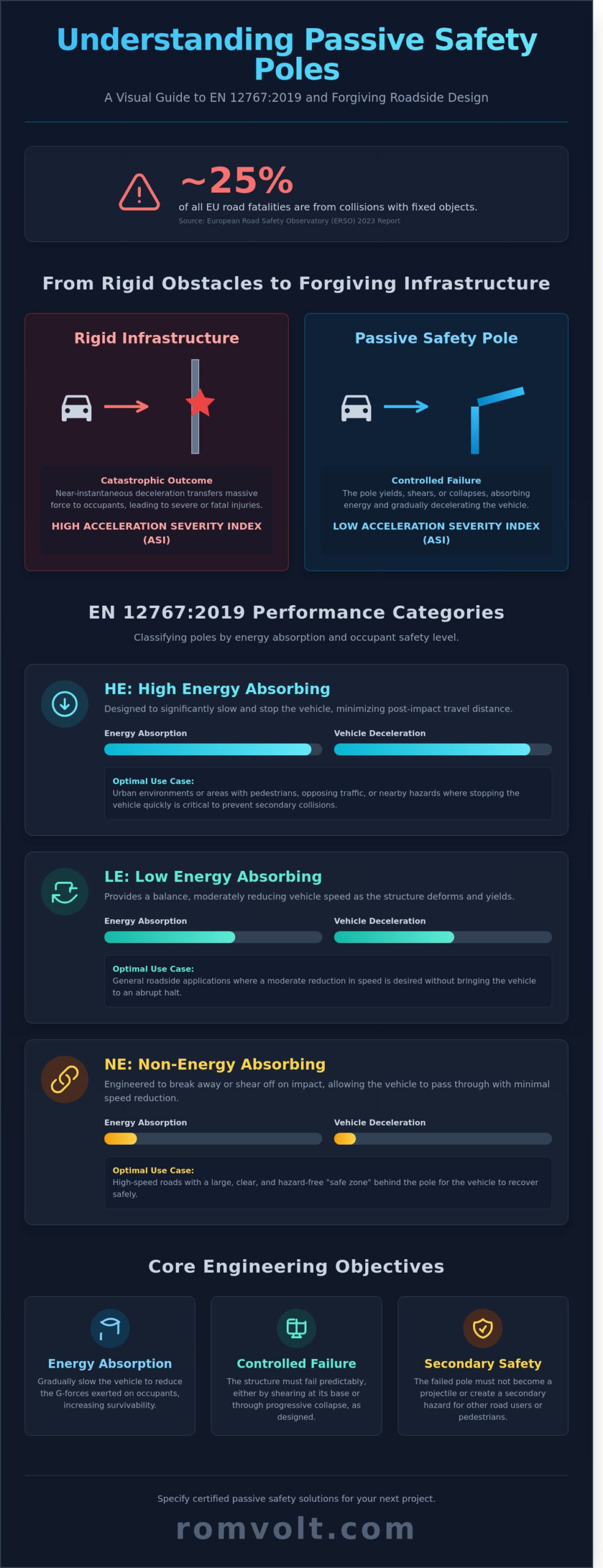
According to the European Road Safety Observatory (ERSO) 2023 report, collisions with fixed objects account for approximately 25% of all road fatalities across the European Union. You’ve likely observed that while traditional infrastructure provides necessary structural support, its inherent rigidity often results in catastrophic outcomes during high-speed vehicular impacts. Balancing the demand for structural integrity with the necessity of crashworthiness remains a primary concern for engineers who prioritize long-term safety and operational reliability.
This technical guide delivers a rigorous overview of passive safety poles, providing the expertise needed to implement solutions that meet the EN 12767:2019 standard. We’ll analyze the performance characteristics of High Energy (HE), Limited Energy (LE), and Non-Energy (NE) categories to facilitate informed specification decisions. You’ll gain a structured framework for evaluating material durability and ensuring your projects comply with national safety regulations through precise engineering and optimized maintenance strategies.
Key Takeaways
- Understand the engineering principles behind forgiving roadside design and how it systematically reduces the severity of vehicle collisions.
- Identify the technical differences between HE, LE, and NE energy absorption classes to ensure precise compliance with the EN 12767 standard.
- Evaluate the deformation characteristics and long-term durability of steel versus aluminium when specifying passive safety poles for critical infrastructure.
- Learn to integrate local wind zone data and foundation stability calculations to ensure structural integrity without compromising safety performance.
- Master the best practices for drafting rigorous technical specifications and verifying manufacturer certifications for large-scale public tenders.
The Evolution of Forgiving Roadsides and Passive Safety
Passive safety poles are specialized infrastructure components designed to minimize the physical impact of vehicle collisions. Unlike traditional support structures, these systems prioritize energy dissipation and structural yielding to protect occupants. The transition toward these technologies marks a fundamental shift in civil engineering, moving from rigid, unyielding designs to a more sophisticated “forgiving” roadside approach. This evolution is driven by the recognition that human error is inevitable; therefore, the infrastructure must be resilient enough to allow for survival after a crash.
The implementation of these systems is governed by the EN 12767 standard, a European regulation established to categorize the impact performance of support structures. By using passive safety poles, highway authorities can reduce fatality rates in urban and high-speed environments. Data from European road safety reports indicates that forgiving infrastructure can reduce the severity of run-off-road accidents by up to 40% compared to traditional rigid installations. Engineers now integrate passive safety features as a primary requirement for modern road design.
The Problem with Rigid Infrastructure
Standard utility poles act as unyielding obstacles during high-speed impacts. When a vehicle strikes a rigid steel or concrete mast at 100 km/h, the deceleration is nearly instantaneous. The physics of energy transfer dictate that this abrupt stop forces the vehicle’s occupants to absorb the kinetic energy, which leads to fatal internal injuries. The forgiving roadside is an engineering philosophy that aims to design a roadside environment where a vehicle leaving the pavement doesn’t result in a serious or fatal crash.
Core Objectives of Passive Safety Poles
The primary goal of any passive safety installation is the reduction of the Acceleration Severity Index (ASI). This metric quantifies the impact’s effect on vehicle occupants; lower values represent a higher probability of survival. To achieve this, passive safety poles are designed with specific mechanical properties:
- Controlled Failure: The structure must fail predictably upon impact, either by shearing at a designated point or through progressive collapse.
- Energy Absorption: High-energy absorbing poles slow the vehicle down gradually, reducing the forces exerted on the human body.
- Secondary Safety: Engineers ensure the pole doesn’t detach and become a projectile, which could endanger other road users or pedestrians.
Modern engineering rigor ensures that these systems maintain their structural integrity against wind loads and environmental stressors while remaining ready to yield when a collision occurs. It’s a balance of stability and safety that defines the current standard of industrial infrastructure. This approach moves away from simply building stronger barriers toward building smarter, more responsive systems.
Understanding EN 12767: Performance Categories and Testing
The European standard EN 12767:2019 establishes a rigorous framework for the classification and testing of support structures for road equipment. It’s not merely a set of recommendations; it represents a technical mandate to ensure that passive safety poles behave predictably during a collision. This standard categorizes poles based on their ability to absorb kinetic energy and the resulting risk of injury to vehicle occupants. The technical objective is to replace rigid obstacles with forgiving structures that mitigate the severity of accidents.
High, Low, and Non-Energy Absorbing (HE, LE, NE)
The energy absorption capacity is divided into three distinct classes, each serving a specific strategic purpose in roadside safety. High Energy (HE) poles are designed to slow the vehicle down significantly upon impact. This characteristic is vital in urban or congested areas where stopping the vehicle quickly prevents secondary collisions with pedestrians or other traffic. Low Energy (LE) poles provide a calculated middle ground, offering moderate deceleration while the structure yields to the force of the impact.
Non-Energy (NE) absorbing poles are engineered to shear off or break away completely. In these scenarios, the vehicle continues its path with minimal speed reduction. This category is particularly effective when implemented as part of a forgiving roadside design, provided there’s a clear zone free of hazards behind the pole. By allowing the vehicle to pass through, the system prevents the violent deceleration that often leads to fatal internal injuries.
Interpreting Test Results for Project Specification
Engineers must look beyond simple labels and analyze the alphanumeric coding system found in certification reports. A typical code like 100-NE-C-S-SE-MD-0 provides a comprehensive profile of the pole’s performance. The initial digits (50, 70, or 100) indicate the test speed in km/h, which must match the speed limit of the road where the pole’s installed. The subsequent letters define the energy class and the occupant safety level, ranging from Level 1 to Level 3.
- Occupant Impact Velocity (OIV): This is the most critical metric. It measures the speed at which a theoretical occupant strikes the dashboard or steering wheel. For a Level 3 safety rating, the OIV doesn’t exceed 33 km/h.
- Acceleration Severity Index (ASI): This value quantifies the physical stress on the human body during the impact. A lower ASI indicates a higher probability of the occupants walking away without permanent injury.
- Backfill Requirements: Certification is only valid if the pole’s installed according to the specific soil or foundation conditions used during the crash test.
Choosing the right category requires a thorough site assessment. If a steep embankment or a deep water body is located immediately behind the installation point, an NE pole could lead the vehicle into a greater hazard. In such technical contexts, an HE pole is the responsible choice. For complex infrastructure projects requiring precise compliance with these standards, you can consult the engineering team at Romvolt to ensure every specification meets the highest safety benchmarks.
Material Engineering: Steel vs. Aluminium Safety Poles
Selecting the appropriate material for passive safety poles requires a rigorous analysis of impact dynamics and environmental stressors. While both steel and aluminum provide high-performance solutions under EN 12767 standards, their mechanical behaviors during a collision differ significantly. Engineers must balance initial capital expenditure against long-term operational costs, particularly when considering the 25-year infrastructure lifecycle standard in modern urban planning. The choice between these materials dictates not only the safety class of the installation but also the logistical requirements for transport and site deployment.
Steel Safety Poles: Strength and Yielding
Steel’s structural integrity remains a benchmark in infrastructure, but for passive safety, it relies on precisely engineered failure points. Specialized base designs utilizing shear bolts or slip-base mechanisms allow the column to detach or yield upon impact, preventing the pole from acting as a rigid obstacle. Hot-dip galvanization, applied according to ISO 1461, ensures these safety mechanisms don’t seize due to oxidation over decades of exposure. This protective coating is vital for maintaining the predictable shearing force required for the pole to function as intended during an accident. For a comprehensive understanding of corrosion protection and long-term durability, our technical guide to galvanized steel poles for infrastructure projects provides detailed metallurgical analysis and EN ISO 1461 compliance requirements. For a deeper look at material selection and technical specifications, consult this Street Lighting Poles: A Technical Guide to Infrastructure Selection.
Aluminium Poles: Natural Energy Absorption
Aluminum alloys, such as the 6000 series, possess a lower modulus of elasticity compared to steel. This physical property makes them naturally suited for NE (Non-Energy absorbing) and LE (Low-Energy absorbing) performance classes. In coastal regions where salinity levels are high, aluminum’s self-passivating oxide layer provides a maintenance-free lifespan that often exceeds 50 years without the need for additional chemical treatments. Detailed technical metrics regarding these properties are available in our Aluminum Lighting Poles vs. Steel: A Technical Engineering Comparison.
Safety isn’t limited to mechanical deformation alone. The IHE Passive Safety Electrical Guide highlights that electrical disconnection systems must function flawlessly regardless of material choice to prevent secondary hazards. Aluminum’s lighter weight, often 40% to 60% less than steel, reduces the kinetic energy during secondary impacts and simplifies the installation process. Lower mass translates to reduced transport emissions and the ability to use smaller, more agile lifting equipment on-site, which is a critical factor in narrow urban corridors or remote highway stretches.
From a cost-benefit perspective, steel often presents a lower initial purchase price. However, when factoring in the 25-year maintenance cycle, aluminum’s resistance to corrosion and ease of handling frequently result in a lower total cost of ownership. The decision matrix should include:
- Impact Performance: Aluminium’s inherent flexibility vs. Steel’s mechanical shear systems.
- Environmental Exposure: High-salinity or industrial zones favor the corrosion resistance of aluminium.
- Installation Logistics: Reduced weight of aluminium lowers labor costs and equipment requirements.
- Compliance: Both materials must meet the stringent EN 12767 criteria for passive safety poles.
Structural Integrity: Foundations and Wind Load Calculations
Engineering passive safety poles requires a precise balance between structural resilience and predictable failure. The design process begins with wind load calculations, as these determine the baseline resistance needed to prevent fatigue failure under environmental stress. In regions experiencing significant wind forces, where speeds can reach 30 m/s, poles must withstand significant lateral forces without compromising their ability to yield during a vehicle collision. If a pole is too rigid, it becomes a lethal obstacle; if it’s too weak, it fails under standard atmospheric conditions.
Foundation Engineering for Safety Columns
Foundation stability is the silent partner of passive safety. Engineers must prevent a phenomenon known as foundation ploughing, where the entire concrete base shifts through the soil upon impact. This movement absorbs energy that should be directed toward the pole’s shearing or buckling mechanism, potentially preventing the safety system from activating. Using pre-cast concrete foundation blocks ensures consistent structural performance across an entire project, as these units are manufactured under controlled factory conditions to meet specific density requirements.
The specification of foundation depth depends heavily on local soil morphology. Cohesive clay soils might allow for a standard 1.2-meter depth, but loose or sandy terrains require deeper installations or soil stabilization to maintain equilibrium. A stable foundation ensures that the pole remains the weakest point in the system during a crash, which is essential for protecting vehicle occupants.
Wind Load and Static Compliance
Static compliance involves managing the relationship between the mast’s flexibility and the weight of the equipment it supports. Modern LED luminaires often weigh between 12 and 22 kg, and their surface area creates a “sail effect” during high winds. Calculations for the maximum luminaire weight must be rigorous to prevent the pole from swaying excessively, which can damage internal components or cause light flicker. Wind load calculations are the first step in safety pole design because they define the physical limits within which the passive safety mechanisms must operate. Engineers working on public lighting infrastructure should also reference the EN 40 lighting columns technical reference for a definitive guide to load calculations and structural verification methods under Eurocode standards.
- Mechanical Yield: The pole must remain upright during 140 km/h wind gusts but collapse predictably when struck by a 1,500 kg vehicle.
- Electrical Safety: The internal disconnect system must trigger within 0.4 seconds of impact to eliminate the risk of electrocution.
- Material Integrity: Using galvanized steel or aluminum alloys ensures the structure doesn’t degrade over its 25-year service life.
The electrical disconnect system is integral to the structural design. It relies on the pole’s predictable deformation to pull the power plug at the base. If the wind load isn’t calculated correctly and the pole undergoes structural fatigue, the internal alignment might shift, potentially causing the disconnect system to jam during a real emergency. Safety is a holistic objective where mechanical and electrical systems function as a single unit.
Ensure your infrastructure projects meet the highest standards of technical precision and safety. Discover how our team at Romvolt implements complex solutions by visiting our specialized electrical and automation services page.
Specifying Passive Safety Poles for National Projects
Drafting technical specifications for public tenders requires a high degree of engineering precision. Ambiguity in documentation often leads to the procurement of equipment that fails to meet safety benchmarks. Professionals must prioritize EN 12767:2019 standards, which classify passive safety poles based on their energy absorption capabilities. Specifiers need to determine whether a project requires High Energy (HE), Limited Energy (LE), or Non-Energy (NE) absorbing properties. These decisions shouldn’t be arbitrary; they must reflect the specific speed limits and roadside hazards identified during the risk assessment phase.
Logistics for these components require careful planning. Transporting poles that exceed 10 or 12 meters involves specialized trailers and strict adherence to oversized cargo regulations. Improper handling during transit can compromise the structural integrity of the break-away mechanisms or the specialized aluminum alloys used in construction. At Romvolt, we manage these complexities through a structured delivery protocol that ensures every component arrives on-site ready for immediate installation.
Regulatory Compliance and Documentation
Compliance isn’t a mere formality; it’s a legal safeguard for infrastructure managers. Every product must carry the CE mark, signifying adherence to the Construction Products Regulation (CPR) 305/2011. Technical documentation shouldn’t stop at basic brochures. It must include detailed structural calculations based on Eurocode 3 and verified crash test reports from accredited laboratories. Romvolt maintains a rigorous ISO 9001:2015 quality management system, ensuring that every batch of passive safety poles meets the exact specifications outlined in the design phase. This level of transparency is vital for international shipping and cross-border infrastructure projects where regulatory scrutiny is intense. Specifiers responsible for compliant column documentation should also consult the comprehensive technical reference for EN 40 lighting columns to ensure structural calculations align with the full scope of applicable European standards.
Partnering with a Specialized Manufacturer
Working with Romvolt provides planners with a strategic advantage from the initial design stages. We don’t just supply hardware; we offer integrated engineering solutions. This includes custom calculations for foundations and specialized mounting brackets that account for soil density and local wind loads. By consolidating the pole design, engineering fees, and foundation requirements into a single package, project managers reduce the risk of installation errors. Our team acts as a technical consultant, helping to optimize the placement of passive safety poles to maximize driver protection while controlling costs. Use the contact details below to request a technical consultation for your next national infrastructure project.
- Verification of EN 12767:2019 performance classes (100,NE,B,S,SE or similar).
- Provision of full technical files for municipal and national audit compliance.
- Custom engineering for unique environmental or structural constraints.
- Expert logistics management for oversized safety infrastructure.
Optimizing Roadside Safety Through Technical Precision and EN 12767 Compliance
Implementing high-performance infrastructure requires a rigorous commitment to the EN 12767:2019 standard, which defines the safety performance of support structures for road equipment. We’ve seen that selecting the correct energy absorption category is vital for reducing fatality risks during 100 km/h impacts. Engineering teams must balance material durability, such as galvanized steel’s structural rigidity, against the specific deformation requirements of the site. Accurate wind load calculations and foundation stability assessments remain the pillars of any successful deployment. Integrating these technical variables ensures that passive safety poles function as intended during critical failure events.
Romvolt’s approach combines certified compliance with integrated engineering design and manufacturing capabilities. We handle the complexities of specialized logistics for oversized infrastructure, ensuring that every component arrives on-site ready for immediate implementation. It’s essential to partner with experts who understand the intersection of mechanical resistance and public safety regulations. For comprehensive support and detailed technical documentation, contact our technical engineering team for passive safety specifications to ensure your project meets the highest industry benchmarks. We’re ready to assist in building a more secure and resilient national transport network.
Frequently Asked Questions
What is the primary difference between HE and NE passive safety poles?
The primary difference lies in the kinetic energy absorption levels defined by the EN 12767 standard. HE (High Energy) poles are designed to slow the vehicle significantly upon impact, which reduces the risk of secondary collisions with other road users or obstacles. In contrast, NE (Non-Energy) poles allow the vehicle to continue its trajectory with minimal speed reduction, as the structure shears or bends easily to prevent sudden deceleration forces on the occupants.
Are passive safety poles mandatory for all new road projects?
Passive safety poles aren’t mandatory for every single project, but they’re required by regulations for high-speed routes under specific risk conditions. Engineering specifications typically mandate these columns on roads with speed limits exceeding 80 km/h where a safety barrier isn’t present. Designers perform a formal risk assessment to determine if a forgiving infrastructure approach is necessary to meet modern safety benchmarks and legal compliance requirements in the 2024 regulatory landscape.
How do passive safety poles handle electrical components during a crash?
These systems incorporate specialized electrical disconnect mechanisms that instantly sever power upon impact. To prevent fire or electrocution, engineers install snatch-off connectors or shear-base systems that isolate the circuit within 0.4 seconds. This ensures that live wires don’t remain exposed on the ground. Reliability is maintained through IP68-rated components that withstand environmental stress while remaining functional during structural failure, ensuring the site remains safe for emergency responders.
Can a passive safety pole be reused after a minor collision?
A passive safety pole must be replaced after any collision that triggers its deformation or shearing mechanism. Even if damage appears superficial, the internal structural integrity is compromised, and it won’t perform as certified in a subsequent impact. Safety standards require a full technical inspection and replacement to ensure the infrastructure continues to provide the 100% protection level specified by the original manufacturer. Reusing a compromised pole creates significant legal and safety liabilities.
Do passive safety poles require special foundations compared to standard ones?
Passive safety poles often require specific foundation designs that differ from rigid alternatives. These foundations are engineered to support the pole’s wind load while allowing the shearing or bending mechanism to activate correctly during a crash. Using a standard rigid foundation for a safety-certified column might prevent it from performing its life-saving function. Technical drawings must be followed precisely to ensure the soil resistance matches the pole’s performance class and the manufacturer’s specific installation requirements.
What is the lifespan of a galvanised steel passive safety pole?
A galvanised steel pole manufactured to ISO 1461 standards typically has a service life of 25 to 50 years. The hot-dip galvanising process provides a protective zinc coating that prevents corrosion even in harsh industrial or coastal environments. Regular maintenance inspections every 5 years ensure the protective layer remains intact. This longevity makes steel a cost-effective choice for long-term infrastructure projects requiring both durability and high safety performance under the EN 12767 certification. For a deeper technical analysis of zinc coating performance and service life expectations across different corrosive environments, refer to our technical guide to galvanized steel poles for infrastructure projects.
How does wind load affect the performance of a safety-certified column?
Wind load calculations, governed by EN 40-3-1, ensure the pole remains stable under extreme weather while still being able to fail safely during a vehicle impact. Engineers must balance the structural thickness required for wind resistance with the material’s ability to yield during a crash. If a pole is too rigid to withstand high winds, it might fail to meet its energy-absorption category. This technical equilibrium is critical for operational safety and structural reliability.
Are aluminium safety poles always safer than steel ones?
Aluminium isn’t inherently safer than steel; safety depends on the specific EN 12767 performance classification. Both materials can achieve 100NE or 70HE ratings through different engineering approaches. While aluminium is lighter and naturally corrosion-resistant, modern galvanised steel poles are engineered with precise laser-cut patterns to ensure predictable failure. The choice depends on the specific site requirements, environmental conditions, and the required energy absorption category for that specific section of the road network.