
The structural integrity of a power grid or urban lighting network is often decided not by its visible mass, but by the microscopic chemical bond formed during the hot-dip process. While traditional painted structures require invasive maintenance every 5 to 10 years, galvanized steel poles offer a maintenance-free horizon that can span over half a century. You likely understand the frustration of managing structural degradation in coastal or industrial environments where salt and pollutants accelerate oxidation. It’s a reality that compromises safety and inflates long-term operational budgets through constant site visits and repairs.
This technical guide provides a rigorous analysis of how galvanized steel poles meet the demanding requirements of modern infrastructure projects. We’ll explore the engineering principles behind EN ISO 1461 compliance, ensuring your installations achieve a 50-year service life even in C5-class corrosive environments. You’ll gain a clear understanding of the metallurgical transition during the zinc-coating process, the precision required for wind load calculations under Eurocode standards, and the specific manufacturing protocols that prevent structural failure in high-stress industrial applications. We’ll also examine the cost-benefit ratio of choosing zinc-coated solutions over traditional alternatives to optimize your project’s lifecycle performance.
Key Takeaways
- Understand the rigorous hot-dip galvanization process according to EN ISO 1461 and how critical surface preparation ensures maximum protection against atmospheric corrosion.
- Explore the diverse applications of galvanized steel poles in modern infrastructure, ranging from urban street lighting to specialized high-mast systems for stadiums and ports.
- Learn to navigate technical compliance and EN 40 safety standards, including the necessity of precise wind load calculations for various geographic locations.
- Discover how to optimize project timelines by selecting integrated engineering solutions and pre-cast foundation blocks designed for rapid and secure site deployment.
Understanding Galvanized Steel Poles in Modern Infrastructure
Galvanized steel poles represent the fundamental structural component of national utility and transport networks, providing the necessary support for high-voltage power lines, telecommunications equipment, and urban lighting systems. These structures are defined as carbon steel components that have undergone a specialized thermal treatment to incorporate a protective zinc coating, specifically engineered to neutralize atmospheric corrosion. The implementation of these poles ensures a stable foundation for critical systems, where failure is not an option due to safety and connectivity requirements. In the context of industrial expansion, the selection of materials must prioritize long-term stability over initial cost savings, making high-quality steel the standard for large-scale engineering projects.
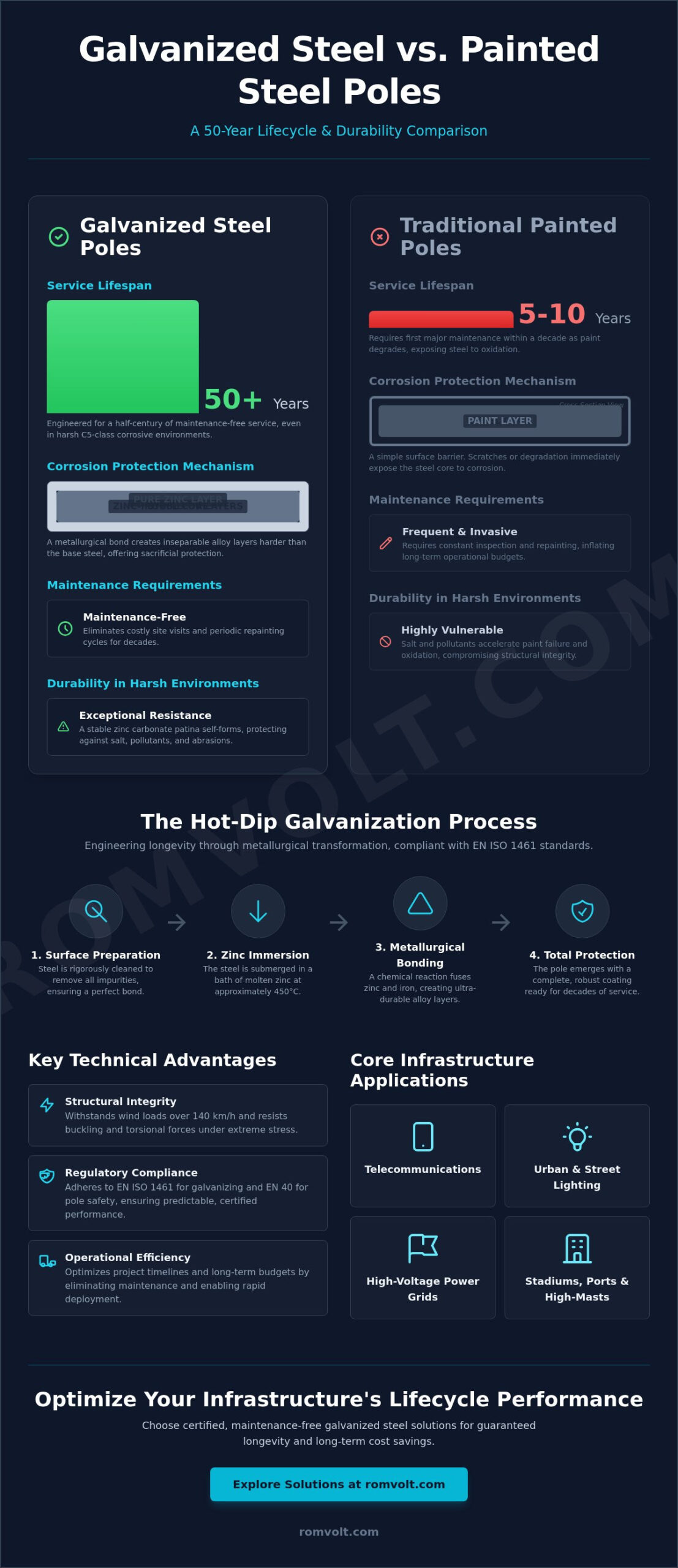
The technical superiority of these structures is evidenced by their 50-year maintenance-free lifecycle, a benchmark established in accordance with ISO 1461 standards for most temperate and C3-class environments. This longevity is achieved through a controlled chemical reaction that occurs during the immersion process. Beyond mere durability, galvanized steel poles offer exceptional structural rigidity and impact resistance, allowing them to withstand wind loads exceeding 140 km/h and mechanical stresses during installation. This combination of physical strength and chemical resistance provides a cost-effective solution for infrastructure managers who must optimize operational budgets while ensuring the highest safety standards.
The Role of Zinc Coating in Corrosion Protection
The efficacy of the Galvanization process lies in the creation of a metallurgical bond between the zinc and the substrate steel. Unlike standard barrier coatings, such as industrial paint or powder coating that merely adhere to the surface, galvanization produces a series of zinc-iron alloy layers. The innermost layers are often harder than the base steel itself, providing a shield that is virtually inseparable from the structure. This coating functions through sacrificial protection; the zinc act as an anode, corroding in place of the steel if the surface is ever breached. This electrochemical priority ensures that the structural core remains intact even when the exterior is subjected to harsh mechanical wear.
Durability in Industrial and Urban Environments
In high-salinity coastal regions or urban zones with elevated levels of sulfur dioxide, galvanized steel poles maintain their integrity where alternative materials often degrade. The zinc surface reacts with the atmosphere to form a stable, insoluble patina of zinc carbonate, which significantly slows the rate of further corrosion. This self-healing characteristic is vital during the logistics and assembly phases, as minor abrasions or scratches sustained during transport do not require immediate on-site repair. From a sustainability perspective, the extended service life of these poles reduces the total carbon footprint of a project. Steel remains 100% recyclable, and the lack of required maintenance interventions over five decades minimizes the consumption of additional resources and labor.
- Structural Integrity: High resistance to buckling and torsional forces under extreme weather conditions.
- Regulatory Compliance: Adherence to European norms for hot-dip galvanizing ensures predictable performance.
- Operational Efficiency: Eliminates the need for periodic inspections and repainting cycles.
The Hot-Dip Galvanization Process: Engineering for Longevity
The structural reliability of galvanized steel poles is not merely a result of the material choice but a direct consequence of the metallurgical transformation occurring during the hot-dip process. Governed by the EN ISO 1461 standard, this procedure ensures that the zinc coating is not just a superficial layer but an integral part of the steel’s molecular structure. The process demands absolute precision in temperature control and chemical balance to achieve the desired protective properties required for decades of exposure in harsh environments.
Surface Preparation and Chemical Bonding
The success of the galvanization depends entirely on the initial stages of surface preparation. Before any zinc contact occurs, the steel undergoes a rigorous cleaning sequence. Degreasing removes organic contaminants like oils and grease that would otherwise prevent the acid from reaching the metal. This is followed by pickling, where the steel is submerged in a hydrochloric acid solution, typically at a concentration of 10% to 15%. This step is essential for removing mill scale and iron oxides, leaving a chemically clean surface.
The final preparatory stage is fluxing, involving a solution of zinc ammonium chloride. This prevents any oxidation from forming on the cleaned steel before it enters the molten bath. It’s this chemical cleanliness that facilitates the development of four distinct intermetallic layers during immersion. These layers provide a bond strength that far exceeds that of mechanical coatings like paint or powder. Without this meticulous preparation, the coating would be prone to delamination, compromising the structural integrity of the infrastructure.
- Immersion Temperature: The zinc bath is maintained at a constant 450°C to ensure optimal fluid dynamics and reaction rates.
- Coating Thickness: Depending on the steel’s silicon and phosphorus content, thickness typically ranges from 55 to 100 microns.
- Reaction Time: Immersion duration is calculated based on the mass of the pole to reach thermal equilibrium.
- Quenching: Controlled cooling stabilizes the coating and prevents the continued growth of brittle alloy layers.
Maintenance-Free Lifecycle and ROI
When calculating the Total Cost of Ownership (TCO), galvanized steel poles demonstrate a clear economic advantage over painted steel systems. While the initial capital expenditure might be comparable, the long-term savings are substantial because the process eliminates the need for periodic on-site recoating or rust remediation. In standard C3 atmospheric environments, a hot-dip galvanized coating can provide 50 to 70 years of protection without requiring any manual intervention.
Maintenance-free service life is defined under EN ISO 1461 as the duration of time until the zinc coating thins to a point where 5% of the base steel surface shows signs of red rust, necessitating the first major maintenance cycle. This predictability allows infrastructure managers to allocate budgets more effectively, focusing on system upgrades rather than basic corrosion repair. For projects requiring such high-performance standards, exploring the integrated electrical solutions offered by Romvolt ensures that every component meets these rigorous technical benchmarks. Final inspection involves magnetic thickness testing and visual checks to confirm coating uniformity, ensuring the pole is ready for immediate installation in the field.
Core Applications of Galvanized Steel in Structural Engineering
The implementation of galvanized steel poles across modern infrastructure projects isn’t merely a matter of tradition; it’s a calculated engineering decision based on the material’s superior load-bearing capacity and corrosion resistance. These structures provide the essential framework for public safety, connectivity, and industrial logistics. By utilizing zinc-coated steel, engineers ensure that utility assets remain functional for 50 years or more, even in high-salinity or high-pollution environments where untreated metals would fail within a decade.
Urban Lighting and Utility Infrastructure
Municipal streetscapes rely on standardized conical and stepped poles to maintain safety and visibility. These designs aren’t chosen for aesthetics alone. A conical profile offers better aerodynamic performance, while stepped poles provide a cost-effective solution for standard height requirements. Modern urban planning now demands more from these structures than just light. Today’s street lighting poles act as integrated hubs for smart-city technology, housing 5G small cells, EV charging ports, and environmental sensors.
When selecting the appropriate material for these integrated systems, structural integrity is paramount. While some projects might consider lighter alternatives, a detailed aluminum lighting poles vs steel analysis usually reveals that steel provides the necessary rigidity for heavy sensor arrays and wind-load resistance. Galvanized steel remains the industry benchmark for projects where vibration dampening and long-term structural stability are non-negotiable requirements.
High-Mast Systems for Large-Scale Projects
For industrial hubs like port terminals, airports, and sports stadiums, illumination must be delivered from significant heights. High-mast systems typically exceed 30 meters, requiring specialized engineering to manage the massive overturning moments caused by wind pressure. These systems utilize specific mechanical configurations to ensure operational efficiency:
- Mobile Crown Systems: These allow the entire lighting ring to be lowered to ground level via an internal winch. It’s a safer choice for maintenance in high-traffic areas like busy highway interchanges.
- Fixed Crown Systems: Often used in stadiums where high-capacity lighting arrays are required. These provide maximum stability but require specialized aerial platforms for maintenance.
- Wind-Resistant Design: Engineers design these masts to withstand gusts exceeding 160 km/h, utilizing high-tensile steel grades that maintain flexibility without compromising the galvanized protective layer.
Beyond lighting, galvanized steel poles serve as the primary support for telecommunication antennas and renewable energy components. In the telecommunications sector, the rigidity of steel prevents the signal “sway” that can disrupt high-frequency data transmission. For custom projects, such as monumental flagpoles or decorative urban masts, the galvanization process allows for a clean, industrial finish that can be further enhanced with powder coating (duplex systems) to meet specific architectural color palettes without losing the underlying cathodic protection.
The technical reliability of these structures rests on their compliance with EN ISO 1461 standards. This ensures that every square centimeter of the pole, including internal surfaces, receives a uniform zinc coating. This level of precision is why galvanized steel remains the preferred choice for engineers managing high-stakes infrastructure where failure isn’t an option.
Technical Specifications, Compliance, and Safety Standards
The engineering of galvanized steel poles requires a strict adherence to international benchmarks to ensure long-term structural viability. Every component must withstand static and dynamic forces, particularly wind-induced vibrations and heavy equipment mounting. Material selection serves as the primary determinant of performance; S235 grade steel offers a standard yield strength of 235 MPa for general applications, while S355 grade provides 355 MPa, allowing for reduced wall thickness without compromising load-bearing capacity in high-stress environments.
EN 40 Standards and Structural Integrity
Compliance with the EN 40 series is non-negotiable for lighting columns and structural masts across Europe. These standards dictate precise limits for horizontal deflection, which are categorized into classes to prevent excessive movement that could damage luminaires or sensitive sensors. Engineers must perform site-specific wind load calculations based on Eurocode 1, Part 1-4, accounting for local topography and gust factors.
Verification of weld quality follows EN ISO 5817, ensuring that joints are free from defects that lead to structural fatigue. For municipal projects, the technical documentation package must include a Declaration of Performance (DoP) and CE marking. These records prove that the poles have undergone rigorous testing for load resistance and durability under extreme weather conditions. The documentation serves as a legal guarantee that the infrastructure can support its intended payload for a service life often exceeding 25 years. Engineers seeking a definitive reference for interpreting these requirements will find the EN 40 lighting columns technical reference an essential resource for navigating the standard’s seven distinct sections and ensuring full structural compliance.
Passive Safety and Driver Protection
In areas with high traffic volumes, the implementation of passive safety poles is a critical strategy for mitigating collision severity. These structures are engineered according to EN 12767, which classifies masts based on their energy absorption levels: High Energy (HE), Low Energy (LE), and Non-Energy absorbing (NE).
The design of galvanized steel poles for passive safety relies on controlled deformation. Through specific base triggers or shear-off mechanisms, the pole absorbs kinetic energy or yields upon impact, significantly reducing the deceleration forces acting on vehicle occupants. This balance between structural rigidity for daily loads and predictable failure during an accident is the hallmark of modern infrastructure safety. Engineers prioritize these solutions on motorways and high-speed urban corridors where traditional rigid barriers aren’t feasible.
Specifying Galvanized Solutions for National Infrastructure
Success in national infrastructure projects depends on more than just material selection; it requires a manufacturer capable of providing end-to-end engineering expertise. Selecting galvanized steel poles involves a rigorous evaluation of structural integrity and environmental resilience. Romvolt approaches these projects as a strategic partner, ensuring every component meets Eurocode 3 standards for steel structures. This technical alignment minimizes the risk of structural failure and extends the operational lifecycle of assets beyond 50 years in C3 or C4 corrosion environments. It’s a process that balances structural necessity with the aesthetic requirements of modern urban planning.
Technical Design and Structural Calculations
Engineering precision begins with advanced CAD modeling and Finite Element Analysis (FEA) to simulate real-world stressors. Romvolt utilizes these tools to design custom masts that accommodate specific equipment loads, such as high-density luminaires or telecommunications arrays. We provide comprehensive technical documentation, including static calculations and material certificates, which are essential for tender compliance and regulatory approval. It’s vital that foundation specifications are precisely calibrated to match both the pole height and local soil bearing capacities, often determined through geotechnical reports. Our engineers ensure that wind load calculations account for peak gusts exceeding 140 km/h, providing a safety margin that protects public investment.
Logistics and Foundation Integration
Managing the transport of high-masts and oversized galvanized steel poles requires specialized logistics planning, especially for remote infrastructure sites. Romvolt streamlines this process by integrating pre-cast concrete foundation blocks into the delivery cycle. These blocks allow for rapid site deployment, reducing installation time by up to 65% compared to traditional poured-in-place methods. This approach ensures consistent quality control, as foundations are manufactured in a controlled factory environment rather than being subject to variable weather conditions on-site. It’s a method that guarantees structural stability from the moment of installation.
Final site commissioning involves a strict quality assurance protocol. We verify vertical alignment tolerances and torque specifications for all fastening elements. This systematic approach ensures that the infrastructure performs according to design parameters from the first day of operation. By coordinating the logistics of oversized components and pre-cast elements, we eliminate the common bottlenecks associated with large-scale deployments. Our focus remains on providing a stable, durable, and compliant backbone for the nation’s electrical and lighting networks through disciplined engineering and logistical excellence.
Achieving Structural Resilience in National Infrastructure
Selecting materials for large-scale utility projects requires a commitment to rigorous technical standards and long-term durability. The implementation of galvanized steel poles ensures that infrastructure remains resilient against atmospheric corrosion for decades, primarily due to the metallurgical bond created during the hot-dip process. Adherence to ISO 9001 and EN 40 certification protocols isn’t just a regulatory requirement; it’s a fundamental guarantee of safety for public spaces and industrial zones. These standards provide the necessary framework for maintaining structural integrity under diverse environmental loading conditions.
Romvolt integrates specialized structural engineering support with global logistics expertise to manage the complex requirements of oversized components. This methodical approach minimizes site-specific risks and optimizes the deployment timeline for critical utility networks. By prioritizing certified manufacturing and precise technical specifications, engineers can secure the functional lifespan of national grids. It’s about building systems that withstand the test of time and environmental stress. We’re ready to provide the technical rigor your project demands.
Consult with Romvolt’s engineering team for your next infrastructure project. We’re here to ensure your vision is supported by engineering excellence and reliable manufacturing.
Frequently Asked Questions
What is the typical lifespan of a galvanized steel pole?
A standard galvanized steel pole provides a service life exceeding 50 years in most atmospheric conditions. The American Galvanizers Association indicates that the corrosion rate of zinc is approximately 1/30th that of bare steel. This longevity results from the metallurgical bond formed during the hot-dip process, creating a coating thickness of at least 86 microns for steel over 6mm thick. Such durability ensures that infrastructure remains functional without the need for frequent replacement cycles.
Does galvanization affect the structural strength of the steel?
Hot-dip galvanization doesn’t compromise the structural integrity or mechanical properties of the base steel. The process occurs at temperatures around 450 degrees Celsius, which is well below the critical transition temperature of structural steel. Engineering tests confirm that the yield strength and tensile properties remain within the original 100% specification limits after immersion. This thermal process actually helps identify surface defects that might’ve been hidden before the treatment.
Can galvanized steel poles be painted for aesthetic reasons?
You can paint galvanized steel poles using a duplex system to enhance both aesthetics and corrosion resistance. This combination extends the maintenance cycle by 1.5 to 2.3 times the sum of the individual lifetimes of the paint and the zinc layer. Success depends on surface preparation according to ASTM D6386 standards to ensure the coating adheres to the zinc surface. It’s a strategic choice for urban environments where visual integration is as important as structural longevity.
How do galvanized steel poles compare to aluminum in cost and durability?
Galvanized steel poles offer a modulus of elasticity of 200 GPa, which is three times higher than the 69 GPa provided by aluminum alternatives. While aluminum resists corrosion naturally, it costs approximately 30% to 50% more than steel per unit of strength. Steel remains the preferred choice for high-load infrastructure where deflection limits are strictly enforced by EN 40-3 standards. The higher density of steel also provides better resistance against physical impacts in high-traffic areas.
What maintenance is required for hot-dip galvanized poles?
Maintenance requirements for hot-dip galvanized poles are virtually nonexistent for the first 25 to 30 years of service. Operators should perform visual inspections every 5 years to check for mechanical damage or localized zinc depletion. If the coating thickness falls below 20 microns, a cold-galvanizing compound containing at least 92% zinc dust can be applied to restore protection. This proactive approach ensures the structure reaches its full 50-year design life without structural failure.
Are galvanized poles suitable for coastal areas with high salt exposure?
Galvanized poles are suitable for coastal environments, though they face higher corrosion rates due to constant chloride exposure. In C5-M marine environments, the zinc erosion rate can reach 8 microns per year. Specifying a thicker initial coating or a duplex system ensures the structure maintains its integrity for the intended 20-year design life in high-salinity zones. Regular rinsing with fresh water can also help remove salt deposits that accelerate the depletion of the protective zinc layer.
What standards govern the production of galvanized lighting poles?
The production of galvanized steel poles is governed primarily by the EN 40 lighting columns standard series in Europe and ASTM A123 in North America. These standards dictate the material composition, welding quality, and minimum zinc coating weights required for public safety. Compliance with ISO 1461 ensures that the batch hot-dip galvanizing process meets international quality benchmarks for consistency. These regulations provide a framework for engineers to verify that every component meets the necessary load-bearing requirements.
How are wind loads calculated for high-mast galvanized structures?
Engineers calculate wind loads for high-mast structures using the ASCE 7-16 standard or Eurocode 1 protocols. These calculations account for a 50-year mean recurrence interval and specific gust factors based on the pole’s height and geometric shape. For a 30-meter mast, the design must withstand wind speeds often exceeding 160 kilometers per hour depending on the local topography. Proper calculation prevents catastrophic failure during extreme weather events and ensures public safety.