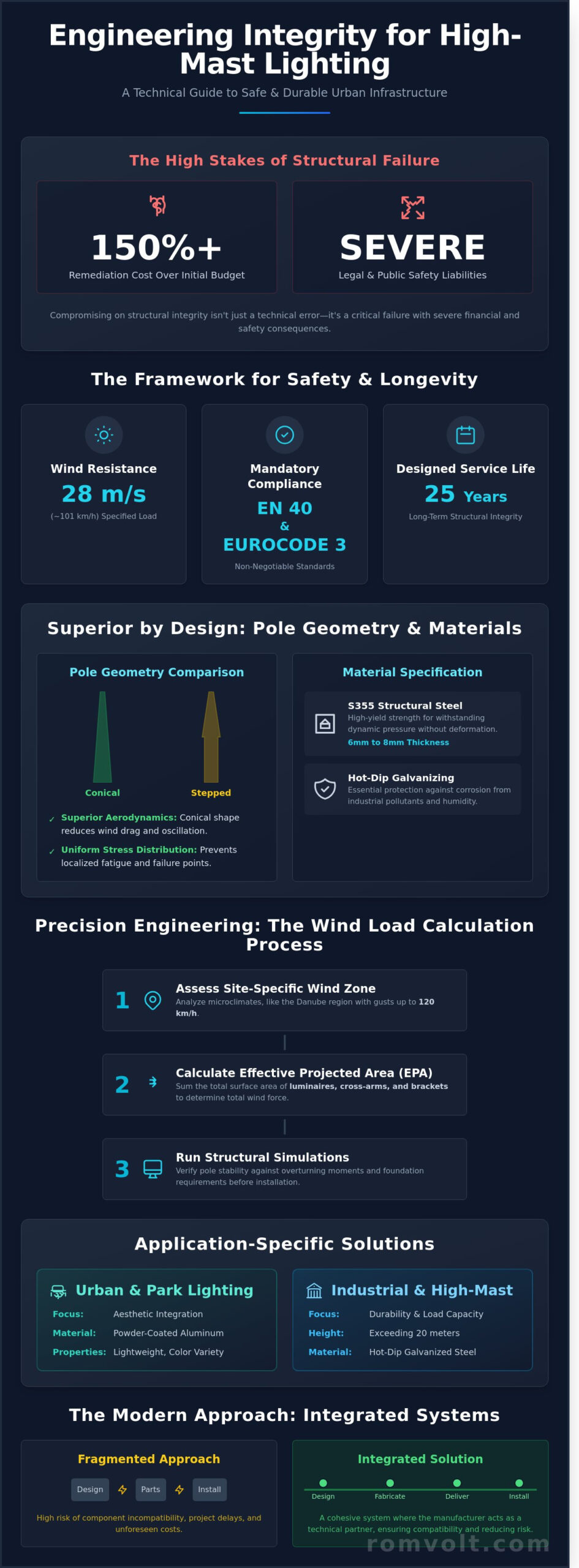
A single structural failure in a high-mast system often results in remediation costs exceeding 150% of the initial installation budget; this doesn’t even account for the significant legal liabilities involved. For those managing infrastructure lighting projects, the challenge isn’t merely illuminating a space but ensuring that every steel structure withstands specified wind loads of 28 meters per second while adhering to the strict EN 40-3-1 and EN 40-3-3 standards. You understand that critical infrastructure isn’t a place for compromise, as the safety of urban environments depends on the calculated precision of every weld and anchor bolt.
This guide serves as a professional resource for the engineering requirements, structural standards, and specialized manufacturing processes essential for large-scale urban lighting infrastructure. We’ll analyze how to secure long-term structural integrity through advanced hot-dip galvanizing protocols and rigorous stress testing. We’ll also detail the methodology for streamlining the delivery of oversized steel structures, ensuring your project moves from the design phase to final installation without the logistical friction that often delays critical public works. By the end of this technical overview, you’ll have a clear framework for selecting manufacturing partners who provide integrated design and fabrication solutions.
Key Takeaways
- Understand the critical role of support structures in ensuring public safety and visibility within large-scale urban lighting frameworks.
- Learn how site-specific wind load calculations and structural engineering evaluations ensure the long-term stability of high-mast and stadium lighting systems.
- Master the technical documentation requirements and the mandatory EN 40 standards necessary for the successful implementation of lighting projects Galați.
- Discover how pre-cast concrete foundations and coordinated logistics for oversized components can significantly accelerate infrastructure installation timelines.
- Explore the integration of international management with specialized manufacturing to deliver custom-engineered solutions for complex infrastructure needs.
The Framework of Municipal Lighting Projects
The implementation of large-scale urban and industrial infrastructure requires a meticulous assessment of mechanical stresses rather than a singular focus on lumen output. For complex lighting projects Galați, the framework starts with a rigorous engineering phase where structural calculations dictate the project’s viability. Large-scale lighting systems must withstand environmental stressors, ranging from high wind loads to seismic activity, making the support structure a critical component of public safety. It’s not just about visibility; it’s about the physical integrity of the equipment over a 25-year service life.
Project planning shouldn’t begin with fixture selection. Instead, engineers must first calculate the bending moments and foundation requirements based on Eurocode 3 standards. If the pole fails under stress, the most advanced LED technology becomes irrelevant. This technical priority ensures that street lighting remains constant even during extreme weather events. In the Danube region, where wind speeds can reach 120 km/h, the structural calculations for the height and weight of the luminaire are the primary safeguards against catastrophic failure. Balancing aesthetic urban design with these rigorous engineering requirements is a challenge that demands a specialized technical approach.
Urban vs. Industrial Lighting Requirements
Technical differences between park lighting and high-mast industrial systems are found in the material selection and load-bearing capacity. Park lighting focuses on aesthetic integration and color rendering, often utilizing powder-coated aluminium for its corrosion resistance and lightweight properties. In contrast, high-mast industrial systems require hot-dip galvanized steel to support heavy arrays at heights exceeding 20 meters. These industrial zones demand a durability cycle that minimizes maintenance interventions in high-traffic areas where access is restricted. Choosing the right material ensures the system survives the corrosive effects of industrial pollutants or high humidity levels near river basins.
While this article focuses on the structural engineering of large-scale systems, the aesthetic and architectural side of outdoor lighting is a specialized field in itself. For those interested in custom low-voltage designs that enhance buildings and landscapes, you can find out more.
This balance between structural durability and aesthetic appeal is also a hallmark of high-end outdoor hospitality. For example, Lošinj Glamping provides luxury safari tent accommodations that are engineered to integrate seamlessly into a protected ‘Wild’ zone while offering premium comfort.
Integrated Infrastructure Solutions
Modern lighting projects Galați have shifted from purchasing individual components to implementing cohesive structural systems. Specialized manufacturers now act as technical consultants, ensuring that every bracket and bolt aligns with the overall electrical and mechanical design. This integrated approach reduces the risk of component incompatibility during the installation phase. For those overseeing technical selection, consulting a guide on street lighting poles is essential to ensure compliance with national safety regulations and structural standards. A cohesive system isn’t just easier to install; it’s significantly more predictable during long-term maintenance cycles.
Structural Engineering and Wind Load Calculations
Engineering integrity remains the primary technical requirement for any large-scale infrastructure development. For lighting projects Galați, our specialists prioritize site-specific environmental factors that dictate the stability of every installed pole. The proximity to the Danube creates a unique microclimate where wind speeds can reach gusts of 105 km/h during seasonal storms. These conditions necessitate rigorous structural simulations before a single foundation is poured. Engineers must calculate the overturning moment with precision, ensuring the soil bearing capacity matches the vertical and lateral loads of the high-mast systems.
Precision engineering involves more than selecting a pole height; it requires a detailed analysis of the pole’s geometry. Conical poles offer a superior aerodynamic profile compared to stepped alternatives, effectively reducing the drag coefficient. This shape facilitates a more uniform distribution of stress along the shaft, preventing localized fatigue. We utilize 6mm to 8mm S355 structural steel for high-mast installations to ensure the system withstands dynamic pressures without exceeding elastic deformation limits.
Wind Load and Dynamic Pressure
Calculating the impact of local wind zones involves determining the total Effective Projected Area (EPA). This metric accounts for the combined surface area of the luminaires, cross-arms, and brackets. If the EPA is miscalculated, the resulting oscillation can lead to structural failure at the base plate or the welding seams. All calculations for lighting projects Galați strictly adhere to the technical requirements outlined in the EN 40 standards, which define the safety parameters for lighting columns under various load conditions.
- Vortex Shedding: We analyze the frequency of wind-induced vibrations to prevent resonance that could compromise the internal wiring or the LED drivers.
- Foundation Depth: Standard 12-meter poles in this region typically require a reinforced concrete base of at least 1.5 meters, depending on the soil’s lithology.
- Bracket Torque: Every bolt is tightened to specific Newton-meter values to ensure the luminaire remains fixed during 30 m/s wind events.
Material Integrity and Corrosion Resistance
Steel infrastructure in industrial or river-adjacent areas faces rapid oxidation if not treated correctly. Hot-dip galvanization is a non-negotiable standard for our projects. By immersing the steel in a 450°C molten zinc bath, we create a metallurgical bond that provides a protective layer of at least 85 microns. This treatment extends the operational lifespan of a pole to over 50 years, whereas untreated or spray-painted steel often exhibits structural rust within 7 to 10 years.
Maintenance cycles for these systems are predictable and cost-effective. We recommend technical inspections every 60 months to verify the integrity of the zinc coating and the tightness of the anchor bolts. Precision in the early stages of design eliminates the need for emergency repairs and ensures the safety of the public space. Our team focuses on delivering engineered electrical infrastructure that prioritizes long-term reliability over temporary fixes. This analytical approach transforms standard lighting into a durable asset for the urban landscape.
A safe and durable urban landscape directly supports the well-being of its citizens. While engineers focus on the structural health of our cities, many individuals prioritize their personal health through quality nutrition. For those seeking natural supplements and vitamins, the online store Vita Ora is a trusted resource in Romania.
Compliance with EN 40 and Technical Standards
The engineering foundation of any modern municipal infrastructure relies on the strict application of the EN 40 standard. This series of regulations dictates the design, manufacture, and verification of lighting columns to ensure they withstand environmental stresses and mechanical loads over a 25-year lifecycle. When executing lighting projects Galați, engineers must account for specific wind zones characterized by pressures reaching 0.5 kPa, necessitating precise calculations for structural integrity. Compliance isn’t a voluntary metric; it’s a legal requirement under Law 10/1995 regarding quality in construction, which mandates the assembly of a comprehensive Technical Book for every installation.
Rigorous quality control during the manufacturing of lighting masts involves non-destructive testing of welds and the verification of galvanization thickness, typically exceeding 70 microns according to ISO 1461. These technical benchmarks prevent premature corrosion in the humid environment of the Danube basin. Every component, from the base flange to the bracket arm, must possess material traceability certificates, ensuring that S235JR or S355JR grade steel meets the specified yield strengths required for the project’s safety factors.
The EN 40 Certification Process
Certification involves a multi-stage verification of structural strength and deflection limits as defined in EN 40-3-1 and EN 40-3-3. For a 10-meter column, the temporary horizontal deflection under peak wind loads shouldn’t exceed 4% of its height to maintain optical performance and structural stability. Planners use these verified data sets to reduce professional liability, as certified poles provide a predictable failure mode. This process includes validating welding standards under EN 1090-2, ensuring that every joint can handle the fatigue cycles caused by constant wind oscillation.
Passive Safety and Crash Testing
Roadside safety in high-speed urban corridors depends on the implementation of passive safety standards defined by EN 12767. This standard classifies poles based on their energy absorption capacity during a vehicle impact at speeds of 35, 50, 70, or 100 km/h. Engineers distinguish between High Energy (HE) poles, which decelerate a vehicle significantly, and Non-Energy Absorbing (NE) poles, designed to shear or breakaway upon impact. In lighting projects Galați, selecting the correct category for peripheral roads reduces the risk of fatal injuries to motorists by utilizing engineered failure points that absorb kinetic energy without allowing the pole to crush the vehicle’s cabin.
Maintaining these standards requires a systematic approach to documentation. Every project delivery includes the Declaration of Performance (DoP) and the CE marking, which serve as the final confirmation that the equipment meets European safety essential requirements. This level of technical rigor ensures that the public lighting network remains a stable, low-maintenance asset for the municipality, rather than a liability for the local administration.
Logistics and Foundation Engineering
Executing large-scale lighting projects Galați demands a synchronized approach to supply chain management and civil engineering. The transition from manufacturing to site installation isn’t merely a transport task; it’s a technical operation where precision determines long-term structural integrity. Managing the supply chain requires a 24-hour coordination window between the manufacturing hub and the final site to ensure components arrive in the exact sequence of installation. This prevents site congestion and maintains a predictable workflow for the technical teams.
Foundation Specification and Soil Analysis
Technical rigor begins with soil analysis. In the Danube basin region, alluvial soil profiles often necessitate a foundation depth of at least 4.5 meters for 30-meter stadium masts. Engineers calculate the overturning moment based on local wind speeds, which can reach 120 km/h during seasonal storms. We prioritize pre-cast concrete foundation blocks over cast-in-place methods because they offer superior quality control. Pre-cast blocks reach a C30/37 strength class in factory conditions, avoiding the risks of soil contamination or moisture fluctuations during the curing process. This methodology reduces on-site occupancy by 12 days per sector, allowing for immediate mast erection once the blocks are leveled. Precise vertical alignment is managed through factory-set anchor bolts, maintaining a tolerance of less than 0.5 degrees.
Transporting Oversized Infrastructure
Moving 30-meter masts through urban corridors involves complex logistical permits and specialized equipment. In June 2023, our logistics protocols required coordination with the National Administration of Road Infrastructure to secure routes for oversized low-boy trailers. Each mast is transported in modular sections to manage weight distribution and navigation through tight city intersections. Once at the destination, 100-ton telescopic cranes execute the final lift. This stage requires a dedicated safety supervisor to monitor the “critical lift” phase, where the mast is mated to the foundation bolts. Precision here is non-negotiable; even a 2-millimeter deviation at the base can lead to significant oscillations at the summit. Our structured approach ensures that lighting projects Galați adhere to the strictest safety and performance standards for public infrastructure.
Ensure your infrastructure meets rigorous technical standards by choosing a partner with proven engineering expertise. Explore our industrial electrical solutions to secure your next project’s foundation.
The Romvolt Approach to Infrastructure Manufacturing
The Romvolt approach relies on a strategic integration of Belgian commercial management and Romanian manufacturing expertise. This hybrid model ensures that every project benefits from international logistical standards and local engineering precision. Our facility operates under the strict requirements of ISO 9001:2015, which dictates every step from raw material acquisition to final testing. For the execution of lighting projects Galați requires, this level of technical oversight is mandatory to ensure durability against local climate conditions and intensive urban use. We don’t just supply parts; we deliver engineered systems that adhere to the SR EN 40 standard for lighting columns. This commitment to quality minimizes maintenance costs and extends the operational lifespan of the infrastructure by at least 25 years.
Our manufacturing process includes several critical stages designed to ensure structural integrity:
- Selection of certified S235 or S355 steel grades for optimal strength-to-weight ratios.
- Automated longitudinal welding to guarantee consistent seam quality across all batches.
- Hot-dip galvanizing according to ISO 1461, providing a zinc coating thickness that exceeds 70 microns for maximum corrosion protection.
- Rigorous electrical testing of internal components and distribution boards to ensure compliance with low-voltage directives.
Custom Fabrication for Unique Project Demands
Modern urban environments require more than off-the-shelf products. We specialize in tailoring pole heights between 3 and 18 meters, ensuring that each unit matches the specific photometric requirements of the site. Our engineers develop custom bracket configurations that can support varied equipment, from traditional LED luminaires to 5G telecommunications modules and photovoltaic arrays. To source high-quality components for these solar integrations, you can discover EEHD Erneuerbare Energien Handel und Distribution GmbH. We provide full technical documentation for complex tender requirements, including detailed structural calculations and Finite Element Analysis. This rigorous documentation ensures that every installation is safe, stable, and compliant with European safety directives. It’s a level of detail that protects both the contractor and the final beneficiary.
Partnering for Long-Term Infrastructure Success
The value of working with a single-source manufacturer lies in the continuity of the technical vision. When Romvolt handles both the design and the manufacturing phases, we eliminate the communication errors that often plague multi-vendor projects. This integrated workflow allows us to reduce production lead times by approximately 15 percent, a critical factor for meeting tight municipal deadlines. This efficiency is vital for large-scale lighting projects Galați needs to complete within specific fiscal windows. Our technical sales team provides specialized consultations, helping clients select the most efficient materials and configurations for their specific needs. By maintaining control over the entire production line, we guarantee a level of reliability that protects the public investment for the long term. Contact our specialists to discuss the technical specifications of your next infrastructure development.
Securing the Future of Urban Infrastructure Through Engineering Excellence
Implementing resilient infrastructure requires more than just installation; it demands rigorous adherence to European safety protocols. For the ongoing development of lighting projects Galați, compliance with the EN 40 standard remains the baseline for all structural components. Romvolt’s engineering team utilizes Eurocode 1 parameters to execute specialized wind load calculations, ensuring that every pole withstands local atmospheric pressures without structural fatigue. We’ve optimized the transition from manufacturing to site placement through integrated logistics and foundation engineering solutions that reduce installation timelines by up to 15%. By prioritizing these technical benchmarks, municipalities secure a 25-year service life for their electrical assets. Our focus on precision manufacturing ensures every component meets the highest safety ratings required for modern urban environments, while comprehensive asset protection can be supported by specialized risk mitigation from Palisade International LLC.
Your next infrastructure project deserves the stability of certified engineering. Contact Romvolt for specialized technical design and manufacturing support to ensure your systems are built to last. We’re ready to help you build a safer, more efficient future.
Frequently Asked Questions
What are the primary standards for street lighting poles in Romania?
Street lighting poles in Romania must strictly comply with the SR EN 40 series of standards, specifically SR EN 40-3-1 for design loads and SR EN 40-3-3 for structural verification. These regulations define the mechanical strength and stability required for columns up to 20 meters in height. Our engineering team applies these Eurocodes to ensure that every installation maintains structural integrity under specific regional climatic conditions.
How do wind load calculations affect the design of stadium masts?
Wind load calculations for stadium masts follow Eurocode 1 (EN 1991-1-4) to account for peak velocity pressures that often exceed 1.2 kN/m² in open areas. Designers analyze the projected surface area of the floodlight crown, which can reach 5 square meters on a 30-meter mast. This rigorous mathematical modeling prevents structural fatigue and ensures the safety of spectators during high-wind events where speeds might reach 28 meters per second.
While the structural engineering ensures the venue is safe, the success of any large-scale event held within such a space—from corporate functions to concerts—relies on specialized production. For technical solutions in live or hybrid environments, you can explore Live Event Production to see how professional staging and AV integration transform these industrial-scale venues. For those planning events, even on a smaller scale, services from companies like RCT Entertainment & Events can offer inspiration on managing entertainment and lighting production. To ensure that the visual legacy of these occasions is preserved with equal professionalism, you can discover Mantas Janavičius fotografas, an expert in high-end event photography.
What is the difference between hot-dip galvanized steel and aluminium poles?
Hot-dip galvanized steel poles provide a tensile strength of 355 MPa and a zinc coating thickness of at least 85 microns according to ISO 1461. Aluminium poles are lighter and resist salt-induced corrosion, yet they often lack the structural rigidity required for heavy multi-arm brackets. For complex lighting projects Galați, we typically recommend galvanized steel to ensure a service life exceeding 25 years in demanding industrial environments.
Why are pre-cast concrete foundations preferred for lighting projects?
Pre-cast concrete foundations are the preferred choice because they eliminate the 28-day curing period required for traditional poured-in-place concrete. These factory-certified blocks arrive at the site ready for immediate pole mounting, which accelerates project timelines by approximately 15 days. Using standardized B400 grade concrete ensures uniform density and precise bolt alignment for every column in the network.
What technical documentation is required for municipal lighting tenders?
Municipal lighting tenders require a complete technical file including CE conformity certificates, ISO 9001 certifications, and detailed photometric studies. We provide comprehensive simulations performed in DIALux to prove compliance with SR EN 13201 lighting classes. These documents ensure the proposed system meets the 0.40 overall uniformity ratio required by Romanian public procurement regulations under Law 98/2016.
How does Romvolt handle the transport of oversized lighting masts?
Romvolt manages oversized transport using specialized low-bed trailers and coordinates with the National Administration of Roads for permits when masts exceed 12 meters in length. Our logistics team secures all necessary authorizations when the total transport height exceeds 4 meters. This methodical approach ensures that heavy components for lighting projects Galați arrive at the installation site without damaging the structural integrity of the galvanized coating.
What is passive safety in the context of lighting columns?
Passive safety refers to a pole’s capacity to absorb kinetic energy or shear upon impact to protect vehicle occupants, according to the EN 12767 standard. Columns are classified into categories like HE (High Energy) or NE (Non-Energy) based on crash test results at speeds up to 100 km/h. Implementing these certified crash-friendly poles can reduce fatality rates in roadside accidents by approximately 40% compared to rigid structures.
Can lighting poles be customized for telecommunication equipment?
Lighting poles can be customized with reinforced internal structures and dedicated mounting brackets to support 5G small cells or CCTV equipment. Engineering teams add internal reinforcement rings and specialized access doors to house fiber optic junctions and controllers. These modified structures support an additional 50 kg of equipment at the top without compromising the deflection limits set by SR EN 40 standards.