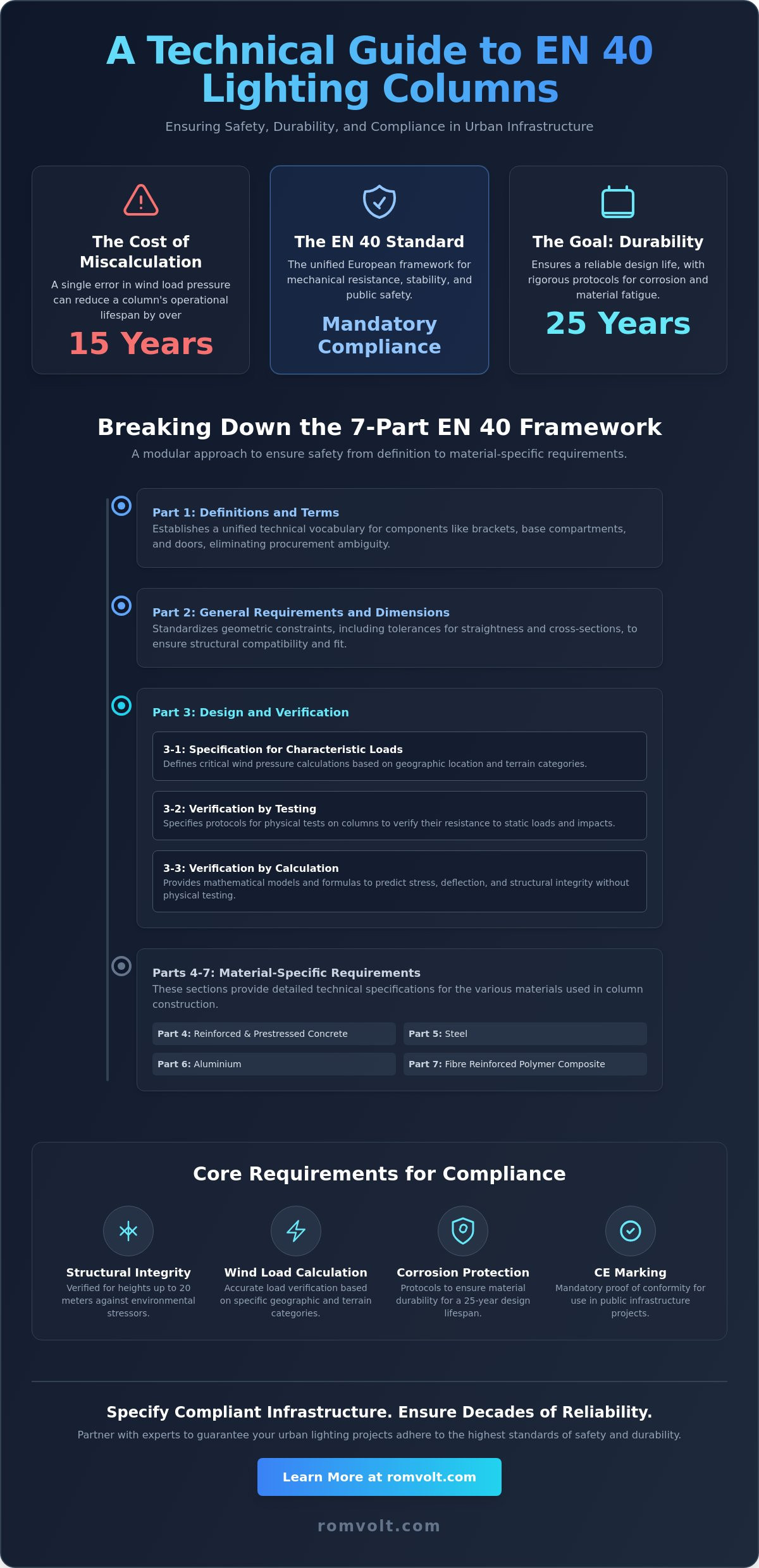
A single miscalculation in wind load pressure according to Eurocode standards can reduce the operational lifespan of urban infrastructure by more than 15 years. Professional engineers and municipal planners often face significant hurdles when interpreting the seven distinct sections of the EN 40 standard, where technical ambiguity frequently leads to structural vulnerabilities. You’re likely aware that the margin for error in public lighting is non-existent, as safety and long-term durability remain the primary metrics for assessing project success. This technical reference provides a definitive engineering guide to EN 40 lighting columns, offering the precision needed to ensure every installation adheres to strict safety protocols and structural integrity requirements. We’ll break down the specific verification methods for steel and aluminium materials, simplify the complexities of Part 3-3 load calculations, and establish a rigorous framework for specifying compliant infrastructure that withstands environmental stress for decades.
Key Takeaways
- Understand the rigorous structural stability and public safety requirements established by the unified EN 40 standard for modern urban lighting infrastructure.
- Learn how to accurately verify characteristic loads, including wind pressure and luminaire mass, based on specific geographic locations and terrain categories.
- Identify the essential material durability standards and corrosion protection protocols required to ensure a reliable 25-year design life for steel components.
- Master the technical process of specifying EN 40 lighting columns while integrating passive safety requirements and mandatory CE marking documentation.
- Gain a comprehensive overview of the seven-part EN 40 series to establish a precise technical vocabulary and maintain full regulatory compliance in engineering projects.
Understanding the EN 40 Standard for Lighting Columns
The EN 40 standard represents the rigorous technical framework governing the design, manufacture, and verification of EN 40 lighting columns across the European Economic Area. This unified regulation ensures that every vertical structure used for public illumination meets specific mechanical resistance and stability criteria. Its scope encompasses columns with a nominal height not exceeding 20 meters, covering various materials including steel, aluminum, and concrete. Compliance isn’t optional; it’s a fundamental requirement for any project involving public tenders or national infrastructure development. By adhering to these benchmarks, engineers guarantee that urban lighting systems withstand environmental stressors while protecting the public from structural failures.
The Evolution of Lighting Column Regulations
Transitioning from fragmented national codes to a harmonized European system was a critical step for industrial safety. Before this unification, manufacturers faced inconsistent requirements that complicated cross-border infrastructure projects. The current framework provides standardized definitions and testing protocols that apply from Stockholm to Bucharest. For a broader context on how these regulations fit into the wider technical landscape, professionals often consult the List of EN standards to understand the interdependencies between material specifications and structural design. This alignment facilitates a transparent procurement process and ensures that all components within a lighting network operate under the same safety assumptions. It’s a system built on decades of empirical data and structural engineering advancements that prioritize long-term durability over short-term cost savings.
Core Safety Objectives of EN 40
The primary engineering focus of the standard involves mitigating risks associated with wind loading and material fatigue. Lighting structures face constant dynamic pressure, especially in coastal or high-altitude regions where wind speeds exceed 25 meters per second. The standard establishes clear baselines for material quality and corrosion resistance, ensuring a service life that typically spans 25 years. It mandates precise calculations for deflection and stresses at the base compartment, which is often the most vulnerable point of the structure. EN 40 lighting columns must pass rigorous verification tests, including static loading and impact resistance assessments. These protocols prevent catastrophic collapses that could endanger pedestrians or motorists during extreme weather events. The standard serves as the structural backbone of European street lighting safety.
- Ensures structural integrity for heights up to 20 meters.
- Standardizes wind load calculations based on regional topography.
- Mandates CE marking as proof of conformity for public infrastructure.
- Defines material performance requirements to prevent premature corrosion.
Breaking Down the Seven Parts of the EN 40 Series
The EN 40 standard operates as a modular framework rather than a single document. It ensures that every EN 40 lighting columns installation meets rigorous safety benchmarks through a structured, seven-part hierarchy. This multi-part approach allows engineers to address specific material behaviors while maintaining a unified safety philosophy across European infrastructure projects. By separating definitions from material requirements, the standard provides a clear roadmap for both manufacturers and site inspectors.
Part 1 to Part 3: The Foundation of Column Design
Part 1 establishes the technical vocabulary for the entire industry. It defines the exact terminology used for brackets, door openings, and base compartments, eliminating ambiguity during procurement. Part 2 focuses on general requirements and dimensions. It standardizes tolerances for straightness and cross-sections, which is vital for ensuring that attachments fit correctly. According to the BS EN 40 – Lighting columns documentation, these early sections set the geometric constraints that all compliant manufacturers must follow to ensure structural compatibility.
Part 3-1 and 3-3 are critical for structural integrity. They specify characteristic loads, including wind pressure variables based on geographical location and terrain categories. Engineers face a choice here: verification by calculation or verification by physical testing. Verification by calculation uses mathematical models to predict stress points, while physical testing involves applying actual loads to a prototype until failure occurs. Both methods ensure the column can withstand the 50-year return period wind speeds common in European design codes. This rigorous verification process prevents catastrophic failures during extreme weather events.
Material-Specific Specifications (Parts 4-7)
Specificity increases as the standard moves into material-specific requirements. EN 40-5 governs steel lighting columns, which remain the industry standard for most urban environments. It mandates strict adherence to welding standards and hot-dip galvanization processes to prevent subsurface corrosion. For projects requiring lighter structures or specific aesthetic qualities, EN 40-6 details the requirements for aluminium columns. These units offer superior corrosion resistance in maritime environments but require different structural calculations due to the material’s lower modulus of elasticity compared to carbon steel.
Part 7 addresses the growing role of fibre-reinforced polymer (FRP) composite columns. These are becoming more common in areas where electrical insulation or low weight is a priority. Each material choice impacts the long-term reliability and maintenance of the electrical infrastructure. Whether utilizing steel, aluminium, or advanced composites, the EN 40 lighting columns standard ensures that the final assembly provides a stable, safe platform for luminaires and auxiliary equipment. This systematic breakdown ensures that every component, from the base bolt to the bracket arm, performs predictably under stress.
Structural Design and Load Verification Methods
The structural integrity of EN 40 lighting columns depends on a precise assessment of characteristic loads. Engineers must evaluate the vertical forces originating from self-weight and luminaire mass alongside the dominant horizontal force of wind pressure. This process ensures the column withstands extreme weather events without compromising public safety. The European Standard EN 40 framework provides the mandatory technical criteria for these assessments, specifically through parts 3-1, 3-2, and 3-3.
Wind Loading and Site-Specific Variables
Wind loading represents the most significant variable in the design phase. Designers utilize national wind maps to determine the fundamental basic wind speed, often measured as a 10-minute mean velocity at 10 meters above ground. This value is adjusted based on the specific terrain category, ranging from Category I (open sea or lakes) to Category IV (urban areas where at least 15% of the surface is covered with buildings exceeding 15 meters in height).
- Effective Projected Area (EPA): Calculations must account for the EPA of both the luminaire and the bracket. Even a small increase in the luminaire’s surface area can exponentially increase the bending moment at the base.
- Dynamic Effects: For columns exceeding 20 meters, designers must address vortex shedding. This phenomenon occurs when wind creates alternating eddies, potentially causing oscillations that lead to structural fatigue.
Verification by Calculation (EN 40-3-3)
Verification by calculation is the standard approach for most infrastructure projects. It utilizes limit state design principles to ensure the structure doesn’t reach a state of collapse or excessive deformation. The analysis focuses on critical stress points where failures are most likely to occur. These include the base plate connection, the welded joints, and the door opening area, which is often the weakest point of the shaft due to the reduction in the cross-sectional area.
The methodology used here is consistent with the rigorous approach required for structural calculations for masts. Engineers apply partial safety factors to both loads and material strengths to provide a buffer against unforeseen environmental extremes. If a design doesn’t meet these mathematical thresholds, it’s rejected before production begins. Precision is mandatory; a discrepancy of just 5% in material thickness can compromise the entire installation’s safety rating.
In cases where complex geometries make mathematical modeling difficult, EN 40-3-2 allows for verification by physical testing. This involves applying static loads to a prototype to measure actual deformation. However, most modern EN 40 lighting columns are verified via software-driven EN 40-3-3 calculations because they’re faster and highly reliable for standard tapered or stepped profiles.
Deflection limits are another vital consideration. To prevent luminaire flicker and maintain a steady light distribution, the horizontal deflection at the top of the column shouldn’t exceed 5% of the height above ground. This rigidity doesn’t just improve lighting quality; it’s a fundamental requirement to prevent long-term material fatigue caused by constant swaying.
Material Durability and Corrosion Protection Requirements
Adherence to EN 40 standards requires a rigorous approach to material selection and surface treatment to ensure a minimum 25-year design life. Environmental factors, particularly atmospheric corrosivity categories from C1 to C5-M, dictate the necessary protective measures. For EN 40 lighting columns, durability isn’t just about structural integrity; it’s about preventing the degradation that leads to catastrophic failure in public spaces. Our engineering approach prioritizes chemical stability and mechanical resistance through standardized coating processes.
Steel Column Longevity and Galvanization
Hot-dip galvanization is the primary defense mechanism for steel infrastructure. According to EN ISO 1461, the process involves immersing the steel in a molten zinc bath at approximately 450 degrees Celsius. This creates a series of zinc-iron alloy layers that provide both barrier and sacrificial protection. When specifying galvanized steel poles, engineers must account for the steel’s chemical composition, specifically silicon and phosphorus levels. These elements influence the Sandelin effect, which can lead to brittle, overly thick coatings if not controlled.
Technical risks like liquid metal embrittlement (LME) and hydrogen induced cracking (HIC) require careful management during the fabrication phase. LME occurs when molten zinc penetrates the grain boundaries of high-strength steel under stress. To mitigate this, we ensure proper venting and drainage hole placement, which also prevents internal corrosion in hollow sections. It’s a precise science that eliminates the risk of structural compromise during the galvanizing cycle.
Comparing Steel and Aluminium under EN 40
Choosing between materials involves a detailed lifecycle cost analysis. Aluminum columns offer a superior weight-to-strength ratio, often weighing 40% to 60% less than their steel counterparts. This reduction significantly lowers foundation requirements and transport costs. While aluminum naturally forms a protective oxide layer, coastal or high-pollution environments often necessitate anodizing or powder coating to prevent pitting corrosion. You can find a deeper breakdown of these trade-offs in our guide on aluminum lighting poles vs steel.
- Maintenance Cycles: Steel typically requires inspection every 5 to 7 years for coating integrity, while aluminum can often go 10 to 12 years without surface intervention.
- Coastal Protection: In C5-M environments, we recommend an additional thermoplastic or bituminous coating on the root section (the part buried in the ground) to prevent soil-side corrosion.
- Internal Sealing: For EN 40 lighting columns installed in high-humidity areas, internal protective sprays are applied to stop condensation-driven oxidation.
The goal is always to match the protection level to the specific micro-climate of the installation site. Precision in these early stages prevents expensive remediation work after the columns are energized. If you’re planning a large-scale project, contact our technical team for compliant infrastructure solutions that meet all Eurocode and EN 40 requirements.
Specifying EN 40 Columns for Modern Infrastructure
Successful infrastructure implementation requires the seamless integration of EN 40 structural standards with the EN 12767 passive safety framework. While EN 40 focuses on the column’s ability to withstand static and dynamic wind loads, EN 12767 governs the behavior of the structure during a vehicle collision. This dual compliance ensures that the EN 40 lighting columns don’t just provide illumination but also contribute to the overall safety of the transport corridor by minimizing impact severity.
During the procurement phase, engineers must prioritize the Declaration of Performance (DoP) and the CE marking. These aren’t mere administrative formalities; they serve as legal proof that the product meets the essential characteristics defined by the Construction Products Regulation. A technical data sheet should be scrutinized for specific material grades, typically S235 or S355 steel, and the quality of the galvanization process according to ISO 1461. If the manufacturer can’t provide batch-specific material traceability, the structural integrity and the 25-year design life of the project are at risk.
Passive Safety and Impact Resistance
Testing for occupant safety involves rigorous crash simulations to determine how a column reacts upon impact. EN 12767 defines three primary energy absorption categories for passive safety poles. High Energy (HE) systems absorb significant kinetic energy, slowing the vehicle down. Low Energy (LE) systems offer moderate resistance, while Non-energy absorbing (NE) columns are designed to shear off, allowing the vehicle to pass through with minimal deceleration. Choosing the correct category depends on the proximity of secondary hazards, such as trees or steep slopes, within the clear zone of the roadway.
The role of pre-cast concrete foundations remains vital for maintaining the EN 40 system’s integrity. Pre-cast units offer a controlled compressive strength that on-site pouring often lacks due to environmental variables. This precision ensures that the foundation can handle the overturning moments calculated during the design phase, particularly in regions with high wind speeds or soft soil conditions where stability is paramount.
Verification and Quality Control in Manufacturing
Rigorous Factory Production Control (FPC) audits are the backbone of quality assurance in the production of EN 40 lighting columns. These audits verify that the welding processes adhere to EN ISO 5817 Level B and that every structural joint is capable of bearing the intended loads. For engineers reviewing compliance documentation, the following checklist is mandatory:
- Verification of the DoP: Ensure the listed wind load resistance matches the local Eurocode 1 requirements for the specific installation site.
- Weld Quality Certification: Request non-destructive testing (NDT) reports for critical structural components to ensure zero defects in the fusion zones.
- Corrosion Protection: Confirm the coating thickness meets the minimum microns specified for the project’s environmental category, ranging from C3 to C5.
This systematic approach to specification and verification eliminates the ambiguity often found in large-scale infrastructure projects. By adhering to these technical benchmarks, specialists ensure the long-term durability and safety of the public lighting network, fulfilling their responsibility toward both the client and the public.
Securing Long-Term Infrastructure Reliability Through Technical Compliance
Adhering to the seven distinct parts of the EN 40 series isn’t just a regulatory requirement; it’s a fundamental safety protocol for modern urban development. These standards dictate precise structural design and load verification methods that account for localized wind speeds and specific mounting heights. Implementing EN 40 lighting columns requires a rigorous approach to material durability, where corrosion protection must meet specific environmental classifications to prevent premature structural failure. Romvolt facilitates this complex process by providing high-volume production of certified steel and aluminium poles, all backed by expert engineering design and detailed structural calculations for every unit. Our team coordinates integrated logistics and provides pre-cast foundation solutions to ensure every installation meets the 100% compliance threshold required for public safety and operational longevity. By prioritizing these technical benchmarks, project managers eliminate structural ambiguity and guarantee the stability of their electrical infrastructure for decades. We’re ready to support your next large-scale deployment with precision and technical authority.
Contact Romvolt for EN 40 Compliant Infrastructure Solutions
Frequently Asked Questions
What is the main purpose of the EN 40 lighting column standard?
The primary purpose of the EN 40 standard is to establish a unified framework for the design, manufacture, and structural verification of EN 40 lighting columns. It ensures these structures maintain integrity under environmental stressors like wind loads while providing standardized dimensions for infrastructure compatibility. This technical regulation prioritizes public safety by defining strict performance criteria that manufacturers must meet before placing products on the European market.
How many parts are included in the EN 40 series?
The EN 40 series currently consists of seven active parts that address different aspects of column engineering. These include Part 1 for definitions, Part 2 for dimensions and tolerances, and Part 3 for design and verification. Parts 5, 6, and 7 specifically detail requirements for steel, aluminum, and fiber reinforced polymer composites. Each section provides the technical rigor necessary for engineers to implement safe and durable lighting solutions.
Is EN 40 compliance mandatory for all street lighting poles in Europe?
Compliance is mandatory for all lighting columns sold within the European Economic Area under the Construction Products Regulation (EU) No 305/2011. Manufacturers can’t legally apply the CE mark without demonstrating adherence to these harmonized standards. This legal requirement ensures that every pole installed in public spaces meets minimum safety thresholds for structural stability and durability, reducing the risk of catastrophic failure in urban environments.
What is the difference between EN 40 and EN 12767?
EN 40 governs the structural design and load bearing capacity of a column, while EN 12767 regulates passive safety during vehicle impacts. While EN 40 ensures the pole stays upright under wind pressure, EN 12767 classifies how the pole behaves when struck by a car. It categorizes poles into high, low, or non-energy absorbing types to minimize occupant injury levels during 100 km/h collisions on high speed roads.
How does wind speed affect the design of an EN 40 compliant column?
Wind speed is the critical factor in determining the structural thickness and base reinforcement of EN 40 lighting columns. Engineers utilize regional wind maps from EN 1991-1-4 to calculate the maximum pressure the pole will face over a 25 year return period. These calculations must account for the specific surface area of the luminaire and the local terrain category to prevent bending or fatigue failure during extreme weather events.
Can a lighting column be verified by both calculation and physical testing?
Verification can be achieved through either structural calculations according to EN 40-3-3 or physical type testing as described in EN 40-3-2. Most industrial projects rely on software based calculations for standard configurations because they’re efficient and precise. However, unique or complex geometries often require physical load tests to confirm the theoretical safety margins. Both methods are valid for proving the product’s resistance to horizontal loads and vertical forces.
What materials are covered under the EN 40 standard?
The standard covers three primary materials: steel, aluminum, and fiber reinforced polymers. Part 5 specifies requirements for steel columns, focusing on corrosion protection and yield strength. Part 6 addresses aluminum alloys, which offer superior weight to strength ratios. Part 7 regulates composite materials, which are increasingly used for their non-conductive properties and resistance to harsh chemical environments. Each material must meet specific mechanical properties to ensure long term structural reliability.
What documentation should I request to prove EN 40 compliance?
You should always request the Declaration of Performance (DoP) and the CE Certificate of Constancy of Performance from the supplier. These documents serve as legal proof that the product has undergone Assessment and Verification of Constancy of Performance (AVCP) system 1 or 3. The DoP lists essential characteristics like wind load resistance and maximum weight capacity. Without these verified documents, a lighting column doesn’t meet the technical requirements for modern public infrastructure projects.